brace of books on PNG
p. 88 · Read in the full issue
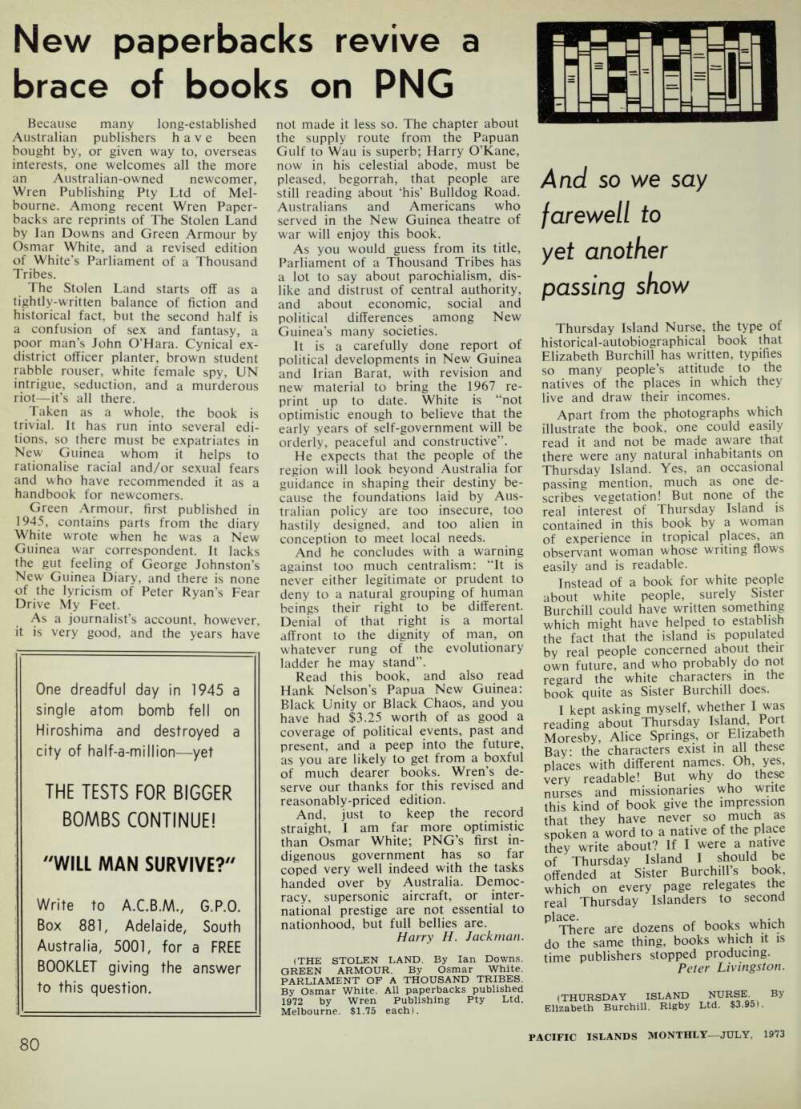
New paperbacks revive a brace of books on PNG
Because many long-established Australian publishers have been bought by, or given way to, overseas interests, one welcomes all the more an Australian-owned newcomer, Wren Publishing Pty Ltd of Mel bourne. Among recent Wren Paper backs are reprints of The Stolen Land by lan Downs and Green Armour by Osmar White, and a revised edition of White’s Parliament of a Thousand Tribes.
The Stolen Land starts off as a tightly-written balance of fiction and historical fact, but the second half is a confusion of sex and fantasy, a poor man’s John O’Hara. Cynical ex district officer planter, brown student rabble rouser, white female spy, UN intrigue, seduction, and a murderous riot—it’s all there.
Taken as a whole, the book is trivial. It has run into several edi tions, so there must be expatriates in New Guinea whom it helps to rationalise racial and/or sexual fears and who have recommended it as a handbook for newcomers.
Green Armour, first published in 1945, contains parts from the diary White wrote when he was a New Guinea war correspondent. It lacks the gut feeling of George Johnston’s New Guinea Diary, and there is none of the lyricism of Peter Ryan’s Fear Drive My Feet.
As a journalist’s account, however, it is very good, and the years have
not made it less so. The chapter about the supply route from the Papuan Gulf to Wau is superb; Harry O’Kane, now in his celestial abode, must be pleased, begorrah, that people are still reading about ‘his’ Bulldog Road.
Australians and Americans who served in the New Guinea theatre of war will enjoy this book.
As you would guess from its title.
Parliament of a Thousand Tribes has a lot to say about parochialism, dis like and distrust of central authority, and about economic, social and political differences among New Guinea’s many societies.
It is a carefully done report of political developments in New Guinea and Irian Barat, with revision and new material to bring the 1967 re print up to date. White is “not optimistic enough to believe that the early years of self-government will be orderly, peaceful and constructive”.
He expects that the people of the region will look beyond Australia for guidance in shaping their destiny be cause the foundations laid by Aus tralian policy are too insecure, too hastily designed, and too alien in conception to meet local needs.
And he concludes with a warning against too much centralism: “It is never either legitimate or prudent to deny to a natural grouping of human beings their right to be different.
Denial of that right is a mortal affront to the dignity of man, on whatever rung of the evolutionary ladder he may stand”.
Read this book, and also read Hank Nelson’s Papua New Guinea: Black Unity or Black Chaos, and you have had $3.25 worth of as good a coverage of political events, past and present, and a peep into the future, as you are likely to get from a boxful of much dearer books. Wren’s de serve our thanks for this revised and reasonably-priced edition.
And, just to keep the record straight, 1 am far more optimistic than Osmar White; PNG’s first in digenous government has so far coped very well indeed with the tasks handed over by Australia. Democ racy, supersonic aircraft, or inter national prestige are not essential to nationhood, but full bellies are.
Harry H. Jackman.
(THE STOLEN LAND. By lan Downs.
GREEN ARMOUR. By Osmar White.
Parliament Of A Thousand Tribes.
By Osmar White. All paperbacks published 1972 by Wren Publishing Pty Ltd, Melbourne. $1.75 each).