through colourful kiap country
p. 87 · Read in the full issue
Camera permits a nostalgic stroll through colourful kiap country
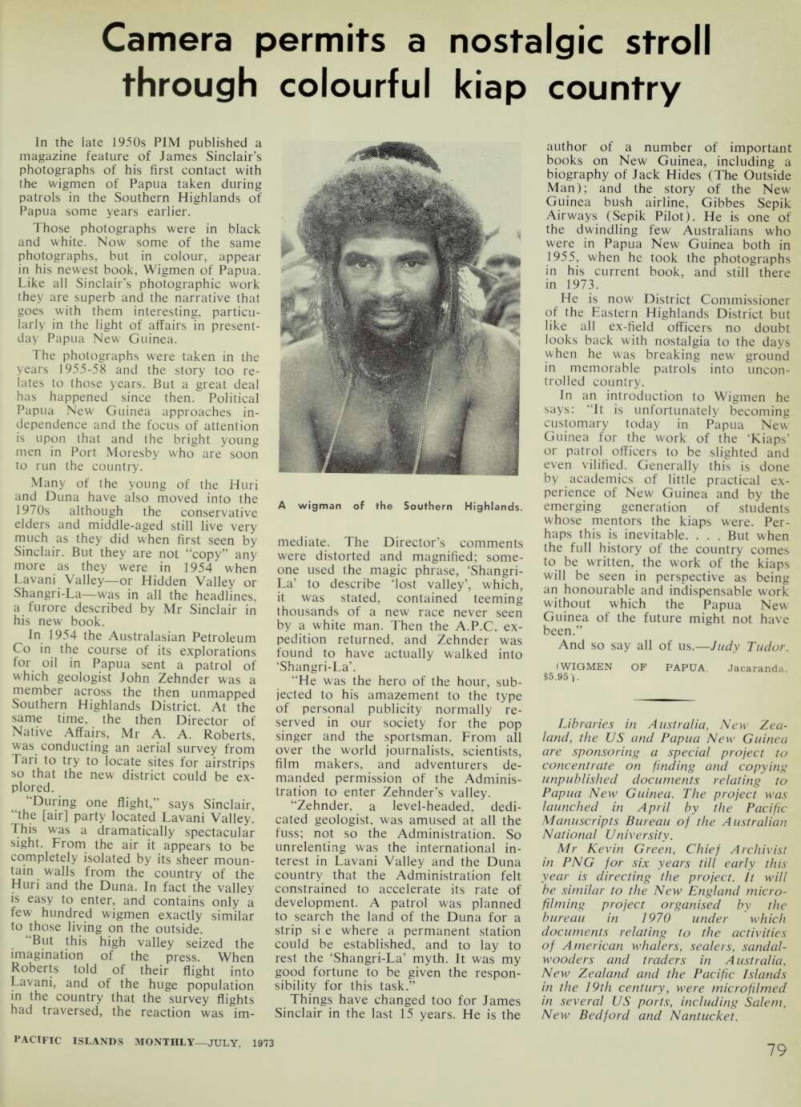
In the late 1950 s PIM published a magazine feature of James Sinclair’s photographs of his first contact with the wigmen of Papua taken during patrols in the Southern Highlands of Papua some years earlier.
Those photographs were in black and white. Now some of the same photographs, but in colour, appear in his newest book, Wigmen of Papua.
Like all Sinclair’s photographic work they are superb and the narrative that goes with them interesting, particu larly in the light of affairs in present day Papua New Guinea.
The photographs were taken in the years 1955-58 and the story too re lates to those years. But a great deal has happened since then. Political Papua New Guinea approaches in dependence and the focus of attention is upon that and the bright young men in Port Moresby who are soon to run the country.
Many of the young of the Huri and Duna have also moved into the
1970 s although the conservative
elders and middle-aged still live very much as they did when first seen by Sinclair. But they are not “copy” any more as they were in 1954 when Lavani Valley—or Hidden Valley or Shangri-La—was in all the headlines, a furore described by Mr Sinclair in his new book.
In 1954 the Australasian Petroleum Co in the course of its explorations for oil in Papua sent a patrol of which geologist John Zehnder was a member across the then unmapped Southern Highlands District. At the same time, the then Director of Native Affairs, Mr A. A. Roberts, was conducting an aerial survey from Tari to try to locate sites for airstrips so that the new district could be ex plored. ‘During one flight,” says Sinclair, “the [air] party located Lavani Valley.
This was a dramatically spectacular sight. From the air it appears to be completely isolated by its sheer moun tain walls from the country of the Huri and the Duna. In fact the valley is easy to enter, and contains only a few hundred wigmen exactly similar to jhose living on the outside.
“But this high valley seized the imagination of the press. When Roberts told of their flight into Lavani, and of the huge population in the country that the survey flights had traversed, the reaction was im-
mediate. The Director’s comments were distorted and magnified; some one used the magic phrase, ‘Shangri- La’ to describe ‘lost valley’, which, it was stated, contained teeming thousands of a new race never seen by a white man. Then the A.P.C. ex pedition returned, and Zehnder was found to have actually walked into ‘Shangri-La’.
“He was the hero of the hour, sub jected to his amazement to the type of personal publicity normally re served in our society for the pop singer and the sportsman. From all over the world journalists, scientists, film makers, and adventurers de manded permission of the Adminis tration to enter Zehnder’s valley.
“Zehnder, a level-headed, dedi cated geologist, was amused at all the fuss; not so the Administration. So unrelenting was the international in terest in Lavani Valley and the Duna country that the Administration felt constrained to accelerate its rate of development. A patrol was planned to search the land of the Duna for a strip si.e where a permanent station could be established, and to lay to rest the ‘Shangri-La’ myth. It was my good fortune to be given the respon sibility for this task.”
Things have changed too for James Sinclair in the last 15 years. He is the
author of a number of important books on New Guinea, including a biography of Jack Hides (The Outside Man); and the story of the New Guinea bush airline, Gibbes Sepik Airways (Sepik Pilot). He is one of the dwindling few Australians who were in Papua New Guinea both in 1955, when he took the photographs in his current book, and still there in 1973.
He is now District Commissioner of the Eastern Highlands District but like all ex-field officers no doubt looks back with nostalgia to the days when he was breaking new ground in memorable patrols into uncon trolled country.
In an introduction to Wigmen he says: “It is unfortunately becoming customary today in Papua New Guinea for the work of the ‘Kiaps’ or patrol officers to be slighted and even vilified. Generally this is done by academics of little practical ex perience of New Guinea and by the emerging generation of students whose mentors the kiaps were. Per haps this is inevitable. . . . But when the full history of the country comes to be written, the work of the kiaps will be seen in perspective as being an honourable and indispensable work without which the Papua New Guinea of the future might not have been.”
And so say all of us.
Judy Tudor.
(WIGMEN OF PAPUA. Jacaranda. $5.95).
Libraries in Australia, New Zea land, the US and Papua New Guinea are sponsoring a special project to concentrate on finding and copying unpublished documents relating to Papua New Guinea. The project was launched in April by the Pacific Manuscripts Bureau of the Australian National University.
Mr Kevin Green, Chief Archivist in PNG for six years till early this year is directing the project. It will be similar to the New England micro filming project organised by the bureau in 1970 under which documents relating to the activities of American whalers, sealers, sandal wooders and traders in Australia, New Zealand and the Pacific Islands in the 19th century, were microfilmed in several US ports, including Salem, New Bedford and Nantucket.
A wigman of the Southern Highlands.