Yesterday
p. 64 · Read in the full issue
Was there ever a more volatile crop (marketwise and sometimes politically) than sugar. Twenty years ago there was a glut world-wide, and but for the British Commonwealth Sugar Agreement, Fiji growers would have had to take bedrock prices. Now, prices are at the other end of the scale, but with Britain in the Common Market, there is apprehension about stabilised prices, in spite of assurances.
Sugarless Western Samoa 20 years ago was enjoying record trade and there were abundant signs of great prosperity.
But there was a fly in the ointment— there was an acute shortage of beer.
Not a bottle could be obtained from the Government Stores at any price.
The NZ administrative authority had complete monopoly over the supply, and only persons approved by officials could receive alcoholic beverages —when they were available.
Qantas has been out of Papua New Guinea for many years, except for touching down at Port Moresby on Australia-SE Asia flights. But 20 years ago Qantas was the main carrier in the territory and made news when it withdrew the reliable old DC3s from the Sydney-Port Moresby run and replaced them with Sandringham flying-boats to operate twice a week, with one service going on to Rabaul. Also in the flying-boat game, TEAL (now Air-NZ) was forced to delay for a month a service it proposed to launch in July, 1953, between Laucala Bay, Suva, and Tonga. Now, the last flying-boat will soon be withdrawn from South Pacific services—that operated by Airlines of NSW between Sydney and Lord Howe Island.
The Mayor of Lautoka, Cr S. Hollander, was described by a fellow councillor, C. A. (Gerry) Adams as a "would-be basketball dictator" for denying a women's basketball team the right to use Churchill Park unless the team affiliated with the Fiji Basketball Association. There was a stormy debate and the council, by six votes to four, carried a motion of no-confidence in the mayor. The Mayor refused to resign and the six councillors who opposed him threatened to boycott future meetings till he did.
The defeat 20 years ago of a member of the Cook Islands Legislative Council, Mr W. H. Watson, was attributed to a rather extraordinary system of voting.
He had lived in the Cooks for many years and was an unsparing critic of the administration. PIM suggested that the bureaucrats had "ganged up" on him, and openly advocated the candidature of two of his rivals. As 72 of the 134 voters on the European roll were officials or their wives, Mr Watson was evidently at a dis advantage. It was suggested that no European should have the right to vote until he (or she) had lived there for three years (12 months was then the
qualifying period). They also suggested
that Euronesian (part-European) wives of European residents should have the right to vote for European candidates for the council. They believed that NZ public servants, and their wives, in the Cooks for three-year terms, had an overwhelming voice in local affairs under the voting arrangements.
The Fiji-lndians were the butt of much criticism for their lack of military effort during World War 11. So it was with some pleasure that their critics noted five of them joining the Fiji Battalion fighting the communists in Malaya, with another five soon to follow. There were a number of Indians willing to serve, but among the non-Christians the question of food was a problem.
It was a problem which could not be overcome till there were enough Indians to form at least a company so that they could have their own food and their own cooks.
Australia is hell-bent on forcing self government, soon to be followed by independence on Papua New Guinea, as were what PIM called "the extra ordinary crop of sociological nuisances and banner-waving cranks produced by World War II" 20 years ago. Talking about native advancement in the South Pacific PIM said Melanesians would not reach the Polynesian stage of development for a long time; and the responsible Europeans in charge (the British in Eastern New Guinea and the Solomons, the French in New Caledonia and the Dutch in Western New Guinea) should be left alone to carry out their duties during this period of
transition, without interference . . .
Suva's old Melbourne Hotel, a wooden building in danger of falling down, was advertised for sale 20 years ago.
It was believed that part of the property was to be taken over under Suva's town planning scheme to widen MacArthur Street. Well, the hotel was pulled down in 1972, and is being replaced by a multi-storey commercial
building, but MacArthur Street is still awaiting widening.
Queen Elizabeth II was crowned 20 years ago in June, and in the following July PIM carried a pictorial cover of celebrations in Papua New Guinea and Fiji. Suva took advantage of the occasion to hold a debutantes' ball.
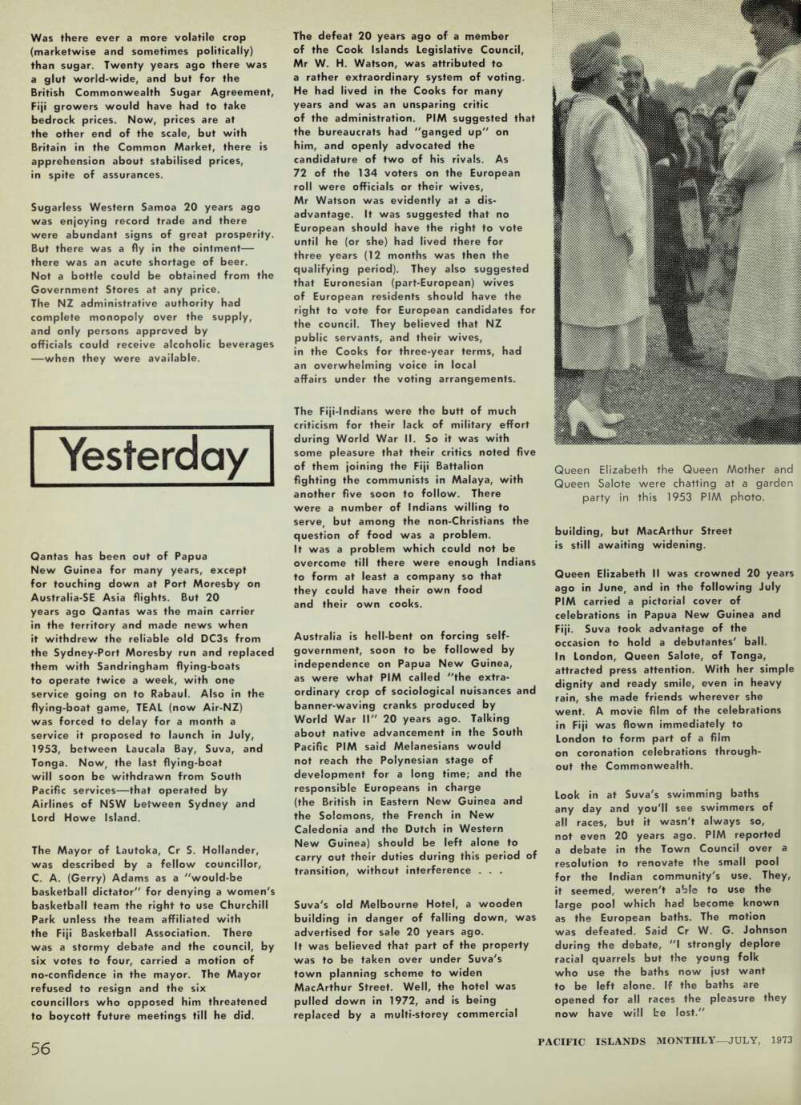
In London, Queen Salote, of Tonga, attracted press attention. With her simple dignity and ready smile, even in heavy rain, she made friends wherever she went. A movie film of the celebrations in Fiji was flown immediately to London to form part of a film on coronation celebrations through out the Commonwealth.
Look in at Suva's swimming baths any day and you'll see swimmers of all races, but it wasn't always so, not even 20 years ago. PIM reported a debate in the Town Council over a resolution to renovate the small pool for the Indian community's use. They, it seemed, weren't able to use the large pool which had become known as the European baths. The motion was defeated. Said Cr W. G. Johnson during the debate, "I strongly deplore racial quarrels but the young folk who use the baths now just want to be left alone. If the baths are opened for all races the pleasure they now have will be lost."
Queen Elizabeth the Queen Mother and Queen Salote were chatting at a garden party in this 1953 PIM photo.