Magazine Section
pp. 61-63 · Read in the full issue

Kwaisulia, Malaita big man
By Jim Boutilier
Solomon Island society of old was essentially egalitarian. Almost any man who worked hard, distributed his wealth, fulfilled his obligations, and enjoyed mana —that good fortune bestowed by the spirits—could rise to become the acknowledged leader or big man of his clan or village. Few figures in Solomon Islands’ history ex emplify this fact more vividly than Kwaisulia, the big man of Ada Gege in the Lau Lagoon of north-eastern Malaita.
North Malaitan social structure was based on patrilineal descent and the institution of the chief; an ex ception to the matrilineal organisa tion prevailing in most of the archi pelago. Thus, though he was re lated to the chiefly family of Sulu Fou, Kwaisulia was ineligible for the position of chief because the connec tion was on his mother’s side. He was forced to acquire power by other means.
He began by recruiting for service in Queensland as an indentured labourer in 1875. The schooner that carried him away was the Bobtail Nag from Brisbane. Her captain had just taken off the castaway, John Renton, a Scotsman, who deserted with four others in 1868 from an American ship taking on guano at McKean’s Island in the mid-Pacific.
They drifted ashore on Malaita and while his companions were killed by the Manaoba people, Renton was spared on account of his youth.
He came to be adopted by Kabau, the chief of the artificial island of Sulu Fou, and, by conducting him self in a helpful and unobtrusive way, he survived until his rescue. It seems likely that Renton was probably the figure upon whom Joseph Conrad based his character, Renouard, in the short story, Planter of Malata.
Kwaisulia worked for six years in
Queensland, probably in the Rock hampton district. During that time he became fluent in pidgin English, a facility which assisted him in becom ing a powerful “Passage Master” on his return to Ada Gege.
Because of the multiplicity of languages and dialects in the Solo mon Islands, labour recruiters, en gaging men to work in Queensland or Fiji, came to rely heavily on the services of islanders who could act as interpreters and procurers of labour.
When a labour vessel came to anchor in a “passage”, or spot on the coast where recruiting normally took place, the passage masters, like Foulanger of Walande Island, off south-eastern Malaita, or Mahooalla, alias “Billy Langa Langa”, of Mgwai Fou, would come aboard with eager recruits.
Kwaisulia acted with great con fidence and authority; persuading, cajoling, and enticing saltwater people and bushmen to engage. In some
cases, he convinced the skeptical or wary that his association with the Europeans would guarantee them favourable treatment, while, in others, such as the voyage of the schooner William Manson in 1894, he appears to have forced bushmen to recruit.
W. T. Wawn, an experienced labour recruiter, alleged that Kwaisulia and Foulanger were “simple crimps” who sold islanders to the highest bidder, but there seems little evidence to that effect.
Kwaisulia was handsomely reward ed for his services as an interpreter, procurer, guide and liaison. He took his share of trade goods from the recruits, received a commission from the recruiters, and levied a tax on the returns. As a consequence, his strong hold at Urassie Cove came to be well stocked with guns and ammunition, in addition to the usual supplies of tobacco, calico, mirrors and axes, With these firearms Kwaisulia established himself as a ramo or great
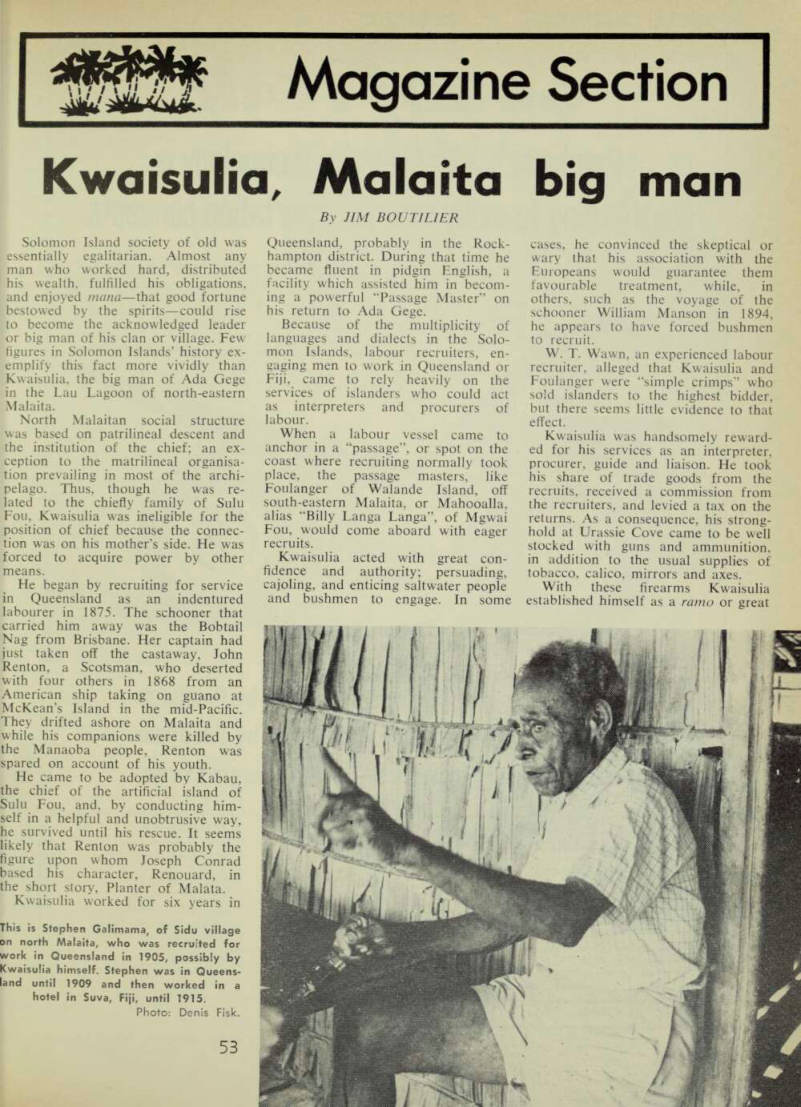
This is Stephen Galimama, of Sidu village on north Malaita, who was recruited for work in Queensland in 1905, possibly by Kwaisulia himself. Stephen was in Queens land until 1909 and then worked in a hotel in Suva, Fiji, until 1915.
Photo: Denis Fisk.
warrior, responsible for defending the interests of his people. His name, which means to “cut bits off”, denoted the fate of his victims who were bound and cut to pieces while still alive.
Slowly and steadily his prestige grew as he extended his power and authority over northern Malaita.
His greatest enemies were the neighbouring Manaobans. He fought them several times and at one stage succeeded in over-running the island of Fuana Fou and installing his nephew “Jackson” Kaa as chief.
When the Manaobans, in turn, secured a number of modern rifles from a Samoan labour ship and seemed likely to achieve military ascendancy, Kwaisulia requested that Ada Gege be annexed by Fiji.
Jock Cromar—that “derelict of the labour trade”, as Charles Wood ford, the Resident Commissioner for the Solomon Islands, described him —related the story of how Kwaisulia had offered to supply 50 fighting men to attack the Manaobans after they had treacherously murdered Arm strong, the government agent on the schooner Ariel.
The Sinerango people had put up a large quantity of shell money in re turn for a white man’s head, and, when the Manaobans delivered Arm strong’s skull, Kwaisulia allowed them to cross the Lau Lagoon, where his power was absolute, without com plaint because they were tambu and thus inviolate.
Cromar declined his offer of assis tance and when he went ashore to recover the government agent’s per sonal effects he found that the little finger on the dead man’s left hand had been cut off in order to remove his signet ring. Twenty-two years later the ring found its way into the pos session of the trader, Norman Wheatley, the uncrowned “King of New Georgia”.
At the height of his power Kwaisulia’s authority extended throughout the northern half of Malaita and possibly even as far as the Maramasike Passage. It is said that he could put 1,000 spearmen in the field and his command of events over a wide area was impressive.
In 1902 he ordered his son, who was known from his service in Fiji, as Kaiviti, to seek out two murderers who were hiding in the bush south of Ataa. The fugitives had hitherto eluded Woodford’s assistant, Arthur Mahaffy, and when they were cap tured the latter expressed his surprise and admiration.
“It is quite plain”, he wrote, “that Quisulia is able to keep order in this district and I impressed upon him
that he would in future be held re sponsible for the peace of this part of Mala (Malaita).
There is probably no other chief in the island who could send nine or 10 miles down the coast and effect, without any disturbance, the arrest of two malefactors who do not belong to his tribe. .
The end came dramatically. One day in 1911 Kwaisulia was fishing with dynamite. The fuse failed to sputter and when he held the charge up to his ear it exploded, blowing him to pieces. “A clearer case of effect following cause”, Woodford ob
served, ‘‘it would be difficult to imagine”.
However, five elders of Ada Gege convened in secret session and de termined that an old man of the island had brought about Kwaisulia’s death by giving him a charm which made him deaf.
Kwaisulia was a product of his age. The labour trade permitted him to achieve great prominence by ex ploiting his skills as in interpreter, manager and warrior. In so doing, he overshadowed the legitimate chiefs of the Lau Lagoon and became the foremost big man of Malaita.
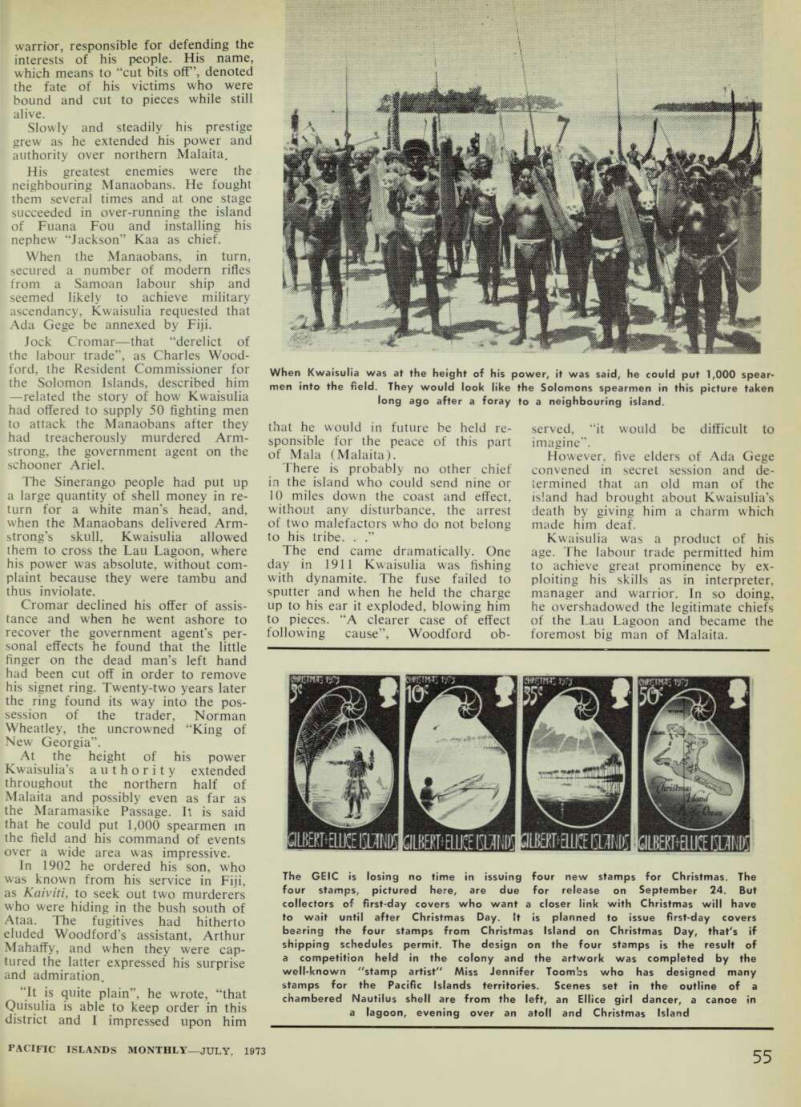
When Kwaisulia was at the height of his power, it was said, he could put 1,000 spear men into the field. They would look like the Solomons spearmen in this picture taken long ago after a foray to a neighbouring island.
The GEIC is losing no time in issuing four new stamps for Christmas. The four stamps, pictured here, are due for release on September 24. But collectors of first-day covers who want a closer link with Christmas will have to wait until after Christmas Day. It is planned to issue first-day covers bearing the four stamps from Christmas Island on Christmas Day, that's if shipping schedules permit. The design on the four stamps is the result of a competition held in the colony and the artwork was completed by the well-known "stamp artist" Miss Jennifer Toombs who has designed many stamps for the Pacific Islands territories. Scenes set in the outline of a chambered Nautilus shell are from the left, an Ellice girl dancer, a canoe in a lagoon, evening over an atoll and Christmas Island