Buy NZ goods and you'll get
pp. 103-105 · Read in the full issue
the know-how as a gift
From KATHLEEN HANCOCK in Wellington
Lloyd G. Brown of Vibrapac Masonry (Wgtn) Ltd, will lead the New Zealand trade delegation to Fiji, Western Samoa and American Samoa in July, and he will also launch New Zealand’s building and furniture dis play in Suva during the week July 23-28.
As president of the Wellington Manufacturers’ Association, Mr Brown is well aware of the need to encourage two-way trade between New Zealand and her Pacific neighbours.
As managing director of Vibrapac Masonry he is up to his eyebrows in the export of his own kind of ex pertise—concrete technology, plant design, chemicals and other allied products involved in the manufac ture of concrete masonry blocks. He lectures in this area of knowledge as far afield as Mexico and the US.
As chairman of the Technical Cor respondence Institute he also has an awareness of New Zealand’s capacity for training both Kiwis and Pacific Islanders in trade technology. “New Zealanders have a great reputation as teachers,” says Mr Brown. He thinks it’s a good idea to get Island children into technical schools young enough to make them really familiar
with New Zealand technical termino logy.
“We already share a common language,” he says. “If we can work from the same standards and build ing codes, that’s half the battle towards reaching a position where
both Islanders and Kiwis can reap a benefit.”
Lloyd Brown reckons New Zea landers have a bright future in ex port. Ten years ago, he says, export of manufactured goods and processed foods was in its infancy, but now it’s rolling. And with the steady march of Island territories towards indepen dence he thinks Island business firms are less likely to confine their buying to Australian sources, and New Zea land salesmen less likely to have to face a running battle with Australian oriented purchasing officers. Prices and quality, he says, are right on.
The New Zealand salesman should be able to develop island markets on a much bigger scale than in the past.
A solid improvement in shipping between NZ and Fiji will also help to improve this, he says. The Holm burn and the Pukeko have been brought in to service this run, with the Tofua still supporting. “There’s twice as much space,” he says, “and this helps Island businessmen main tain high-frequency sales which they couldn’t do before with infrequent and often uncertain shipping.”
When he comes over to Suva in July, Lloyd Brown won’t just be pro
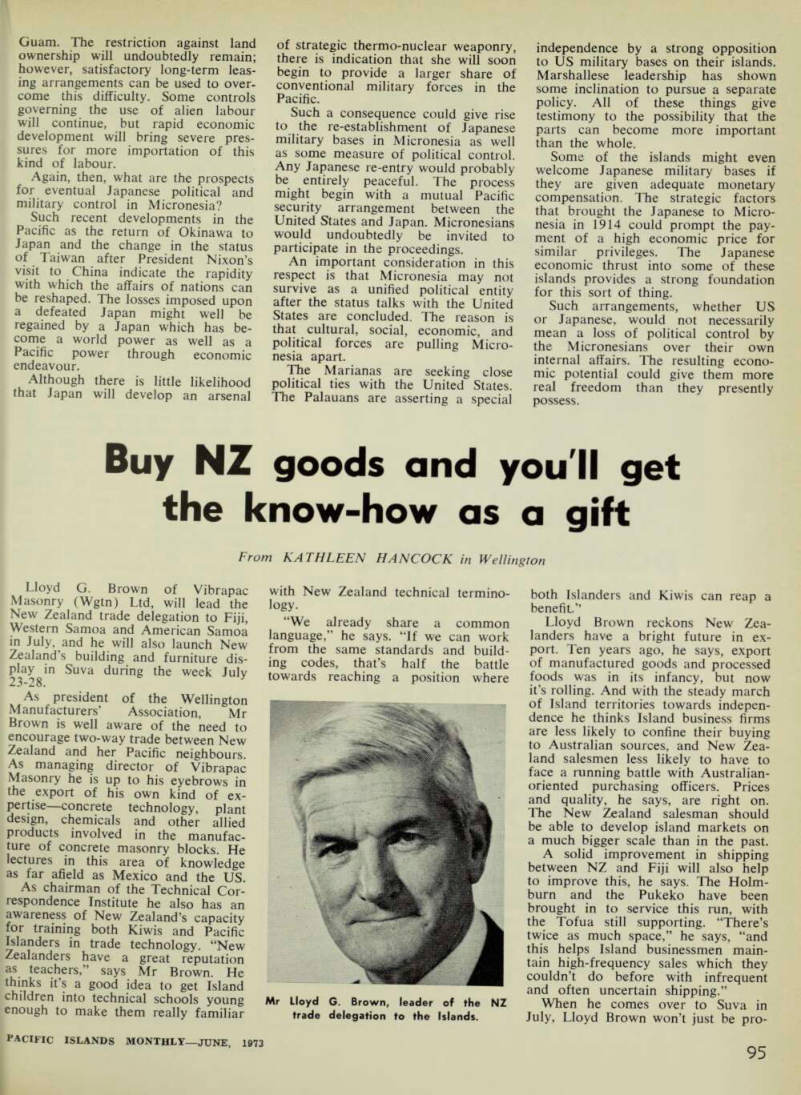
Mr Lloyd G. Brown, leader of the NZ trade delegation to the Islands.
moling NZ trade. He’s deeply in volved within the Islands themselves, both in manufacture, in training Islands personnel in building and production techniques on the spot, and in fighting for higher aesthetic standards in Pacific building ventures.
He has set up a factory in New Caledonia for the Pentecost Group and exports aggregate for precast concrete products and masonry to that territory. Another factory in the Cook Islands is almost completed.
Here especially, he’s keen to see local people trained in modern techniques —“We New Zealanders have a responsibility. We can’t live next door to poverty. It's up to us to share our knowledge.”
Mr Brown is a man who can get quite passionne, as the French have it, over concrete masonry. What is to most people an ordinary concrete block is to him an exciting break through in low-cost building methods.
And this without spoiling an en vironment he obviously loves. He likes to see airy, open structures that fit into the Islands environment. Ex periments in outlying districts in Mexico have convinced him of the aesthetic possibilities of concrete masonry as a means of housing Islands peoples. The use of crushed coral with cement is the logical answer to the search for a low cost, permanent, attractive building material. He is appalled by the intrusion of corrugated iron into the Island scene.
NZ trade
prospects in
New Caledonia
Last year’s Australian/New Zealand trade union boycott of French ship ping had a lot to do with a change in the pattern of New Caledonian importing methods. A big increase in trans-Pacific air freight coming into the affluent French island can largely be accounted for by a switch from New Zealand to the US as a supplier of fruit, vegetables and meat to this food-conscious country. For New Caledonians the changeover means even higher prices than usual for their airborne foodstuffs. But in this rich country pay packets are fat enough to cope and housewives are simply adjusting to yet another jump in the cost of living.
The US has emerged on the New Caledonian scene as a big supplier of pip fruit. New Zealand Apple and Pear Board export figures to New Caledonia have dropped a whopping 33 per cent since the boycott. Dairy products haven’t been hit quite so
Canada takes timber orders
hard, possibly because the price between the New Zealand and the US product would be just too much, even for the well-heeled New Cale donian.
New Zealand’s timber trade has fallen off the bough, too, in the rapidly-expanding French Pacific ter ritory. New Caledonia has long been New Zealand’s best South Pacific customer for timber and pre-cut houses—well ahead of the next in line, Guam and Tahiti. But post boycott figures show a sharp drop.
Some of this decrease is probably due to an easing off of domestic building in and around Noumea, now that the housing shortage has been contained. But it’s significant that the mighty Societe le Nickel has imported pre-cut houses from France instead of from New Zealand for its initial building programme at the big new mining project at Poum. In the past nearly all this business came to New Zealand. And likewise Canada is getting the sawn timber orders that Kiwi firms formerly collected.
Efforts made by New Zealand over the last 10 years to build up trade with her richest Pacific island neigh bour seemed at the beginning of last year to be bearing fruit. In 1970 New Zealand sales to New Caledonia had increased sevenfold of 1964 figures. But now the Kiwi exporter seems to be almost back at square one in New Caledonia. And his French customers are looking to Common Market countries for the canned foods and manufactured goods that NZ factories were supply ing in rapidly increasing quantities in pre-boycott days.
On the face of it, Australian unions were equal partners with their New Zealand brotherhood in boycotting French shipping last year. Australian trade union leader Bob Hawke said that his unions’ ban on French ship ping was “totally effective”. But a funny thing happened on the way to the docks. Not only did Australian ships, manned by Australian seamen, continue to supply New Caledonia and Tahiti (New Zealand’s second biggest customer in the Pacific islands) but traders also used space in chartered non-French vessels to lift goods to Noumea and Papeete.
Australian exporters not only held their trade. They built it up and dealt very effectively with the increasingly dangerous NZ competition.
There’s a big public relations job to be done if New Zealand is to re capture her lost trade in this market.
But the effort will be worth it. This French territory has the highest wage
rates in the South Pacific. To the locals money is no object, but quality is all important. And in 1969 New Caledorua spent $30.85 per head on New Zealand foodstuffs and manufactures compared with $15.20 spent Regular refrigerated shipping between New Zealand and New Caledonia is at last being reestablished by Sofrana Unilines. Last year’s long overdue appointment of a New Zealand consul-general should
help to get trade moving again. And the revaluation of the Australian dollar may regain for the Kiwis some of the ground lost to Australian com petitors.
Your New Caledonian is a thrifty fellow at heart, in spite of that bulg ing pay packet. He doesn’t find it easy to bypass low prices combined with high quality. Hopefully, his good will can be salvaged from the wreck age. With the application of common sense and a lot of hard work, New Zealand could start coming back into the New Caledonian trade picture this year.