Business and Development
pp. 101-103 · Read in the full issue


Armed With The Yen, Japan Takes
The Road Back To Micronesia
Last month PIM, in several articles, told how the Japanese had begun to play an important part in the development of Papua New Guinea. Billions of yen are being poured into the country and the Japanese have become partners with the government in several projects. Below, Dr Albers relates a similar story with regard to Micronesia where once the Japanese reigned supreme.
By Dr Henry H. Albers
What are the prospects for eventual Japanese political and military control in Micronesia?
The islands that make up Micro nesia have played a major role in Japanese history. Japan acquired them in 1914 from a Germany at war in Europe and unable to defend its Pacific territories. The islands soon became stepping stones for an ex panding Japanese empire. The initial development was essentially economic, but later military goals became a primary consideration.
Micronesia provided strategic bases from which Japan launched war against the United States and ex tended its domain throughout South east Asia and the surrounding Pacific.
Late in World War II the United States returned through a series of island invasions. Such Micronesia islands as Eniwetock, Saipan, Peleliu, and Angaur became the names of the major battles of this period. One of them, the island of Tinian, has gained a place in history as the site from which the US bomber, the Enola
* Dr Henry H. Albers is chairman and professor of the Department of Management at the University of Nebraska, USA. He has served as a consultant with the United States Forces, the South Pacific Commission and the Trust Territory of the Pacific. He has also served as a con sultant and lecturer on economic development in Korea, Okinawa and Fiji, and is the author of a number of management books including a widely-used basic textbook, which has been translated into eight languages.
Gay, took to the air to drop the atomic bomb on Hiroshima.
Micronesia has been administered since 1947 as a US Trust Territory under a United Nations trusteeship agreement. A major consideration for the United States, as for the Japan ese earlier, is the strategic location of Micronesia for military purposes. The Marshalls have been used as missile
testing sites and there are plans for US military bases in the Marianas (Tinian and Saipan) and the Western Carolines (Palau).
Japan has at least partially re established itself in Micronesia through her post-war economic endeavours and has again become a major power in the Pacific. Japanese automobiles, beer, cameras, electronic equipment, motorcycles and household goods can be found in large volume throughout Micronesia. Japanese tourists are arriving in increasingly large numbers as improved transport facilities and tourist accommodation are made available. Such islands as Saipan, Ponape, and Palau are becoming highly attractive places in the sun for an affluent Japanese middle class.
All of this points to a future in which Japan is likely to play a primary rather than a peripheral role in the economic development of Micronesia.
The Japanese economic penetration of Micronesia has occurred in spite of a number of obstacles. Foreign investment in Micronesia other than US is for all practical purposes pro hibited by the trusteeship agreement which requires that all members of the UN except the administering authority be accorded equal treat ment. There are restrictions against land ownership by non-citizens of Micronesia and alien labour cannot be imported except under certain conditions. There are good reasons to believe that some of these restric tions will be relaxed in the not-too distant future.
Japanese business enterprises will probably be permitted to invest in Micronesia much as they now do in
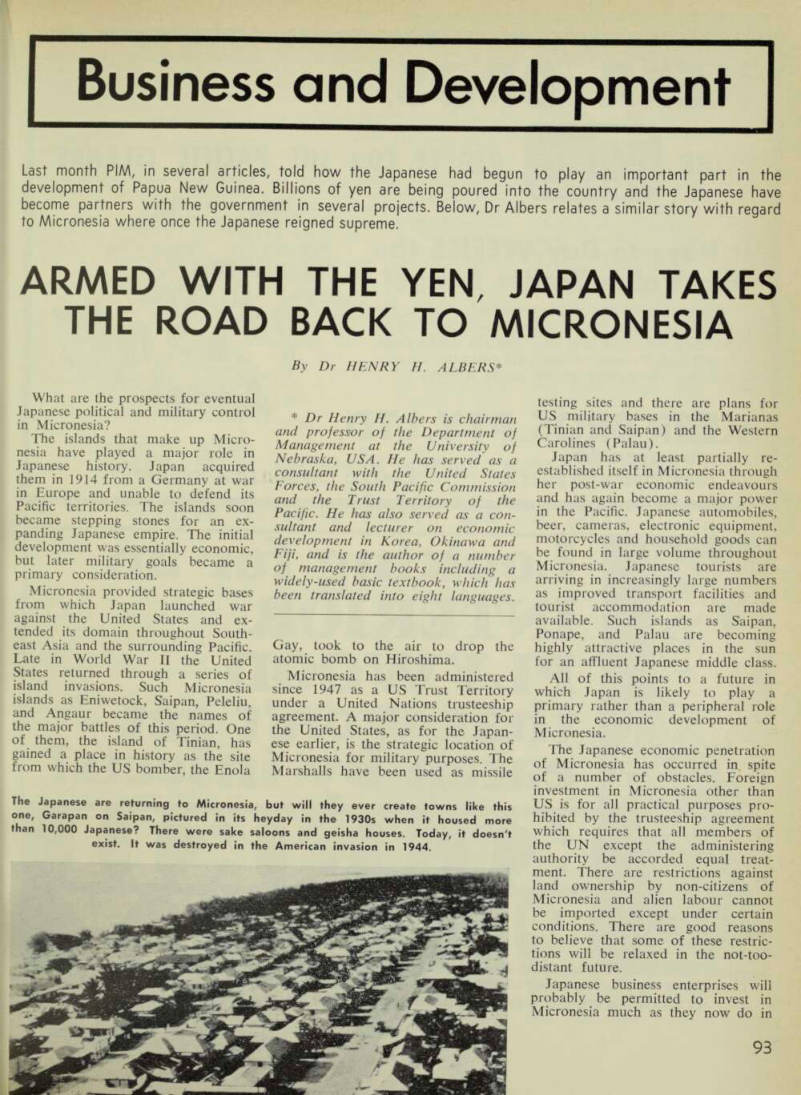
The Japanese are returning to Micronesia, but will they ever create towns like this one, Garapan on Saipan, pictured in its heyday in the 1930s when it housed more than 10,000 Japanese? There were sake saloons and geisha houses. Today, it doesn't exist. It was destroyed in the American invasion in 1944.
Guam. The restriction against land ownership will undoubtedly remain;
however, satisfactory long-term leas-
ZLT^ en 5 e £ if" c USed t 0 ° V T come this difficulty. Some controls governing the use of alien labour SSL| “ k raP economic development will bring severe preskind nfUT importation of this A • th<=»n tu Again then what are the prospects m[litarv n ro a ntrnf Pa n ne M- ohtl( r a ) and Micronesia?
Pacifi? as ihfi 1 rptnm Janan W J** °^ nawa to oT Taiwan t r pi i the status Nixons with which the pffJrf nf he t- rapid y with which the affairs of nations can
a* defeated feDan^mieh,'’ 0t
reeained hv , T ell K be come a woHH n Sr ! h u™ bC ‘ Pacific nower P thrrmJif WC aS 3 endeavon? thr ° Ugh economic Alfhnnoh w ru a that Tan™ Sn dllJ U likelihood that Japan will develop an arsenal
of strategic thermo-nuclear weaponry, there is indication that she will soon begin to provide a larger share of conventional military forces in the Pacific.
Such a consequence could give rise to ' hc re-establishment of Japanese military bases in Micronesia as well as some measure of political control.
Any Japanese re-entry would probably be entirely peaceful. The process mi B h t be S m Wlth a mutual Pacific security arran g ement between the Umted Stat «s and Japan. Micronesians would undoubtedly be invited to P ar A tlcl P ate m the proceedings.
An important consideration in this resp - ct 18 that Micronesia may not survive as a unified political entity he StatUS !*'}*, with the . S ‘ a ! es are concluded. The reason is • cu tu ™ 1 ’ social > economic, and P°l} tlca I forces are pulling Microne !£ a P art * .
Mananas are seeking close political ties with the United States.
The Palauans are asserting a special
independence by a strong opposition to US military bases on their islands, Marshallese leadership has shown some inclination to pursue a separate policy. All of these things give testimony to the possibility that the parts can become more important than the whole Some of the islands might even welcome Japanese military bases if they are given adequate monetary compensation. The strategic factors that brought the Japanese to Micro nesia in 1914 could prompt the pay ment of a high economic price for similar privileges. The Japanese economic thrust into some of these islands provides a strong foundation for this sort of thine Such arrangement, whether US or Japanese, would not necessarily mean a loss of political control by the Micronesians over their own internal affairs. The resulting econo mic potential could give them more real freedom than they presently possess.