The Sea-Jet
pp. 97-98 · Read in the full issue
Age Coming
To Trust Territory
Joe Mitchell would have smiled.
Not with a smirk but with one of those “I told you so” grins his close friends appreciated well.
A $3 million 250-passenger “jet foil” to whiz Japanese visitors around Guam ... a 7,300-ton container-car ship ordered for Guam-Japan runs . . . big increases in trade and interest in the Central Pacific from Australia and the US . . .
Mr Mitchell, one-time general manager of the Burns Philp empire, pioneered regular Australian shipping services to the Central Pacific sea mass that boasted such outposts as Butaritari, Yap, Koror, Ponape, Nauru, Bent and Guam some 75
years ago. As a strapping young man he sailed to these areas from Sydney in long-forgotten ships such as the Titus and Tambo.
Ironically, with Joe dead some years now, only one survivor of those adventuring BP days lives—Neville Chatfield, a former company super cargo and personal friend of Joe, who is now in a northern NSW nursing home.
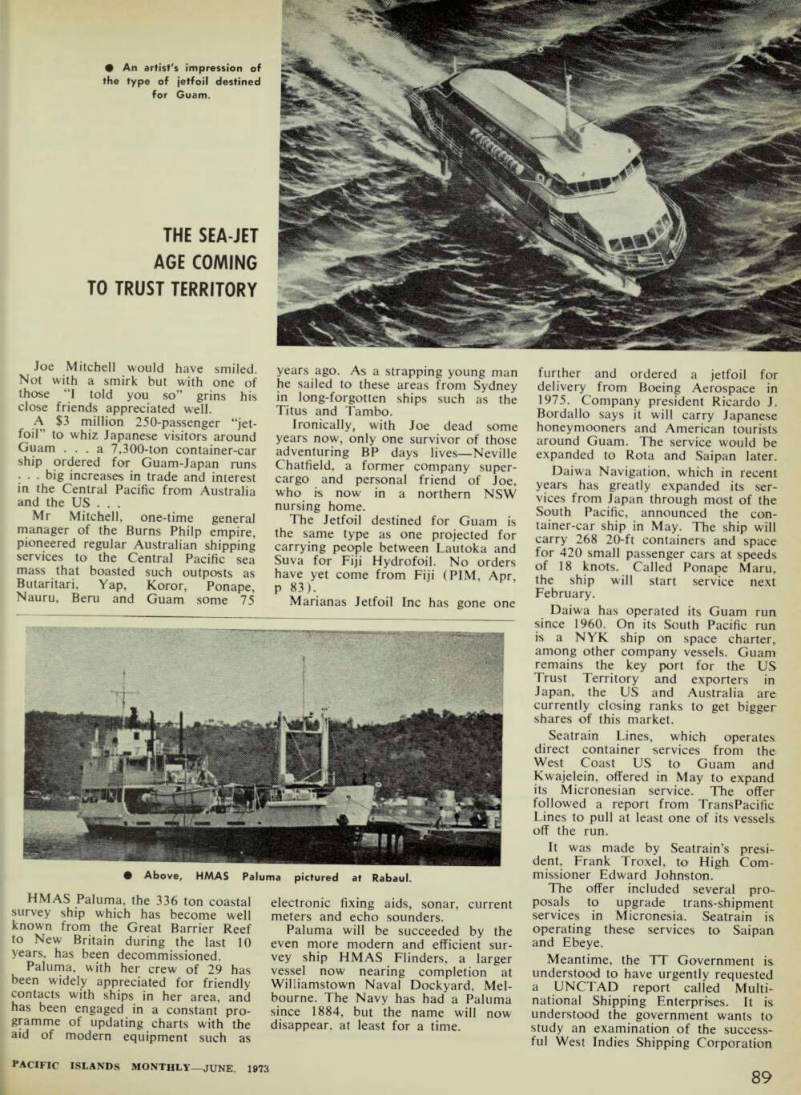
The Jetfoil destined for Guam is the same type as one projected for carrying people between Lautoka and Suva for Fiji Hydrofoil. No orders have yet come from Fiji (PIM, Apr, P 83).
Marianas Jetfoil Inc has gone one
HMAS Paluma, the 336 ton coastal survey ship which has become well known from the Great Barrier Reef to New Britain during the last 10 years, has been decommissioned.
Paluma, with her crew of 29 has been widely appreciated for friendly contacts with ships in her area, and has been engaged in a constant programme of updating charts with the aid of modern equipment such as
electronic fixing aids, sonar, current meters and echo sounders, Paluma will be succeeded by the even more modern and efficient sur vey ship HMAS Flinders, a larger vessel now nearing completion at Williamstown Naval Dockyard, Mel bourne. The Navy has had a Paluma since 1884, but the name will now disappear, at least for a time,
further and ordered a jetfoil for delivery from Boeing Aerospace in 1975. Company president Ricardo J.
Bordallo says it will carry Japanese honeymooners and American tourists around Guam. The service would be expanded to Rota and Saipan later.
Daiwa Navigation, which in recent years has greatly expanded its ser vices from Japan through most of the South Pacific, announced the con tainer-car ship in May. The ship will carry 268 2(>-ft containers and space for 420 small passenger cars at speeds of 18 knots. Called Ponape Maru, the ship will start service next February.
Daiwa has operated its Guam run since 1960. On its South Pacific run is a NYK ship on space charter, among other company vessels. Guam remains the key port for the US Trust Territory and exporters in Japan, the US and Australia are currently closing ranks to get bigger shares of this market.
Seatrain Lines, which operates direct container services from the West Coast US to Guam and Kwajelein, offered in May to expand its Micronesian service. The offer followed a report from Transpacific Lines to pull at least one of its vessels off the run.
It was made by Seatrain’s presi dent, Frank Troxel, to High Com missioner Edward Johnston.
The offer included several pro posals to upgrade trans-shipment services in Micronesia. Seatrain is operating these services to Saipan and Ebeye.
Meantime, the TT Government is understood to have urgently requested a UNCTAD report called Multi national Shipping Enterprises. It is understood the government wants to study an examination of the success ful West Indies Shipping Corporation
• An artist's impression of the type of jetfoil destined for Guam.
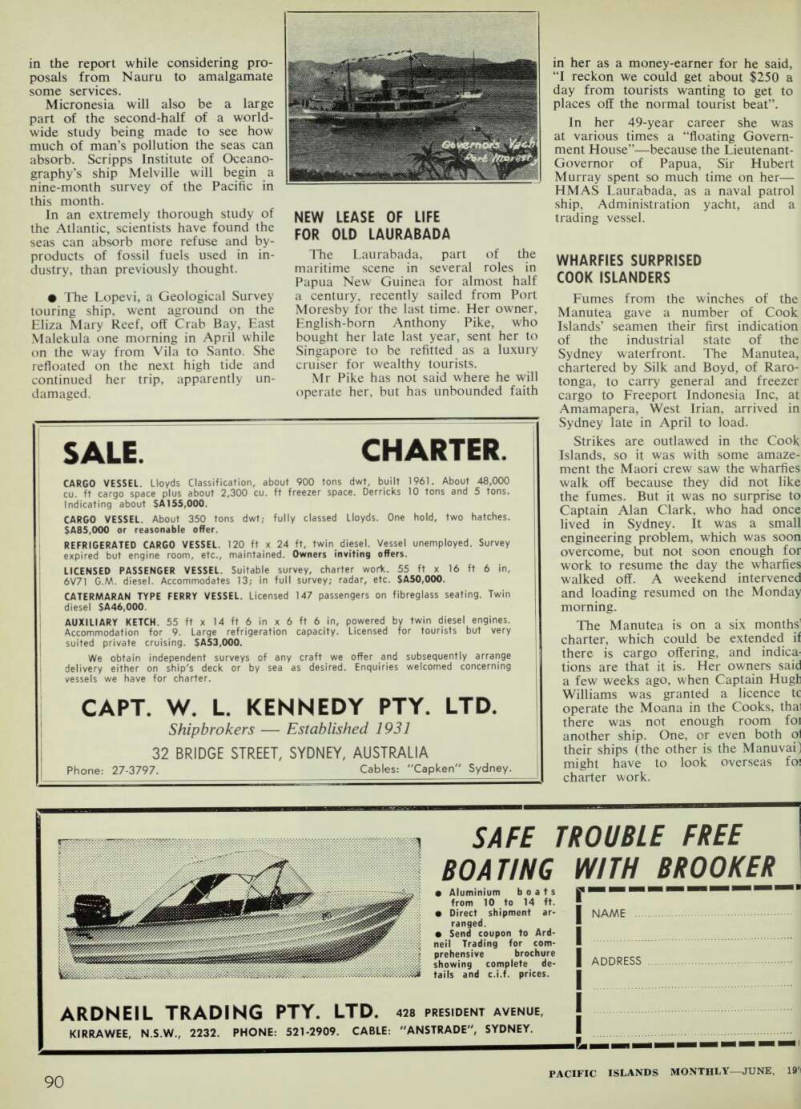
• Above, HMAS Paluma pictured at Rabaul.
in the report while considering pro posals from Nauru to amalgamate some services.
Micronesia will also be a large part of the second-half of a world wide study being made to see how much of man’s pollution the seas can absorb. Scripps Institute of Oceano graphy’s ship Melville will begin a nine-month survey of the Pacific in this month.
In an extremely thorough study of the Atlantic, scientists have found the seas can absorb more refuse and by products of fossil fuels used in in dustry, than previously thought. • The Lopevi, a Geological Survey touring ship, went aground on the Eliza Mary Reef, off Crab Bay, East Malekula one morning in April while on the way from Vila to Santo. She refloated on the next high tide and continued her trip, apparently un damaged.
New Lease Of Life
For Old Laurabada
The Laurabada, part of the maritime scene in several roles in Papua New Guinea for almost half a century, recently sailed from Port Moresby for the last time. Her owner, English-born Anthony Pike, who bought her late last year, sent her to Singapore to be refitted as a luxury cruiser for wealthy tourists.
Mr Pike has not said where he will operate her, but has unbounded faith
in her as a money-earner for he said, “I reckon we could get about $250 a day from tourists wanting to get to places off the normal tourist beat”.
In her 49-year career she was at various times a “floating Govern ment House”—because the Lieutenant- Governor of Papua, Sir Hubert Murray spent so much time on her— HMAS Laurabada, as a naval patrol ship, Administration yacht, and a trading vessel.
Wharfies Surprised
Cook Islanders
Fumes from the winches of the Manutea gave a number of Cook Islands’ seamen their first indication of the industrial state of the Sydney waterfront. The Manutea, chartered by Silk and Boyd, of Raro tonga, to carry general and freezer cargo to Freeport Indonesia Inc, at Amamapera, West Irian, arrived in Sydney late in April to load.
Strikes are outlawed in the Cook Islands, so it was with some amaze ment the Maori crew saw the wharfies walk off because they did not like the fumes. But it was no surprise to Captain Alan Clark, who had once lived in Sydney. It was a small engineering problem, which was soon overcome, but not soon enough for work to resume the day the wharfies walked off. A weekend intervened and loading resumed on the Monday morning.
The Manutea is on a six months’ charter, which could be extended if there is cargo offering, and indica tions are that it is. Her owners said a few weeks ago, when Captain Hugh Williams was granted a licence tc operate the Moana in the Cooks, thai there was not enough room foi another ship. One, or even both oi their ships (the other is the Manuvai] might have to look overseas foi charter work.