Pacific Shipping
pp. 91-93 · Read in the full issue
Nauru And Tonga Make First
Move For A Regional Shipping Line
A new passenger/cargo service on the New Zealand-Fiji-Tonga-Samoa run may give the Union Steam Ship Co of NZ Ltd the “out” it is looking for with the Tofua. Nauru Pacific Line has withdrawn the Enna G from its Australia-Pacific Islands tourist cruis ing and cargo service to become the South Pacific regional line’s unof ficial spearhead.
The Enna G left Sydney early in May for its last cruise, carrying 38 passengers, The cruise ended in Auck land, with the passengers being flown back to Sydney. The Enna G then went into dry-dock and is scheduled to start its new monthly service about the middle of June.
The new service is a joint oper ation by Nauru Pacific Line and Tonga’s Pacific Navigation Co Ltd.
It has the blessing of other countries in the proposed regional line set-up, Fiji, Western Samoa and the Cook Islands, which do not operate com mercial shipping services to other countries. The idea of a regional line has been gaining ground in the South Pacific for some time.
Officials of Nauru Pacific Line see the service as a rationalisation of shipping in the region. After the service is established, Tonga and Nauru will be looking to other island groups to join in. In this sense it is a pilot project for a passenger-cargo service. Nauru Pacific is looking for a full passenger list each voyage. ..«^, Nauru Pacific official said: Were confident of getting 100 pas sengers—that’s all that the ship can handle—out of Auckland each voy age”.
That should not be too difficult if the popularity of the Tofua is any guide. It was never easy to get a passage out of Auckland in the Tofua, particularly during the New Zealand winter.
The Enna G will be replaced by the Rosie D on the Australian-South Pacific service.
The advent of the Enna G to this run means one of two things—a paral lel service with the Tofua, or with drawal of the Tofua. The USS Co
has not been happy with the Tofua’s performance and has been looking for a replacement or, possibly, an excuse to withdraw the Tofua. If looking for an excuse, the Enna G could be the answer.
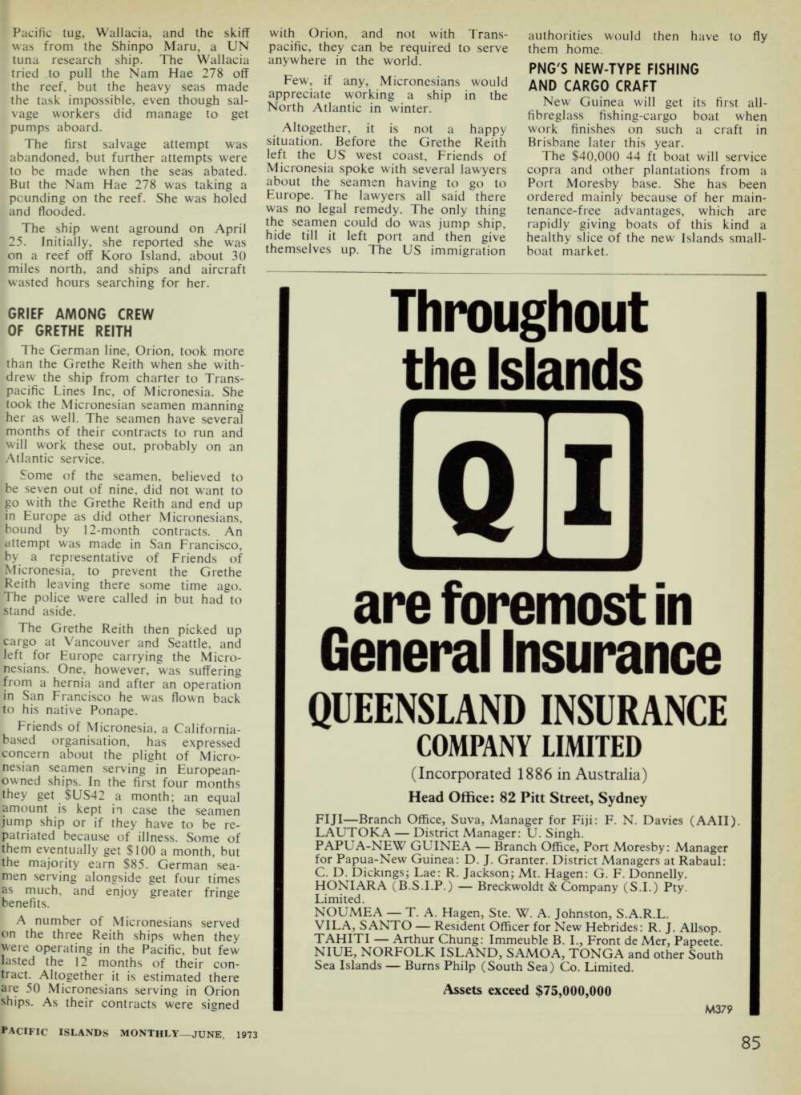
But as the Enna G goes on to the run, the USS Co is about to launch an experimental container service from Auckland to Fiji, Western Samoa and Tonga with the Tarros class Union South Pacific. The ship will carry general, reefer and freezer cargo. The USS Co is ‘‘going it alone” with this service after having unsuc cessfully offered the governments of Fiji, Western Samoa and Tonga a share in a line to service the three groups.
A Sydney spokesman for the USS Co, speaking about the experimental service, said there was a number of problems associated with it. These would become apparent at each port.
The USS Co had asked the Islands governments to provide facilities for the container ships, but there had been no progress with them, pro bably because they did not know how the service would work.
“We are trying this service so that the Islands governments and every body concerned will see what is hap pening”, he said, ‘Then we will be able to make any decision in the face of knowledge whether this is a projection or practical”.
The ship carries just over 100 20 ft containers, but it is not expected there will be that many on board for the first trip. After all, the con tainer ship will be only one of six ships the USS Co uses to service Fiji, Tonga, Samoa and Niue Island.
The containers are discharged by using the ship’s gantry and specialised trailers which move on and off the ship over a stern ramp. Trailers, prime movers and forklift will be carried from port to port to make the ship self-sufficient.
The assistant general manager of the USS Co, Mr D. C. Jury, in a paper recently presented to a Mel bourne conference of the International Cargo Handling Association, said: “These vessels are currently operating elsewhere in conditions not dissimilar to those which apply in the Pacific Islands trade, and we decided they offered an immediate prospect of im proving the service to our clients, and the financial result to ourselves.
“Their principal feature is the abi lity to work at any existing wharf structure with only the minimum of modifications. Virtually, all that is required to operate at a wharf is 50 ft of ordinary berthing space on which the vessel’s own stern ramp can be landed”.
The service will be basically one
A Tarres class container ship.
way, as the Islands are exporting very little to New Zealand. The Fiji banana trade, which has been declining for 15 years, dropped away even further after Hurricane Bebe in October.
The Tarros ship has been chartered on a bare boat basis for three years, but the USS Co has the option to drop it after six months, if necessary.
On the other hand, if it is successful, there is likely to be another ship chartered.
As the service is about to be launched the USS Co is reviewing freight rates between New Zealand and the Pacific Islands. These rates are well under Australian rates. The Sydney spokesman said rising wages and the rising cost of running ships , yere reasons for the review.
A Nice Chore
For The Kolle D
The Kolle D, the new 33,000-tot heavyweight of the Nauru Pacifii Shipping Line, has landed a nia chore —hauling woodchips for th( next 12 months from Tasmania tc Japan. .
She will begin sailings on this long term contract when she returns fron a north-east Russian port nea Vladivostok to which she is nov carrying wheat loaded in Westen Australia.
Described by NPSL officials i: Melbourne as “a conventional, prc duction line bulk carrier and nothin else”, the Kolle D made her maide; voyage from Nauru to ; Australia i
April and May carrying phosphat
which was offloaded at Portlanc Victoria, and Port Lincoln, Sout Australia.
According to officials there are n immediate plans to operate her mt or out of Sydney or Melbourne. Ii deed, it would be difficult to bnn her into Melbourne; the phosphai berth at Yarraville is too far u\ stream for a fully-laden ship the su of the Kolle D.
Narrow Escape
For Koreans
Near-tragedy stalked the Nam H; 278, a Korean fishing ship, two da. after it went aground on Nair Island reef in the Koro Sea, bn Seamen tried to follow salva. workers who rejoined their own vess; the tug Wallacia, by jumping ove board and allowing themselves to swept into a calm area. The Korea got into difficulties, and were beii swept away as a rescue party, usu a wooden skiff and lifeboat, pluck them from the water. The skiff w swamped and upset. But the crew 23 was saved and taken to Suva.
The liferafts were from the Man
Pacific tug, Wallacia, and the skiff was from the Shinpo Maru, a UN tuna research ship. The Wallacia tried to pull the Nam Hae 278 off the reef, but the heavy seas made the task impossible, even though sal vage workers did manage to get pumps aboard.
The first salvage attempt was abandoned, but further attempts were to be made when the seas abated.
But the Nam Hae 278 was taking a pounding on the reef. She was holed and flooded.
The ship went aground on April 25. Initially, she reported she was on a reef off Koro Island, about 30 miles north, and ships and aircraft wasted hours searching for her.
Grief Among Crew
Of Grethe Reith
The German line, Orion, took more than the Grethe Reith when she with drew the ship from charter to Trans pacific Lines Inc, of Micronesia. She took the Micronesian seamen manning her as well. The seamen have several months of their contracts to run and will work these out, probably on an Atlantic service.
Some of the seamen, believed to be seven out of nine, did not want to go with the Grethe Reith and end up in Europe as did other Micronesians, bound by 12-month contracts. An attempt was made in San Francisco, by a representative of Friends of Micronesia, to prevent the Grethe Reith leaving there some time ago.
The police were called in but had to stand aside.
The Grethe Reith then picked up cargo at Vancouver and Seattle, and left for Europe carrying the Micro nesians. One, however, was suffering from a hernia and after an operation in San Francisco he was flown back to his native Ponape.
Friends of Micronesia, a California based organisation, has expressed concern about the plight of Micro nesian seamen serving in European owned ships. In the first four months they get SUS 42 a month; an equal amount is kept in case the seamen jump ship or if they have to be re patriated because of illness. Some of them eventually get $lOO a month, but the majority earn $B5. German sea men serving alongside get four times as much, and enjoy greater fringe benefits.
A number of Micronesians served on the three Reith ships when they were operating in the Pacific, but few lasted the 12 months of their con tract. Altogether it is estimated there are 50 Micronesians serving in Orion ships. As their contracts were signed
with Orion, and not with Transpacific, they can be required to serve anywhere in the world, Few, if any, Micronesians would ffi C^anrS nB win a .er ShiP “ Altogether, it is not a happy situation. Before the Grethe Reith left the US west coast. Friends of Micronesia spoke with several lawyers about the seamen having to go to Europe. The lawyers all said there was no legal remedy. The only thing the seamen could do was jump ship. hide till it left port and then give themselves up. The US immigration
authorities would then have to fly them home,
Png's New . Type Fishing
Cargo Craft
N- will get its first all fibreglass fishing-cargo boat when work finishes on such a craft in Brisbane later this year, The $40,000 44 ft boat will service copra and other plantations from a Port Moresby base. She has been ordered mainly because of her main tenance-free advantages, which are rapidly giving boats of this kind a healthy slice of the new Islands small boat market.