Book Reviews
pp. 86-87 · Read in the full issue
From the emotions of Ulli to a simple descriptive Paulias
I was honest enough to read right through The Night Warrior and Other Stories, edited by Ulli Beier, and wonder why a man of his ex perience in Africa as well as New Guinea still makes everything he edits seem as though he had not edited it but written it from beginning to end. The essential Ulli Beier is the same in Africa as it is in New Guinea.
He sees life through the same eyes in both places, and has the same chips on his shoulder. The extra ordinary thing about Ulli Beier is that he is so efficiently able to ex press his point of view, his literary style, and the chips on his shoulder, through the pens of others both in Africa and in New Guinea. It is, no doubt, some sort of an achieve ment to have established precisely the same assembly line in Papua New Guinea as he had previously in Africa. But, except as a form of personal publicity, what good is it?
How many in a country like Papua New Guinea, to whose people the stories might have some appeal, but where the majority are illiterate, will be able to read them? And who in the big literate world has time for curiosities?
The Night Warrior is a collection of 13 short stories written by 10 Papua New Guinea authors. As exercises in recording observations and emotions the stories have been well executed. As literature they are neither one thing nor another. By no stretch of the imagination can they be described as Melanesian literature, and although they are written in a form of English, it is doubtful if they qualify as English literature.
In some cases the English is obscure enoueh to be meaningless to anyone but the person who wrote it.
No doubt the writers savour these passages, but there is nothing more unfair to a reader than to present him with something, which, through no fault of his own, he cannot under stand.
The French had a different ap proach in encouraging literature pro-
duction among their emerging people. They said in effect, “We have given you the world’s most wonder ful language: when you have mastered it, you may attempt to use it.” Ulli Beier’s attitude seems to be the reverse of this, and the result is that he has succeeded in producing something that is nothing: it is neither fish nor fowl. I think it should be pointed out that the time is long past when it was thought kind to condescend to authors because they were black: James Baldwin and company made sure of that.
Of the stories themselves, what is there to say? If you have read any of Ulli Beier’s previous collections, you have read these. The authors have different names, the situations are different, the localities are dif ferent, the emotions, the things observed, the reactions are the same old Ulli Beier transmitted to the
writers by Ulli Beier’s efficient process. All that one can hope is, that after this exercise it is Ulli Beier’s intention that his elite may emerge from the present influence, think for themselves, observe for themselves, encourage their own emotions, study to develop their own literate indi viduality, and achieve their own chips on their own shoulders.
There is not space to deal with each of the stories in The Night Warrior, and I think it would be unfair to select one or two for individual criticism. It remains then only to say that the book is an interesting collection within the limits imposed by the editor. We owe a kind word to Ulli: perhaps he may have aroused a desire for sincere writing in someone of his collection.
The same Ulli, however, should re member the precept that art lies in concealing the artist.
What a relief it was then to turn from the vicarious emotions of Ulli Beier to the dignified English and pure description of Paulias Matane in My Childhood in New Guinea. It is a simple expression of sincerity.
Matane was asked to write about his life and he has done it. There are no literary frills and no attempt at profundity but he has written a book full of interest and vitality. I found that his story interested me right from the first simply-stated para graph: “My story begins in the early 1930 s on the north-eastern tip of the island of New Britain. ...” No devices, just a simple statement and the reader wants to find out what happened on this island. And Matane maintains this interest throughout.
I think that Matane, with his des cription of the events which attended his own birth (learned, of course, later, from relatives) and the reactions of his family, has done in a simple way what many learned students have attempted to do. Unlike an account written by an anthropologist, Matane’s description of the beliefs and fears of his people at childbirth are pre sented as natural events. He has done
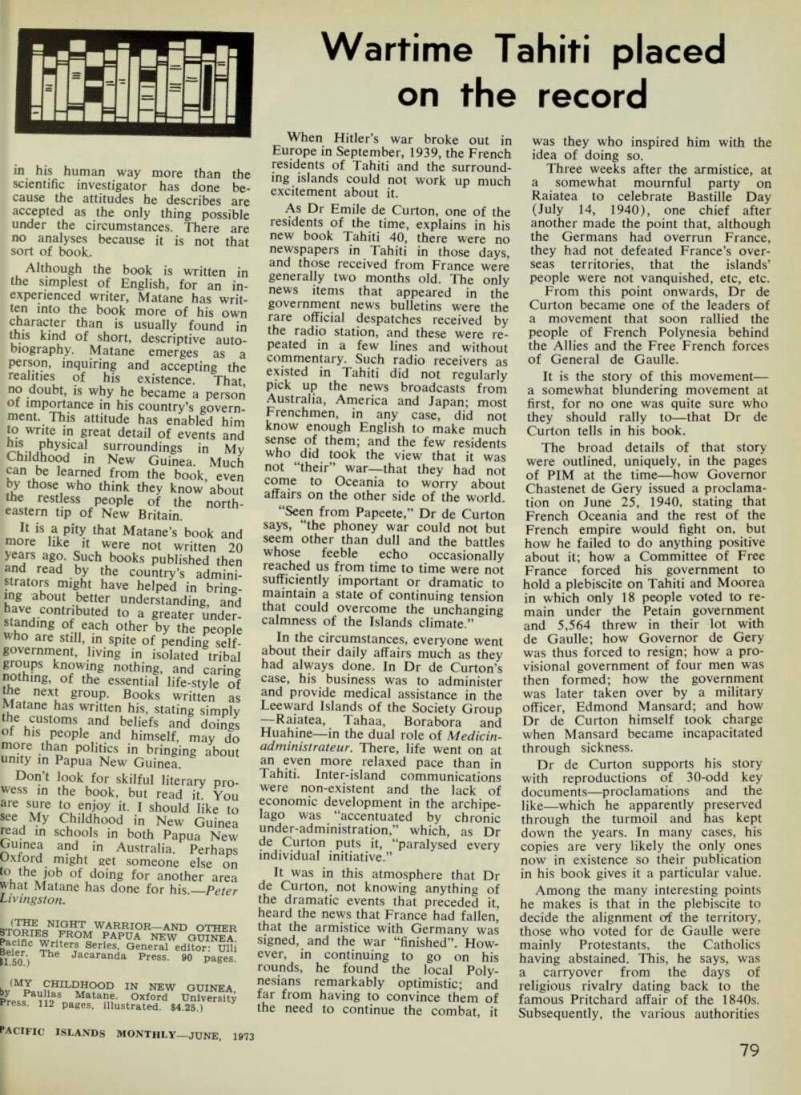
Paulias Matane
in his human way more than the scientific investigator has done be cause the attitudes he describes are accepted as the only thing possible under the circumstances. There are no analyses because it is not that sort of book.
Although the book is written in the simplest of English, for an in experienced writer, Matane has writ ten into the book more of his own character than is usually found in this kind of short, descriptive auto biography. Matane emerges as a person, inquiring and accepting the realities of his existence. That, no doubt, is why he became a person of importance in his country’s govern ment. This attitude has enabled him to write in great detail of events and hys J ca ! surr °undings in My Childhood m New Guinea. Much can be learned from the book, even by those who think they know about the restless people of the north eastern tip of New Britain.
It is a pity that Matane’s book and more like it were not written 20 years ago. Such books published then and read by the country’s admini strators might have helped in bring ing about better understanding, and stln e H;n ontl f t0 u a greater under standmg of each other by the people who are still, in spite of pending self government, living in isolated tribal groups knowing nothing, and caring nothing, of the essential life-style of the next group. Books written as Matane has written his, stating simply the customs and beliefs and doings of his people and himself, may do more than politics in bringing about unity in Papua New Guinea.
Don t look for skilful literary pro wess in the book, but read it. You are Sare ?, nj ’ oy il 1 sh °uld like to see My Childhood in New Guinea read m schools in both Papua New Guinea and in Australia. Perhaps Oxford might get someone else on to . J°b of doing for another area what Matane has done for his. —Peter Livingston.
Ue Night Warrior—And Other
Padfic lE Wrif P ROI S ? APUA NEW GUINEA.
Sfi ter T s Senes - General editor: Ulli fl 50) ™ Ja caranda Press. 90 pages. childhood in new guinea p y rp Pa V 1 1 1 o as Matane. Oxford University Press. 112 pages, illustrated. $4.25.)