Samoa’s Albert Wendt:
pp. 81-82 · Read in the full issue
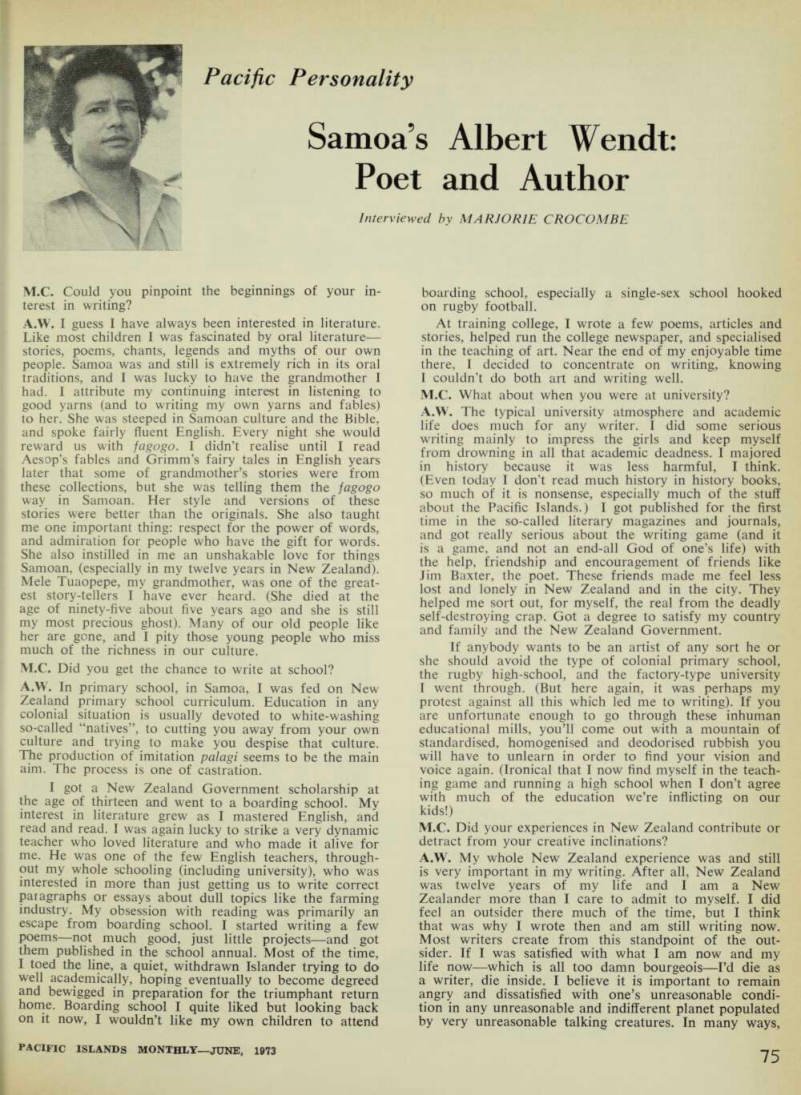
Pacific Personality Samoa’s Albert Wendt: Poet and Author
Interviewed by MARJORIE CROCOMBE
M.C. Could you pinpoint the beginnings of your in terest in writing?
A.W. I guess I have always been interested in literature.
Like most children I was fascinated by oral literature— stories, poems, chants, legends and myths of our own people. Samoa was and still is extremely rich in its oral traditions, and I was lucky to have the grandmother I had. I attribute my continuing interest in listening to good yarns (and to writing my own yarns and fables) to her. She was steeped in Samoan culture and the Bible, and spoke fairly fluent English. Every night she would reward us with fagogo. I didn’t realise until I read Aesop’s fables and Grimm’s fairy tales in English years later that some of grandmother’s stories were from these collections, but she was telling them the fagogo way in Samoan. Her style and versions of these stories were better than the originals. She also taught me one important thing: respect for the power of words, and admiration for people who have the gift for words.
She also instilled in me an unshakable love for things Samoan, (especially in my twelve years in New Zealand).
Mele Tuaopepe, my grandmother, was one of the great est story-tellers I have ever heard. (She died at the age of ninety-five about five years ago and she is still my most precious ghost). Many of our old people like her are gone, and I pity those young people who miss much of the richness in our culture.
M.C. Did you get the chance to write at school?
A.W'. In primary school, in Samoa, I was fed on New Zealand primary school curriculum. Education in any colonial situation is usually devoted to white-washing so-called “natives”, to cutting you away from your own culture and trying to make you despise that culture.
The production of imitation palagi seems to be the main aim. The process is one of castration.
I got a New Zealand Government scholarship at the age of thirteen and went to a boarding school. My interest in literature grew as I mastered English, and read and read. I was again lucky to strike a very dynamic teacher who loved literature and who made it alive for me. He was one of the few English teachers, through out my whole schooling (including university), who was interested in more than just getting us to write correct paragraphs or essays about dull topics like the farming industry. My obsession with reading was primarily an escape from boarding school. I started writing a few poems—not much good, just little projects—and got them published in the school annual. Most of the time, I toed the line, a quiet, withdrawn Islander trying to do well academically, hoping eventually to become degreed and bewigged in preparation for the triumphant return home. Boarding school I quite liked but looking back on it now, I wouldn’t like my own children to attend
boarding school, especially a single-sex school hooked on rugby football.
At training college, I wrote a few poems, articles and stories, helped run the college newspaper, and specialised in the teaching of art. Near the end of my enjoyable time there, I decided to concentrate on writing, knowing I couldn’t do both art and writing well.
M.C. What about when you were at university?
A.W. The typical university atmosphere and academic life does much for any writer. I did some serious writing mainly to impress the girls and keep myself from drowning in all that academic deadness. 1 majored in history because it was less harmful, I think. (Even today I don’t read much history in history books, so much of it is nonsense, especially much of the stuff about the Pacific Islands.) I got published for the first time in the so-called literary magazines and journals, and got really serious about the writing game (and it is a game, and not an end-all God of one’s life) with the help, friendship and encouragement of friends like Jim Baxter, the poet. These friends made me feel less lost and lonely in New Zealand and in the city. They helped me sort out, for myself, the real from the deadly self-destroying crap. Got a degree to satisfy my country and family and the New Zealand Government.
If anybody wants to be an artist of any sort he or she should avoid the type of colonial primary school, the rugby high-school, and the factory-type university I went through. (But here again, it was perhaps my protest against all this which led me to writing). If you are unfortunate enough to go through these inhuman educational mills, you’ll come out with a mountain of standardised, homogenised and deodorised rubbish you will have to unlearn in order to find your vision and voice again. (Ironical that I now find myself in the teach ing game and running a high school when I don’t agree with much of the education we’re inflicting on our kids!) M.C. Did your experiences in New Zealand contribute or detract from your creative inclinations?
A.W. My whole New Zealand experience was and still is very important in my writing. After all, New Zealand was twelve years of my life and I am a New Zealander more than I care to admit to myself. I did feel an outsider there much of the time, but I think that was why I wrote then and am still writing now.
Most writers create from this standpoint of the out sider. If I was satisfied with what I am now and my life now—which is all too damn bourgeois—l’d die as a writer, die inside. I believe it is important to remain angry and dissatisfied with one’s unreasonable condi tion in any unreasonable and indifferent planet populated by very unreasonable talking creatures. In many ways,
my writing is an attempt to stay alive as an individual, bring some measure of order and meaning to the mess around me. An attempt to be a whole person.
New Zealand is my second home. I visited it re cently after an eight year absence, and found myself feeling quite at home there. (In the eight years I was away from it, I did miss it.) I can’t deny or dismiss the very meaningful but often painful time I spent growing up there. My work, I think, belongs in the mainstream of New Zealand literature.
M.C. How do you find creativity in the Islands schools?
A.W. Very few high schools modelled on the British/ New Zealand type models (and most educational institu tions in our islands are like this) are conducive to creative work in the expressive arts. The typical high school in New Zealand and the Pacific Islands is a factory geared to squeezing kids through the School Certificate and University Entrance machines, and it is usually run by petty, unimaginative and pedestrian middle-aged tyrants and teachers who’ve been teaching too long. What hope do kids have therefore to remain young, alive and creative! As teachers and adults we pay a lot of lip service to the expressive arts in our schools.
The typical school curriculum, however, is overloaded with irrelevant soul-destroying crap, and there’s little time and freedom left for young people to express and develop their individuality and style and talents. This is especially horrifying in the Pacific Islands where the curriculum is largely unrelated and contrary to our needs and ways of life. So-called education does not cater to the real needs of young people—it does little to help them cope with their problems concerning love, honesty, self-respect, identity. All we want to do is turn them into “good students” who toe the inane line and become “good” plumbers, “good” pastors, “good” obedient citizens. We kill their creativity and imagination by drowning them in oceans of trivia and irrelevance.
We kill them further in the islands by educating them away from our own cultures. By the end of high school, we have successfully turned most of them into middle aged young people, and, in the islands, we have also turned them into very willing wearers of the white collar noose, chasing the soulless bourgeois dream of respectability in a palagi house, life insurance, a car, savings in the bank, 2.3 kids per family, concrete and plastic and glittering steel. (Our vanity as failed middle aged teachers and parents is astounding!). In our islands, we have betrayed and are betrayed because we have been successfully colonised as individuals—betrayed the visions and ideals of independence.
M.C. What then is the role of the teachers college and university in the expressive arts? Did your degree in history influence some of your creative work? Say, for example, your historical poem “Inside Us the Dead” that was published in Landfall.
A.W. Training colleges and universities should play an important role as catalysts in the development of the expressive arts—but most of them don’t. The Univer sity of the South Pacific should allow itself to develop into one of the centres of this in the South Pacific. At the moment, it certainly isn’t. USP is a unique university in that it has, as students, groups from all over the Pacific, All these young people go to USP, with cultural backgrounds extremely diverse and rich in expressive arts. To ignore this would be a major catastrophe for us. USP, through its extension programme, should also participate in the development of the expressive arts in our region. It would be an “epic” tragedy for the South Pacific if USP merely ossified into another factory mass-producing technicians and so-called “professionals”.
The fact that I have a degree in history matters very
little to me, and, consequently, little to my writing. In a major way, all creative writers are historians. The most revealing and meaningful “histories” about a peo ple are the stories, poems, myths, plays, novels and so on written by themselves. “Inside Us the Dead”—a series of eight poems—is not a straight historical poem, it is a fictional history of my family, at the same time it is a history of palagi penetration and cultural change in the Pacific. It was written to try to understand my own family and country and why the Pacific is what it is now.
The real “histories” of our region have yet to be written. We must write them, and whether these “histories” take the form of straight history or poetry or drama or novels, all to the good. It is also time that we, as Pacific Islanders, reviewed and openly criticised the work of outsiders about us. Our region has been far too long a goldmine for outside research workers, Ph.D students, Hollywood myth-makers, colonial ad ministrators and clerks, transient revivalist preachers, sailing economists, bar-room journalists and UNO “ex perts”. Too many lies and myths have been written about us by these people. Such nonsense ranges from the condescendingly racist to the insanely romantic. (We have also been responsible for perpetuating quite a few lies about ourselves).
• The final part of this Interview will be published next month.
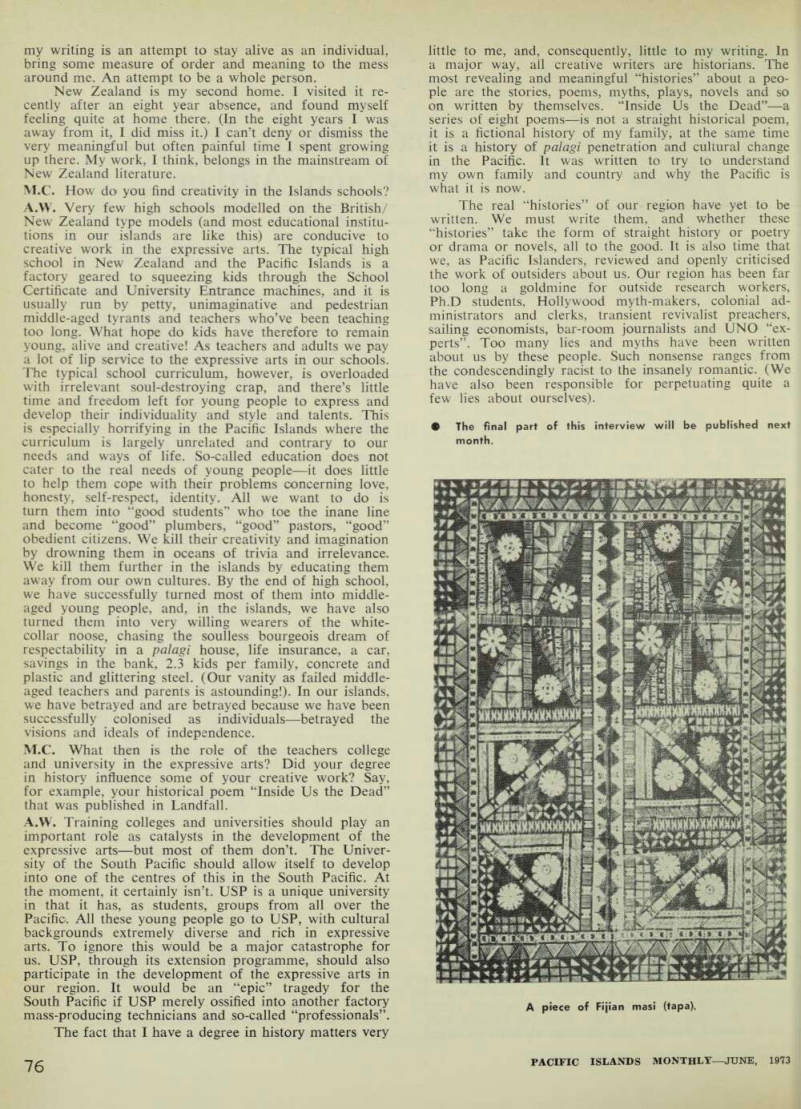
A piece of Fijian masi (tapa).