Magazine Section
pp. 63-65 · Read in the full issue

An Untamed Papua Through The
Eyes Of A Murdered Man
By Robert Langdon
A T daybreak on September 20, 1895, John Green, acting private secretary to Sir William MacGregor, Lieutenant-Governor of British New Guinea, was called from his bed at a camp on the bank of the Musa River, on the north-east coast of what is now called Papua.
Following an anxious guard, he hurried to the bank and there saw between 30 and 40 large canoes com ing up the river, each full of armed natives. There were about 400 of them, all fine, big men, decked out m war gear. They were the same men who, three weeks earlier, had killed John Clarke, the leader of a group of miners who had set out from Samarai to prospect for gold near the headwaters of the River Mambare.
And in Green’s view, they were ob viously bent on more rapine and murder.
“I called the Governor,” Green wrote later in a letter to his family and we prepared for a fight. But they us as if we were not worth looking at. The swish of about 300 paddles in the water and the weird and savage appearance of such a number of men all decked out in war gear was a sight I shall never forget.
“As soon as they had passed we sent two policemen to follow along the bank to see that they did not land aigher up and come on us at the rear.
We cleared a space around our camp o have a good fighting ground. But n half an hour the police returned o say that the canoes had gone on ip the river. . .
The spot where this incident >ccurred was about 20 miles from the nouth of the Musa River. For the
previous few weeks, MacGregor,
jreen and a detachment of Papuan puce had ben busily exploring the nd thereabouts while the govern ment vessel Merrie England, which iad deposited them there, made a As the Merrie England was now ue back at the mouth of the Musa,
MacGregor ordered his camp to be struck at once, and he and his party headed for the river mouth with the idea of getting the Merrie England’s steam launch to go in pursuit of the armed warriors. The launch, with a whale boat and a river boat in tow, set out at 6.30 next morning with MacGregor, Green, several other European officials, and all available native police.
“We steamed steadily up the river until midday seeing traces on each bank of the war party ahead of us,”
Green said in the letter to his family.
“Every garden was ruined, all the sugar-cane cut down and the taro pulled up. After lunch when turning a bend we came suddenly on to the armada’ coming down the river again. They pulled in hurriedly to the
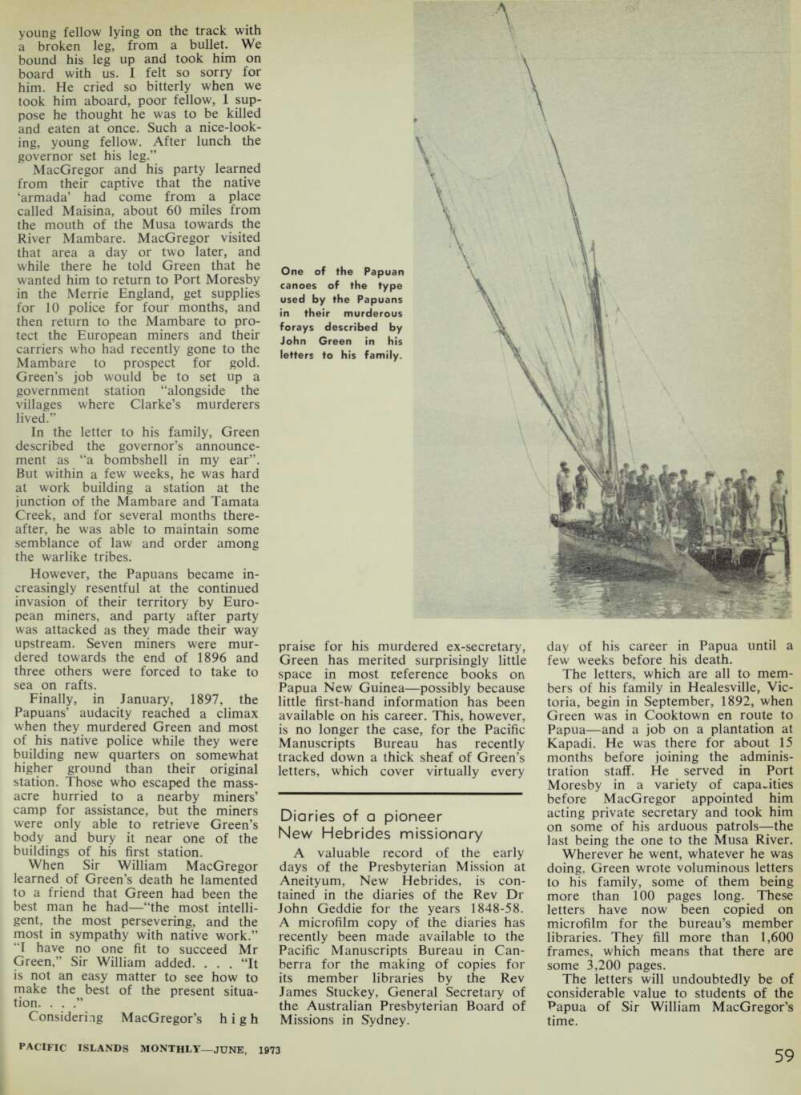
bank and landed. We tooK not the slightest notice of them, but simply steamed past them. We saw five dead bodies in their canoes, and roast legs, arms, ribs, heads, backbones, etc, partly eaten.
“When we passed them all, the launch anchored and we let go our tow ropes and put out our oars. We then made straight for the canoes, determined to shoot the occupants down like pigs, should they offer any resistance to us. But they saw that we meant business and ran up on the bank going into the scrub. While half of us watched the bank the other half cut up the canoes, such splendid canoes, all brand new, evidently specially prepared for the expedition.
“Those furthest down the river tried to get away down the river with their canoes but we ran them down with the launch.
“Not a single canoe escaped us. We smashed 25 to pieces and sent 13 down the river intending to pick them up on the morrow and take them to the mouth of the river.
“We camped for the night on the bank of the river, putting lanterns on both sides of the river to prevent any one passing during the night. We kept a strong guard.
“[Next morning], Sunday 22nd, the steam launch was sent up the river again ... to see if any natives were about. While steaming along we saw a place where a crowd of natives had evidently been preparing to swim across the Musa. We did not stop, but steamed around the bend about a mile and then landed.
“We wefit overland to where we thought they would land and met about 50 just as they landed. We waited until they saw us and then fired into them, killing three and wounding several. We chased them through the scrub and wounded several others.
“We shot them without any com punction, as the sight of dead men, women and children on their canoes the previous day had driven all feel ings of mercy away. We found one
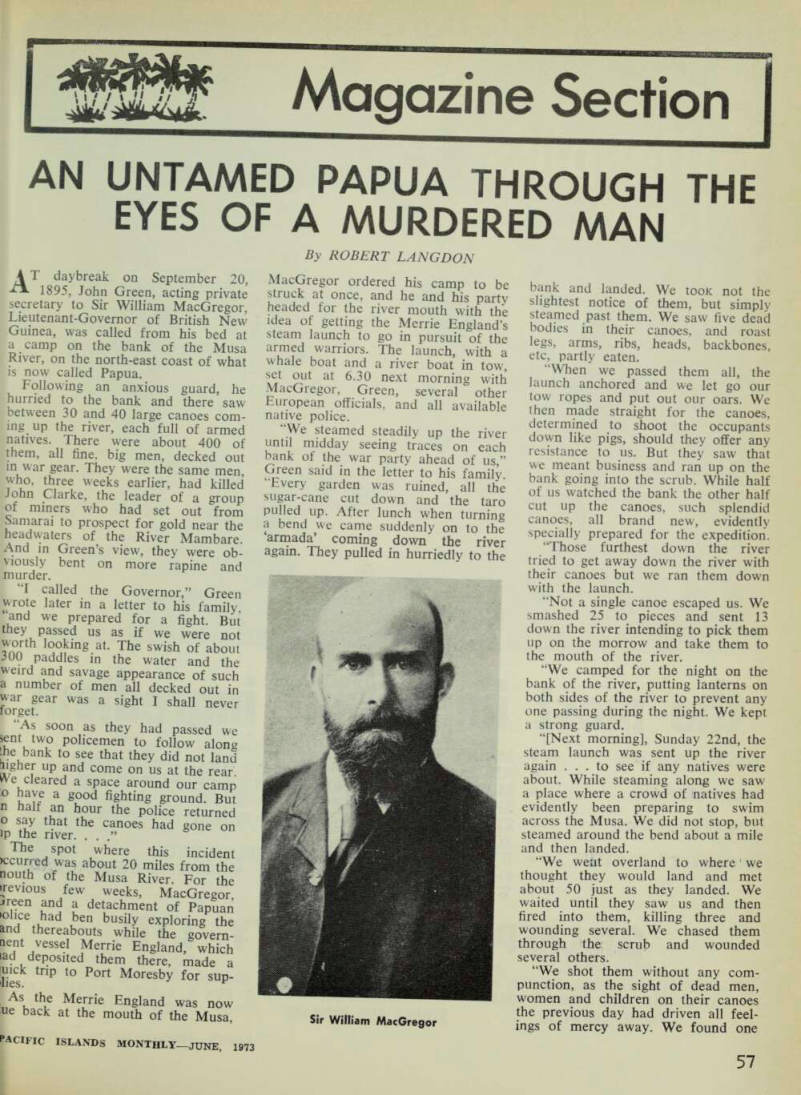
Sir William MacGregor
young fellow lying on the track with a broken leg, from a bullet. We bound his leg up and took him on board with us. I felt so sorry for him. He cried so bitterly when we took him aboard, poor fellow, I sup pose he thought he was to be killed and eaten at once. Such a nice-look ing, young fellow. After lunch the governor set his leg.”
MacGregor and his party learned from their captive that the native ‘armada’ had come from a place called Maisina, about 60 miles from the mouth of the Musa towards the River Mambare. MacGregor visited that area a day or two later, and while there he told Green that he wanted him to return to Port Moresby in the Merrie England, get supplies for 10 police for four months, and then return to the Mambare to pro tect the European miners and their carriers who had recently gone to the Mambare to prospect for gold.
Green’s job would be to set up a government station “alongside the villages where Clarke’s murderers lived.”
In the letter to his family, Green described the governor’s announce ment as “a bombshell in my ear”.
But within a few weeks, he was hard at work building a station at the junction of the Mambare and Tamata Creek, and for several months there after, he was able to maintain some semblance of law and order among the warlike tribes.
However, the Papuans became in creasingly resentful at the continued invasion of their territory by Euro pean miners, and party after party was attacked as they made their way upstream. Seven miners were mur dered towards the end of 1896 and three others were forced to take to sea on rafts.
Finally, in January, 1897, the Papuans’ audacity reached a climax when they murdered Green and most of his native police while they were building new quarters on somewhat higher ground than their original station. Those who escaped the mass acre hurried to a nearby miners’ camp for assistance, but the miners were only able to retrieve Green’s body and bury it near one of the buildings of his first station.
When Sir William MacGregor learned of Green’s death he lamented to a friend that Green had been the best man he had—“the most intelli gent, the most persevering, and the most in sympathy with native work.”
“I have no one fit to succeed Mr Green,” Sir William added. . . . “It is not an easy matter to see how to make the best of the present situa tion. . . .”
Considering MacGregor’s high
praise for his murdered ex-secretary, Green has merited surprisingly little space in most reference books on Papua New Guinea—possibly because little first-hand information has been available on his career. This, however, is no longer the case, for the Pacific Manuscripts Bureau has recently tracked down a thick sheaf of Green’s letters, which cover virtually every
day of his career in Papua until a few weeks before his death.
The letters, which are all to mem bers of his family in Healesville, Vic toria, begin in September, 1892, when Green was in Cooktown en route to Papua—and a job on a plantation at Kapadi. He was there for about 15 months before joining the adminis tration staff. He served in Port Moresby in a variety of capacities before MacGregor appointed him acting private secretary and took him on some of his arduous patrols—the last being the one to the Musa River.
Wherever he went, whatever he was doing, Green wrote voluminous letters to his family, some of them being more than 100 pages long. These letters have now been copied on microfilm for the bureau’s member libraries. They fill more than 1,600 frames, which means that there are some 3,200 pages.
The letters will undoubtedly be of considerable value to students of the Papua of Sir William MacGregor’s time.
Diaries of a pioneer New Hebrides missionary A valuable record of the early days of the Presbyterian Mission at Aneityum, New Hebrides, is con tained in the diaries of the Rev Dr John Geddie for the years 1848-58.
A microfilm copy of the diaries has recently been made available to the Pacific Manuscripts Bureau in Can berra for the making of copies for its member libraries by the Rev James Stuckey, General Secretary of the Australian Presbyterian Board of Missions in Sydney.
One of the Papuan canoes of the type used by the Papuans in their murderous forays described by John Green in his letters to his family.