There Was A Lighter Side To
p. 56 · Read in the full issue
Feeding Starving People
With winter approaching, the people of the Southern and Western Highlands of Papua New Guinea are wondering if, after a long, hot summer, nature will again inflict on them the hunger pangs of last winter when the worst frost in living memory killed their crops and brought famine. Another visitation will, however, find a little more preparedness. The authorities have been studying a report of a survey of the frost-damaged areas carried out by a team of staff and students from the University of Papua New Guinea. What they found on the serious side is contained in the report. There was also a humorous human side. That is related below by Dr John P. Powell of the university’s Education Department.
It is difficult to credit, especially when one is enduring the oppressive heat of Port Moresby, that places so close to the equator could experience more than 20 consecutive nights of frost. As a result thousands of food gardens were destroyed and a serious famine situation was created. In earlier times large numbers of people would inevitably have died but the prompt action of the NiugLnian and Australian Governments in organising a relief programme averted disaster and there has not been a single authenticated case of a death from starvation.
Most of the relief supplies were flown in by the RAAF whose pilots displayed great skill in bringing down their large aircraft safely into small and unfamiliar airfields located in some of the world’s most hazardous flying country. This was the biggest air lift carried out in Papua New Guinea since the war and enabled food to be supplied even to the most remote of
villages extremely quickly. Cargoes
were unloaded at high speed and it was not uncommon for Caribous to land and take off in less than two minutes.
It was an astonishing sight to see the giant Hercules transports landing at Mendi in a choking cloud of lime stone dust. Some of the smaller bush airstrips, accustomed to one or two aircraft a day in normal times, pre sented scenes reminiscent of London Airport with a constant circuiting of RAAF and commercial machines seeking a landing and up to 75 movements a day. Such a level of activity demanded constant main tenance work on the airstrips and at one station the patrol officer had given strict instructions to the labourers to stop what they were doing and get off the strip as soon as they saw a plane approaching. He was taken literally and we watched in alarm as one man calmly abandoned his wheelbarrow and walked away leaving a Caribou pilot to hop over the obstacle as best he could.
In the more remote areas the RAAF helicopters were the centre of interest and the cause of much amusement to onlookers.
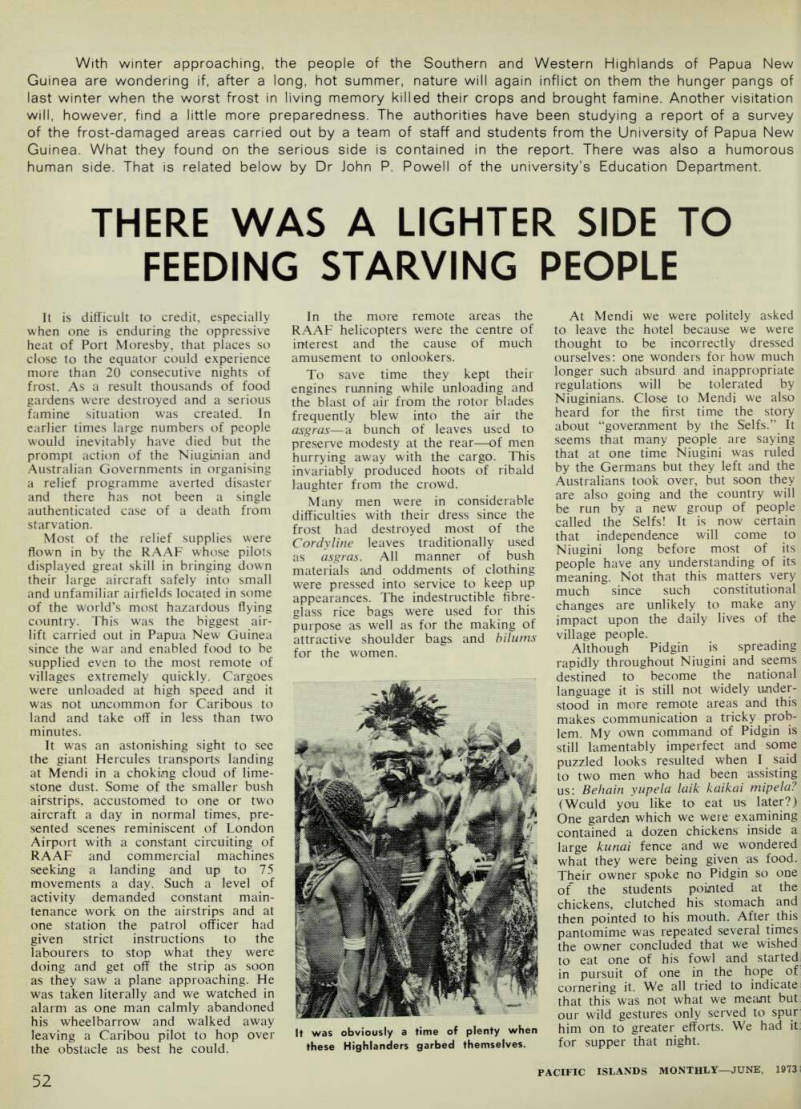
To save time they kept their engines running while unloading and the blast of air from the rotor blades frequently blew into the air the asgras —a bunch of leaves used to preserve modesty at the rear—of men hurrying away with the cargo. This invariably produced hoots of ribald laughter from the crowd.
Many men were in considerable difficulties with their dress since the frost had destroyed most of the Cordyline leaves traditionally used as asgras. All manner of bush materials and oddments of clothing were pressed into service to keep up appearances. The indestructible fibre glass rice bags were used for this purpose as well as for the making of attractive shoulder bags and bilums for the women.
At Mendi we were politely asked to leave the hotel because we were thought to be incorrectly dressed ourselves: one wonders for how much longer such absurd and inappropriate regulations will be tolerated by Niuginians. Close to Mendi we also heard for the first time the story about “government by the Selfs.” It seems that many people are saying that at one time Niugini was ruled by the Germans but they left and the Australians took over, but soon they are also going and the country will be run by a new group of people called the Selfs! It is now certain that independence will come to Niugini long before most of its people have any understanding of its meaning. Not that this matters very much since such constitutional changes are unlikely to make any impact upon the daily lives of the village people.
Although Pidgin is spreading rapidly throughout Niugini and seems destined to become the national language it is still not widely under stood in more remote areas and this makes communication a tricky prob lem. My own command of Pidgin is still lamentably imperfect and some puzzled looks resulted when I said to two men who had been assisting us: Behain yupela laik kaikai mipela? (Would you like to eat us later?) One garden which we weie examining contained a dozen chickens inside a large kunai fence and we wondered what they were being given as food.
Their owner spoke no Pidgin so one of the students pointed at the chickens, clutched his stomach and then pointed to his mouth. After this pantomime was repeated several times the owner concluded that we wished to eat one of his fowl and started in pursuit of one in the hope of cornering it. We all tried to indicate that this was not what we meant but our wild gestures only served to spur him on to greater efforts. We had it for supper that night.
It was obviously a time of plenty when these Highlanders garbed themselves.