Whither
p. 29 · Read in the full issue
Mataafa's government
When Governor Haydon leaves American Samoa, he’ll leave a cleaner, neater capital than he found when he came in 1969.
Then it was run-down and seedy looking. Today, there’s hardly a decrepit building to be seen, all because of Hay don’s belief that a can of paint and a few nails and roof shingles can work wonders. Somerset Maugham’s Sadie Thompson’s house, which is now a general store, looks better than it did in Sadie’s day.
Many cans of paint and a new, multi - storied, air - conditioned bank building have improved the business area out of all recog nition, but the most glamorous addition of all has been imported.
It is a traditional Korean pavi lion, rococo in gold and red, which is the recreational centre for the Korean fishermen.
From FELISE VA’A in Apia Western Samoa’s new Mataafa Government has been surprisingly reticent about its goals and policies.
Official channels have often been approached about possible policy statements from Prime Minister Fiame Mataafa but the reply has always been the same, “Nothing yet”.
Silence by the new government is hardly surprising. When it first took over, late in February the cabinet ministers concentrated most on bring ing themselves up-to-date on depart mental situations, familiarising them selves with departmental progress and their predecessors’ policies. All this took much time. Presumably, they have now finished most of this work and are settling down to for mulating their own policies.
The question now remains whether the new government’s policies will differ greatly from their predecessors’.
Reliable sources say some changes are expected but that, by and large, the new government will continue most if not all the projects already started by the Tamasese Government.
In some cases, the new government supports them, in others it is com pelled to because of the commitments already made.
Biggest problem seems to be mainly economic in origin. For example, it will have to look into problems such as world prices for agricultural ex ports, high cost of living in an en vironment characterised by “slave” wages, economic development, repay ment of government loans and others.
Basically, the government can do little about fluctuating world prices for copra and cocoa, but the Agri culture Department can certainly do something about improving the banana industry though even here the question of prices is also a general one. Samoan planters feel they are being exploited by the sole New Zea land importer, Fruit Distributors, for while New Zealand distributors of Samoan bananas are making a big, big profit, the producers have to con tent themselves with little, relatively speaking.
It would appear—and this has been recognised by some members of Cabinet like the present Minister of Finance, Sam Saili—that one of the soundest solutions to agriculture’s problems would be more industrialisa-
tion based on local requirements and conditions.
Another pressing problem is the rapidly increasing costs of foodstuffs and other products. Almost all im ported products are affected by in creased costs which are still below the limits set recently by the price tribunal but are a constant source of worry to consumers.
“Another price review will have to be made soon,” a member of the tribunal said recently. Now it looks as if employers must raise wages soon, or the government may be forced to do something drastic, like introducing a minimum wage scale, for instance.
However, the government may find answers such as, (1) Mataafa believes in leaving business alone. (2) Re forming the established order must be a slow process.
Minister of Finance Sam Saili has found that previous government bor rowing is a headache. Just before he left for the ECAFE and ADB meet ings in Tokyo and Manila in April, he expressed his concern at the extent of the previous government’s borrow ings which totalled SWSB.9 million at December 31, 1972. Further, negotiations on other loans had already started.
Saili said he was powerless to do anything as the country had already been committed to these loans but that, where possible, he believed the present circumstances required a comprehensive review of the develop ment plan, a change in priorities and more emphasis on the productive sectors of the economy.
Political and social problems do not yet pose a serious threat to Western Samoa, Some of these are already manifest, others are in the latent stage but they are not likely to be explosive, as yet, as compared with the economic problems.
The new government certainly has a task ahead. Perhaps it is just begin ning to realise it.
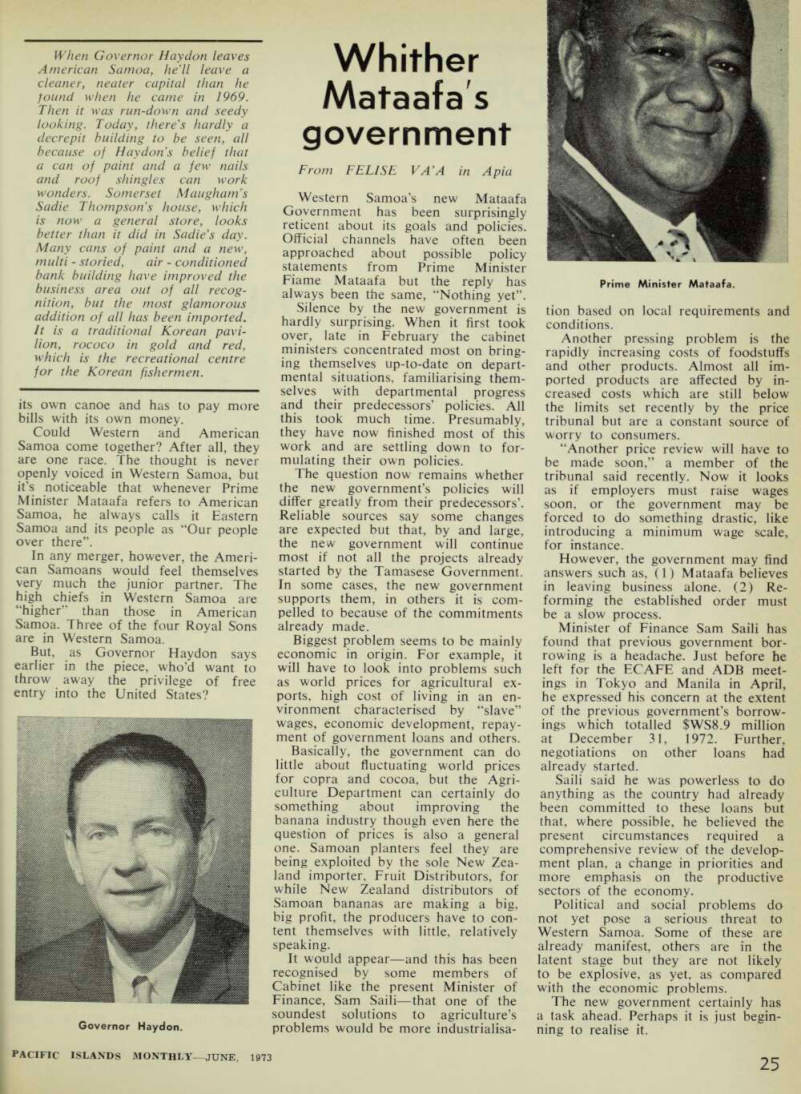
Prime Minister Mataafa.