The Governor Will Be Out Of
pp. 27-29 · Read in the full issue
A Job By 1976
From JOHN CARTER, PlM’s Assistant Editor, in Pago
Magazine owner-publisher and amateur diplomat, Mr John M.
Haydon is hoping to organise himself out of his job as Governor of Ameri can Samoa by 1976. That has been his main ambition since taking up the job in August, 1969, he told me over drinks at Government House.
But, he said, his first task was to make the territory more of a going concern than it was when he took over. He’s had his headaches and obstacles—many, say some people, of his own creation through failure at the outset to understand Samoan customs and traditions—but he thinks he’s succeeded and when a new con stitution is adopted and a local governor heads a self-governing American Samoa he will take over a viable community.
Washington will not let all the reins go. An American hand will still be on the fiscal brake, which will please most of the Samoans who would hate to think they were pad dling their own canoe without rescue being at hand if the canoe capsizes.
Governor Haydon thought his job might end earlier than it did. There were plans to elect the governor and lieutenant governor in 1974 and Governor Haydon had anticipated this by allowing the Fono to sit in on the job of drafting this year’s budget. He also put its members on salary to attract those really fitted for the job. Previously, government service had the pick of the bunch as few were attracted to the legislature when there was no salary.
Although the winds of change, which have blown out the colonials from so many territories, didn’t even amount to a gentle zephyr in Ameri can Samoa, the Samoans managed by last November to get around to the idea of electing their own governor in 1974. That was until the eve of the November elections when about 40 of the highest chiefs des cended on the governor and asked to be relieved of the job of electing the governor. They felt they were being rushed and that they wouldn’t be ready by 1974 to think for them selves.
There are those in Pago Pago who say that the chiefs’ about-turn was the result of propaganda from the governor’s office. This is denied, however. Mr Haydon wouldn’t mind
in the least getting back to his magazine in Seattle, he said.
But 1976 is now a firm date. “By then,” said Governor Haydon, “we will be well on the way to self-govern ment. American Samoa will be depen dent on United States financial aid for many years to come, however.
There is no express desire in the country for independence.
“It’s not likely that Samoans, who have the entree to the United States with no bars at all, except that they can’t vote in a presidential election, are going to throw away that privilege lightly.”
Plans for localisation of jobs are being drawn. Already a number of good jobs are occupied by Samoans and attempts are being made to persuade educated Samoans working in the United States to return to their homeland. This year SUS2OO,OOO is being provided for scholarships for Samoans to attend US schools and
this will be increased to SUS3OO,OOG a year.
The streamlining of the legislature is also underway. At present there are two Houses, the House of Represen tatives elected by popular vote, and the Senate elected by the Matai. They will be merged into one House.
Expansion of the territory’s eco nomy is being speeded up. Under Governor Hay don’s administration there have been rapid strides.
“My primary wish,” he said, “was for things to happen just as they are happening. Economic weakness was one of the problems when I arrived here. In 1969 the total budget was something over $ll million made up of two-thirds contribution from the United States and one-third local.
The local contribution alone for the 1974 budget will be more than $l2 million.
“There are many things in the capital improvement programme but there isn’t enough money to do the things we’d like to do. There’s a tremendous amount going into the water and sewerage systems, roads and telephone equipment. It won’t be long now before that equipment comes and we’ll tie up a completely new telephone system by the end of June. This alone will cost several hundred thousand dollars, but that’s pretty well financed out of the com munications revolving fund.”
One of American Samoa’s big problems has been water supplies, but this will be solved soon with a scheme centred on Tafuna Plain where underground water will be tapped through four wells and piped to the harbour area at a cost of around $3 million. Another job to be tackled is that of too few schools but a programme costing nearly sli million will take care of that.
About $3 million will be spent on the airport to cater for the Jumbo jets; $3 million on roads and the creation of an 80-acre industrial park complete with shopping centre was started last year. The upgrading of roads, however, is a 20-year job, which is surprising on an island only 18 miles long and five miles wide at its widest part.
The governor hopes that the majority of these schemes will be completed by 1976 after which the
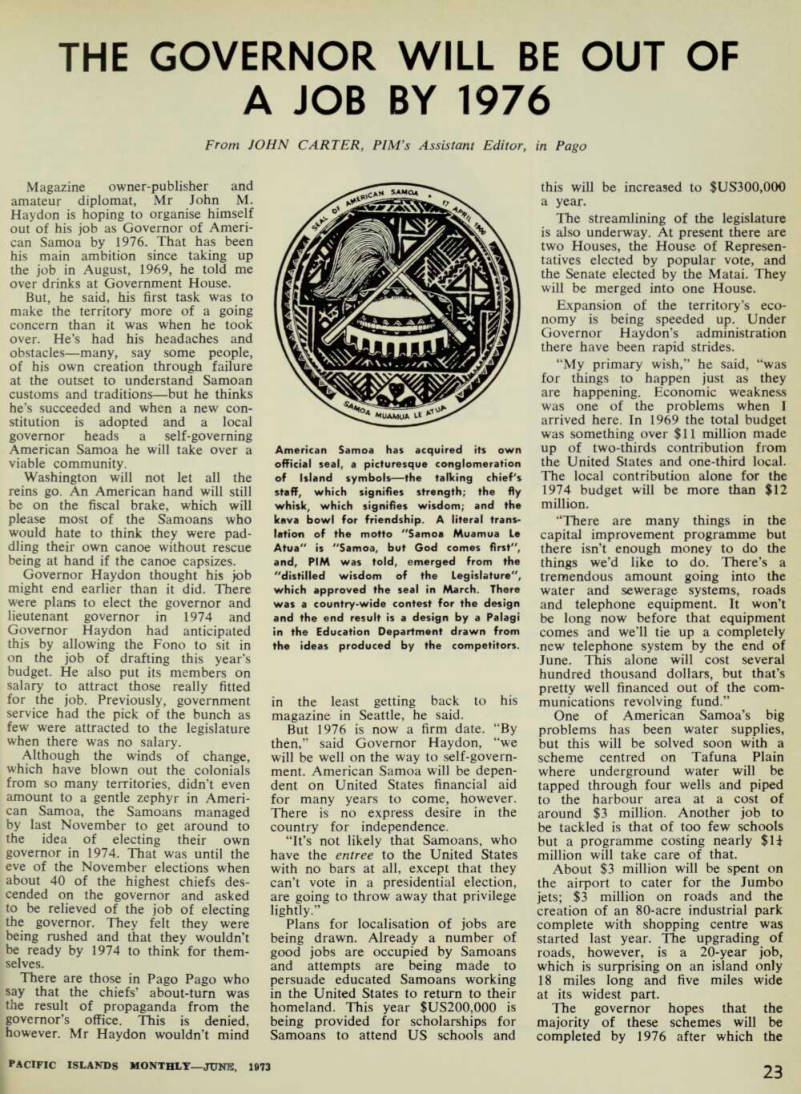
American Samoa has acquired its own official seal, a picturesque conglomeration of Island symbols—the talking chief's staff, which signifies strength; the fly whisk, which signifies wisdom; and the kava bowl for friendship. A literal trans lation of the motto "Samoa Muamua Le Atua" is "Samoa, but God comes first", and, PIM was told, emerged from the "distilled wisdom of the Legislature", which approved the seal in March. There was a country-wide contest for the design and the end result is a design by a Palagi in the Education Department drawn from the ideas produced by the competitors.
territory’s spending spree will be over. The locals will have to bridge the gap after that. The governor is already helping to build the bridge by attracting new industries to help the export trade and create new jobs.
At present the government, with 3,503 local employees on the roll at the end of 1972, is the biggest employer. Then come the fish can neries and the can manufacturers.
Star Kist employs a 600-strong Samoan workforce with a $1.6 million payroll as well as 102 fishing boats with 1,500 Oriental fishermen, who spend a small portion of their wages in Pago Pago. Van Camp, with 113 fishing boats and 2,260 Oriental fishermen, employs 775 Samoans who are getting $1.2 million in wages.
A watch assembly plant, milk pro ducts manufacturing plant and a clothing factory opened in 1972, creating 130 jobs, and there are hopes of bringing in a jewellery manufacturing company, furniture and more clothing factories. Much of their products will go to the US mainland. The fish factories were responsible for most of the export revenue ($52,220,000) but the watch
assembly factory earned $1,448,264.
No wonder Governor Haydon did some crowing recently which upset the Western Samoans. In a televised interview with English TV personality Alan Whicker, the governor was alleged to have compared life in American Samoa with that in West ern Samoa, much to Western Samoa’s disadvantage—and disgust when they got to hear of it.
Western Samoa Prime Minister Mataafa was annoyed and said so.
It wasn’t that the governor had ex aggerated the prosperity of one and the poverty of the other, but that he shouldn’t have made comparisons.
But the fact remains that living standards in American Samoa are higher than those across the water.
For one thing, the American Samoa budget this year works out at more than $l,OOO a head and American Samoa must be the only Island ter ritory with a more than favourable trade balance—imports in 1972 $24,114,332, exports $53,749,997.
All this raises an interesting point.
Western Samoa is independent and proudly so as she pointed out when reacting to Governor Haydon’s com ments on her poverty,. American Samoa is a dependency—a dirty word these days. The majority of American Samoans are satisfied with their lot.
A nucleus of younger, well-educated American Samoans are toying with the idea of working for independence; and their views may make more sense; when the territory begins to paddle:
its own canoe and has to pay more bills with its own money.
Could Western and American Samoa come together? After all, they are one race. The thought is never openly voiced in Western Samoa, but it’s noticeable that whenever Prime Minister Mataafa refers to American Samoa, he always calls it Eastern Samoa and its people as “Our people over there”.
In any merger, however, the Ameri can Samoans would feel themselves very much the junior partner. The high chiefs in Western Samoa are “higher” than those in American Samoa. Three of the four Royal Sons are in Western Samoa.
But, as Governor Haydon says earlier in the piece, who’d want to throw away the privilege of free entry into the United States?
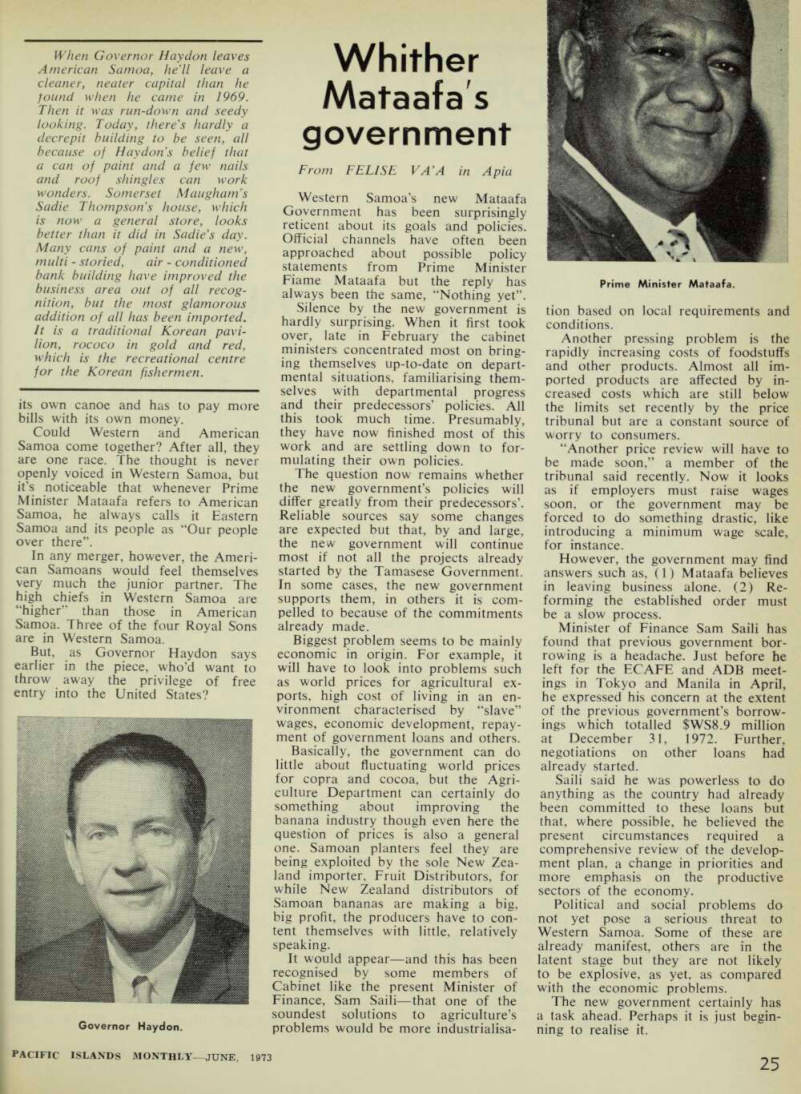
Governor Haydon.