Cashing In
pp. 105-111 · Read in the full issue


On Bebe's
Left-Overs
Thousands of fallen trees, ripped from the ground or with their tops whipped off by the savagery of hurri cane Bebe which rampaged across Fiji last October, are still proving a valuable asset.
The Fiji Forestry Department at the Drasa-Lololo plantation near Lautoka is salvaging this fallen tim ber to be used primarily for housing construction and fencing in the rural areas. It is part of a nation-wide pro gramme to have 50,000 acres of hitherto unproductive land planted to Caribbean Pine trees by 1978.
The plan resulted from a report by experts of the Food and Agriculture Organisation of the United Nations, who are confident that an opportunity exists in Fiji to develop a profitable export industry for the Japanese market in the 1980 s.
A forestry officer, Osea Gavidi, said 56 per cent of the plantation at Drasa-Lololo suffered heavy damage during the hurricane, with 44 per cent of the damaged trees saved or sal vageable. About 250 acres were com pletely written off in the 15,000 acres planted at the station.
Costs to the government to salvage the trees was estimated at $23,000.
Small trees bent as far as 60 degrees by the winds were propped upright and tied to give them an opportunity to continue growth.
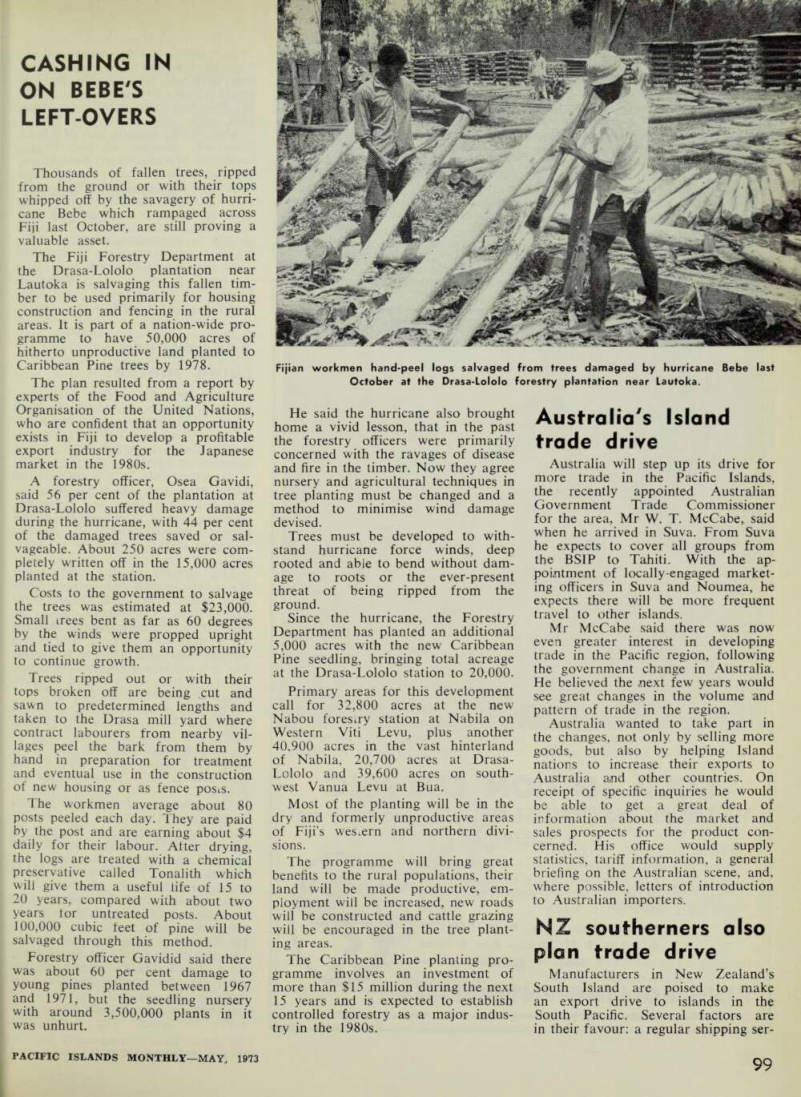
Trees ripped out or with their tops broken off are being cut and sawn to predetermined lengths and taken to the Drasa mill yard where contract labourers from nearby vil lages peel the bark from them by hand in preparation for treatment and eventual use in the construction of new housing or as fence posts.
The workmen average about 80 posts peeled each day. They are paid by the post and are earning about $4 daily for their labour. After drying, the logs are treated with a chemical preservative called Tonalith which will give them a useful life of 15 to 20 years, compared with about two years tor untreated posts. About 100,000 cubic feet of pine will be salvaged through this method.
Forestry officer Gavidid said there was about 60 per cent damage to young pines planted between 1967 and 1971, but the seedling nursery with around 3,500,000 plants in it was unhurt.
He said the hurricane also brought home a vivid lesson, that in the past the forestry officers were primarily concerned with the ravages of disease and fire in the timber. Now they agree nursery and agricultural techniques in tree planting must be changed and a method to minimise wind damage devised.
Trees must be developed to with stand hurricane force winds, deep rooted and able to bend without dam age to roots or the ever-present threat of being ripped from the ground.
Since the hurricane, the Forestry Department has planted an additional 5,000 acres with the new Caribbean Pine seedling, bringing total acreage at the Drasa-Lololo station to 20,000.
Primary areas for this development call for 32,800 acres at the new Nabou forestry station at Nabila on Western Viti Levu, plus another 40,900 acres in the vast hinterland of Nabila, 20,700 acres at Drasa- Lololo and 39,600 acres on south west Vanua Levu at Bua.
Most of the planting will be in the dry and formerly unproductive areas of Fiji’s western and northern divi sions.
The programme will bring great benefits to the rural populations, their land will be made productive, em ployment will be increased, new roads will be constructed and cattle grazing will be encouraged in the tree plant ing areas.
The Caribbean Pine planting pro gramme involves an investment of more than $l5 million during the next 15 years and is expected to establish controlled forestry as a major indus try in the 1980 s.
Australia's Island
trade drive
Australia will step up its drive for more trade in the Pacific Islands, the recently appointed Australian Government Trade Commissioner for the area, Mr W. T. McCabe, said when he arrived in Suva. From Suva he expects to cover all groups from the BSIP to Tahiti. With the ap pointment of locally-engaged market ing officers in Suva and Noumea, he expects there will be more frequent travel to other islands.
Mr McCabe said there was now even greater interest in developing trade in the Pacific region, following the government change in Australia.
He believed the .next few years would see great changes in the volume and pattern of trade in the region.
Australia wanted to take part in the changes, not only by selling more goods, but also by helping Island nations to increase their exports to Australia a.nd other countries. On receipt of specific inquiries he would be able to get a great deal of information about the market and sales prospects for the product con cerned. His office would supply statistics, tariff information, a general briefing on the Australian scene, and, where possible, letters of introduction to Australian importers.
NZ southerners also
plan trade drive
Manufacturers in New Zealand’s South Island are poised to make an export drive to islands in the South Pacific. Several factors are in their favour: a regular shipping ser
Fijian workmen hand-peel logs salvaged from trees damaged by hurricane Bebe last October at the Drasa-Lololo forestry plantation near Lautoka.
vice about to be introduced between South Island ports and Fiji; tremendous goodwill engendered in Fiji through generous aid after Hurricane Bebe; the possibility of an aircargo link between Christchurch and Nadi, via Wellington; and revaluation of the Australian dollar which gives New Zealand a competitive edge.
In the past, except when USS Co ships called at Lyttelton after a run to the Islands, South Island manufacturers, or the buyers of their goods, suffered the disadvantage of double handling costs at Auckland.
The director of the Canterbury Manufacturers’ Association, Mr I. D.
Howell, recently spent 12 days in
Fiji on a survey for South Island ex porters. In spite of the double freight charges he saw several displays of commodities made in the South Is land. Some traders were interested in South Island goods, provided the double freight charge could be elimin ated.
One major company expected to lift imports from NZ from $150,000 worth a month to $400,000 worth, Other traders asked him for quota tions for a wide range of goods, in eluding clothing, foodstuffs and household appliances.
Mr Howell mentioned that ex porters could capitalise on being the closest supplier to Fiji. The average
time between placing orders and re ceipt in Fiji was only two months, compared with four months for UK goods, three and a half months for SE Asia and three months for Aust ralia.
Also in Fiji recently was Mr J. G.
Crawford, director of the Otago- Southland Manufacturers’ Association.
He had a similar story to tell, and referring to Hurricane Bebe said New Zealand’s assistance had been more spontaneous and generous than Australia’s. All commercial people in Fiji were keen to import from NZ.
In the last nine months of 1972, the value of NZ exports to Fiji were worth $11.25 million. The value could rise to sl6 million this year.
Tonga's new
copra market
Tonga is about to sign a contract to supply copra to Vegetable Oils Pty Ltd, of Sydney, a big food in gredient processor. The Tonga Com modity Board in March sent a trial shipment of 15 tons to Vegetable Oils.
Vegetable Oils is a subsidiary of Allied Mills Ltd, which has flourmil ling, baking, essences and margarine interests. One of its subsidiaries is the biggest manufacturer of polyun saturated (table) margarine in Aust ralia.
The director of the Commodity Board, Mr Stemson, who visited Aust ralia recently with the Prime Mini ster, Prince Tuipelebake, and the Secretary to the Government, Mr Dan Tufui, said arrangements were under way for final agreements to be signed.
The first substantial shipment of copra, about 400 tons was expected to leave Tonga about the middle of April.
The deal with Vegetable Oils will not mean higher prices for Tongan copra, but rather a diversification of the copra export market. As it is, most of Tonga’s copra goes to the UK and is sold at world market prices.
The prospect of outward cargoes should prove attractive for the Pacific Navigation Co with the Tauloto 11.
Ever since the Tonga-Fiji-Australia service was inaugurated with the Niuvakai there has been little cargo from the Islands for Australia.
A representative of Vegetable Oils in Sydney, asked about details of the prospective agreement, said: “We are not interested in giving any details.
The best thing would be to get them from the Tongan Government. We don’t like our name being in the
press”. . . „
Tonga is also negotiating to sell copra to Japan. The Aoniu was
scheduled to leave late in April with 375 tons, and will return from Japan with a full load of cement, fertilisers and other goods. Mr Stemson said he was wary about making a long term contract with Japan as Tonga wanted to use its own ships, and needed to be assured of return car goes.
There's money
in fishing
The growing awareness of Pacific Islanders of the commercial value of fish, apart from its traditional place in their diet, is shown in recent re ports from three groups in Western Samoa, Fiji and Papua New Guinea.
Western Samoa is being helped by a team of fisheries experts from Taiwan, not only to set up a cannery, but in a feasibility study of the skipjack tuna industry.
Western Samoa plans to open a cannery this year, partly to help cut down a big import bill, which was almost $500,000 in 1972. Also in the plan is a proposal that Taiwan helps Western Samoa to develop prawn and lobster cultivation.
American, Japanese and Canadian companies are after licences to set up the skipjack tuna industry in Fiji waters. But they will have to wait, for Fiji will make no decision about fishing concessions till publi cation of a report by a United Nations’ team. This is near the end of a two-year study of local tuna stocks. The Fiji Government hopes the survey will recommend a fleet of up to 20 tuna boats and an associated cannery, operated either by local or foreign interests.
The Australian Government has approved the entry of 12 PNG-based fishing ships into the Gulf of Carpen taria to trawl for prawns. According to the PNG Agriculture Minister, Mr lambakey Okuk, the offer could not have come at a better time to help the territory set up a viable prawning industry.
Cooks' fishermen
will try again
A new Cook Islands Fishermen’s Co-operative Society has been registered in Rarotonga. Its predeces sor was wound up in January as it was no longer operating. Help from the government for the new society includes boats, fishing lines and tackle and other assets which include the Fisheries Division’s building an ice-making plant, two deep-freezers
and other equipment useful for main taining fishing boats.
It is necessary to go further afield from Rarotonga for fish as the small lagoons and reefs have virtually been fished out. Don Beer, a New Zealander, who had one of the first boats built for the first society, said he was glad to be out of it because he had lost so much money in 1972.
Apart from operational expenses, the hardest blow was two successive bad fishing seasons. Those bad seasons hit the fishermen in the society so hard that they never recovered. Now, hopes are centred on the new society being a success.
Air fare cuts
with catches
The life of a clerk booking air fares across the Pacific for Qantas and Air New Zealand is not an easy one because of the multitude of fare schedules. Both airlines recently cut a number of their fares in this area, in some cases by more than 50 per cent. Of course, there are catches.
Travellers between Fiji and Syd ney, and vice versa, a Pacific “leg” which generates heavy traffic, will not benefit from reduced fares
because, says Qantas, lATA will not allow all fares to be reduced. But there are cheaper fares for travellers between Fiji and San Francisco, Between Sydney and Noumea there are discounts of up to 45 per cent for group bookings.
A new marketing concept, known as “early purchase individual con tract” (EPIC) fares will apply between Nadi and Auckland from May 15. If a traveller books 60 days in advance he will have to pay only $133.20 return and $66.60 one way, a drop of 30 per cent on the usual schedules.
There are other EPIC fares as well—between Nadi and North America, from May 1, Air NZ travel lers will be able to travel for 44 per cent less than normal fares. Catches to this one are that a traveller must be away for at least 14 days, but not more than 21 days.
Air NZ concessions for group travels rise to as high as 53 per cent.
The Qantas return fare for Nadi to San Francisco at concessions rates is $454.80, payable 60 days in advance.
But from April 1, all normal Fiji- North America fares rose by 5 per cent to offset recent currency changes.
From May 1, the normal Nadi-San Francisco one-way fare will be $571 (currently $518.20). The one-way economy fare will be $407.70 (cur rently $360.80).
The 14-28 day excursion fares will be $577, against $523. A new group inclusive tour fare will be $379, and an individual inclusive fare $459.10.
Bougainville mining's
question mark
Bougainville Mining Ltd expects to easily sell planned production of 175,000 tonnes (172,244 tons) this year, but there is a question mark about the dividend. The chairman, Mr F. F. Espie, at the annual meeting declined to give a dividend forecast.
The first dividend is expected in October. .
There had been changes since the May, 1971, prospectus was issued which made the then estimates of dividends “no longer relevant’. It was then expected there would be annual dividends of 20c a share.
Changes since then included two currency realignments, the 15 per cent withholding tax of the Papua New Guinea Government, a sub stantially higher price for gold, an increase in treatment charges follow ing currency changes, and the cost, of anti-pollution measures taken by our buyers”.
Bougainville Mining owns 80 per cent of Bougainville Copper Pty Ltd..
The other 20 per cent is held by, or o.n behalf of, the PNG Government.
Bougainville Mining is owned by CRA (56.35 per cent), NBHC Hold ings (28.17 per cent), public share holders (14.36 percent) and Panguna Development Foundation Ltd (1.12 per cent).
Air Pacific
off to Brisbane
Air Pacific will open a Suva-Bris bane service on Jane 1, via Nadi, Vila and Honiara. It will be a weekly service, leaving Fiji on Friday and Brisbane on Saturday.
Air Pacific declared its intention of seeking such a service when it acquired its BACI-11 jet in 1972.
The airline at present operates to Honiara from Fiji, via Vila, three times a week and once weekly from Fiji to Port Moresby. The new service will eliminate the need for people who want to travel from the BSTP to Australia to go via Port Moresby.
Travelling east, the airline intro duced a new “triangle fare” linking Fiji, Tonga and Western Samoa on April 1. The service is operated in conjunction with Polynesian Airlines.
The fare is $F 124.40, which is 26 per cent below the total sector fare.
BAG 1-11 jets and HS74B turbo prop aircraft will be used. The concession is confined to those doing the whole triangle.
Fiji aims for
sugar record
Fiji is aiming for a record 408,000 tons of sugar in its first year “under new management”, and is confident it can all be sold. Should the target be achieved it will be almost 110,000 tons more than the 1972 production, the last with SPSM Ltd as millers.
But 1972 production was hit by wet weather and was far short of the original target of 391,000 tons.
The wet weather was followed by drought and the Lautoka mill, for the first time in 10 years, crushed less than one million tons of cane. Britain was the biggest buyer with 145,000 tons, followed by US 39,500 tons, Canada 31,500 tons, New Zealand 25,500 tons, Japan 17,100 tons and Finland 11,800 tons. Local sales took 23,000 tons.
Sugar sales in 1972 were worth $31,257,580. The return to growers was an average of $8.0769 a ton cane.
The sweetness of the cane was the best since 1968. It took only 7.34 tons of cane to make a ton of sugar, compared with 7.9 tons in 1971 and 8 tons in 1970.
Faults in Fiji's
tax structure
The Fiji taxation structure could be in line for a shake-up following release of a three and a half-year old report by Professor Russell Mathews of the Australian National University. Professor Mathews came down solidly in favour of a single consolidated tax instead of the present basic, normal, surtax and surcharge income taxes.
He said taxpayers on $l,OOO to $5,000 a year seemed to have a relatively light tax burden, taxation on those earning less than $l,OOO a
year was regressive, while taxation in the $6,000 to $lO,OOO bracket was high, even by the standards of the most highly-taxed countries in the world.
Professor Mathews also criticised the deductible allowances. He quoted 1967 as an example, saying that on individual incomes totalling $34 mil lion, the entitled allowances were $28.2 million. Some allowances were too generous; others should be abolished.
He suggested death duties on very large estates should be reduced; exemption on savings or Fiji Govern ment loans should be abolished as soon as possible; allowances for
insurance premiums should be al lowed only for life premiums having a minimum term of 10 years; super annuation and retirement benefits should be taxed if paid in a lump sum; tax allowance for education of children outside Fiji should be related to boarding school costs in Fiji; goods in the duty-free class should bear an import tax; a two per cent turn over tax on tourist hotels should be introduced; export taxes on local products should be phased out, with immediate exemption for all manu factured and primary products, except sugar and coconut products.
Professor Mathews also recom mended that allowances for overseas leave passages which taxpayers paid for themselves should be abolished; so should the tax deductions for firms which paid employees’ passages.
Low company dividend taxes were not necessary for Fiji’s development, as long as the company tax was relatively low in comparison with other countries.
The report was presented to Mr H. P. Ritchie, then Finance Minister, in 1969. Since then Mr. Ritchie has gone and there have been two other Finance Ministers, Mr Wesley Barrett, who resigned his portfolio after the 1972 election, and the incumbent, Mr Charles Stinson. Two of these ministers have applied higher dividend tax proposals. But other recommen dations have been ignored so far.
Business Briefs
• Businessmen in Rabaul are hoping to have a larger share of the tourist dollar through some form of duty-free shopping. They point to the part played by tourism in Fiji’s economy and the substantial con tribution made by the attraction of Suva as a duty-free port. Papua New Guinea could likewise benefit financially by adopting one of three proposals put forward by the New Britain Tourist Association, its spokesman Mr F. Pannekoek said in March—a wholly duty-free PNG, Rabaul as a duty-free port, or a number of licensed companies opera ting duty-free shops for tourists. • The cost of the first two stages of the Suva-Nadi road along the south coast of Viti Levu, has risen to $21,447,968 and could rise another $H million through changes in the values of international cur rencies. The two stages are Nadi- Korotogo and Suva-Deuba, leaving a gap of more than 35 miles for some future date. • Air-India, on June 1, will alter its Sydney-Fiji-Sydney schedules.
The Boeing 707 on this service will arrive in Sydney each Friday from Bombay at 7.25 am and will leave for Nadi at 9 am. The return flight will leave Nadi at 8 am on Saturdays, and arrive at Sydney at 10.25 am, enroute to Bombay. The service at present leaves Sydney for Nadi on Tuesday mornings and returns on Wednesday mornings. • An instant coffee processing factory for Papua New Guinea will depend on a feasibility study by a team from the Japan Consulting Institute.
The study is first of a series of studies planned by the Trade and Industry Department and aimed at setting up industries for the further processing of drinking products. • American Metal Climax, one of the biggest mining companies in the world, is intensifying its search for copper over 74,000 acres of rugged country in Namosi Province, Fiji.
Namosi is a few miles inland from the south coast of Viti Levu. The Fiji Minister of Lands and Mineral Development is optimistic about the prospects of a fairly big copper mine in the area. • There should be more intensive trade between the two Samoas, says Dr lan Fairbairn, a South Pacific Commission economist. He said that trade between the two countries was a mere trickle. It was surprising, with the two places less than 100 miles apart, there was so little interest in increasing trade. In 1971, Western Samoan exports to American Samoa were worth $140,000 and $26,000 worth of that was re-exported. The return traffic was only $26,000. Dr Fairbairn mentioned lack of a wide range of goods, similar resources and American Samoa controls on Western Samoa exports as limiting factors. • Drilling for oil in Tonga has been suspended till June, 1974. The consortium of companies prospecting for oil are having difficulty finding a company to take over Tonga Shell NV’s share. The consortium is also looking for a company to do the drilling. Tonga Shell NV withdrew from the consortium some time ago and Ampol took over half that com pany’s share. • Mr C. S. Sadlier, who has been seconded from the Bank of NSW to the Fiji Development Bank as man aging director for the next three years, is no stranger to Fiji. He was in Fiji from 1961 to 1963 as manager of the Ba branch of the “Wales”.
The Fiji Development Bank was est ablished six years ago and operates under a board nominated by the Fiji Government. Mr Sadlier joined the
Wales in Launceston in 1939 and since then has had wide banking experience in Tasmania, Victoria and New South Wales. Prior to being appointed to this new post in Fiji he was manager at Dandenong, Vic toria. • The accent on Pitcairn Island’s afforestation programme is moving to trees which will provide building timber. Three major areas are being developed in a variety of trees—St Pauls, Faute Valley and Tedside.
The St Pauls forest of 50,000 young trees comprises mainly miro. There are more than 10,000 miro at Tedside and 2,000 miro at Faute Valley.
Other plantings are monkey puzzle windbreaks, rain trees, Norfolk pines, orange, papaw and passionfruit. • An American Samoa ban on the import of kegs of beef for six months could prove a double-edged weapon, according to Governor John M. Haydon. The aim is to curb spiralling costs, but Governor Haydon considers the ban could have the effect of sending the price up because of shortage of supply. Efforts will be made to find a suitable replacement. • The Trust Territory High Com missioner, Mr Edward E. Johnston, has revoked permits to Spicewind Fishing Co and Gunther W. Mothes and Co, to fish for lobster and tuna in the Marshalls and Yap districts.
Mr Mothes, who is president of Spice wind, reacted by forming another company. Seafood Specialities Inc, of California, with himself as president. A contract will be let to this company to work for Spicewind till yet another company, Marshall Islands Seafood Enterprises, is in corporated as a Micronesian corpora tion.
Mr C. S. Sadlier