Business and Development
pp. 99-103 · Read in the full issue
The Japanese Back Their Faith
In The Islands With Hard Cash
The Papua New Guinea Govern ment has agreed to the takeover, by the Japanese company, Sohbu Adachi Co Ltd, of Territory Development Ltd. Territory Development Ltd was formerly owned by Placer Develop ment Ltd. (PIM, Jan, p 115).
Although Placer, through its sub sidiaries, will go on managing the company on behalf of its new owners for the next three years, the pioneer NG company has as good as bowed out of the country it helped put on the map in the 1920 s and 19305.
Old New Guinea hands who died fighting the Japanese in New Guinea may be turning in their graves in the war cemeteries there at what has happened, but for those of us who survived it is now all regarded as a beneficial development. The Japanese apparently have a lot of faith in the short term of certain commercial enterprises in the country and they certainly have access to big markets.
Placer’s interest in NG dates back to the late 1920 s when Cecil J.
Levien and his Adelaide associates sold Placer their Guinea Gold leases at Bulolo.
Placer Development Ltd had been formed by Mr W. Addison Freeman; its head office was in Vancouver but its capital was Australian. Placer tested the Bulolo leases, found an initial 40 million cubic yards of wash carrying gold worth 2/- (20c) to the cubic yard and sold the leases to Bulolo Gold Dredging, another Vancouver company with the same technical control as Placer but with capital provided from British, South African and Australian sources. BGD became the operating company and Placer had a substantial share interest in it.
Royalty paid by BGD was a big factor in keeping the NG government financially afloat in the 1930 s when Australia gave that territory no financial assistance at all.
By the time the Pacific War broke out, BGD had eight huge dredges
working and reached its peak produc tion in 1938 with a production of over 400,000 oz of gold. Fine gold was then worth about £Stg7 an ounce (present world price is around SUS9O) but there was this difference —£l was worth £1 in buying power.
The £1 note of 1938 has become today’s $2, but then it bought goods worth around S2O today.
BGD dredges were scuttled at the outbreak of war in New Guinea but refloated in the immediate post-war period, the eighth going into produc tion again in 1949. However, it was obvious that the days of the Bulolo leases were numbered and the com pany turned to klinkii and hoop pine which grew in abundance in the Bulolo area and the exploitation of which had been made possible by a road built during the war from Lae, on the coast, to Bulolo to link up with the existing road from Bulolo to Wau.
In the early 1950 s BGD and the Australian Government went into partnership in Commonwealth New Guinea Timbers Ltd, a $2 million com pany owned 49.9 per cent by BGD and 50.1 per cent by the Common wealth Government. The purpose was to manufacture plywood from the
local pine. The plywood factory went into operation at Bulolo in 1954 and there commenced rotational cutting and reafforestation of the pine forests so that a permanent asset remains. On its own accouni BGD set up its own factory in Lae (South Pacific Timbers) where core material and veneer sheets are manu factured. Plywood and veneer have added millions of dollars to PNG exports in the last 10 years. PNG also went in for large-scale cattle ranching at Leron Plains in the Markham Valley, In the late 19605, Placer came actively back into the New Guinea picture and took over all BCD’s assets in the country. Its partnership with the Commonwealth government in CNGT lasted until June 29, 1972.
At that time Placer put all its NG enterprises—that is, its 49.9 per cent holding in the Bulolo plywood enter prise, its cattle station in the Markham Valley and South Pacific Timbers at Lae—under the CNGT banner and the Australian Government withdrew in favour of the Papua New Guinea Investment Corporation which holds shares on behalf of the PNG Government. But with Placer’s cattle and Lae interests included the Cor-
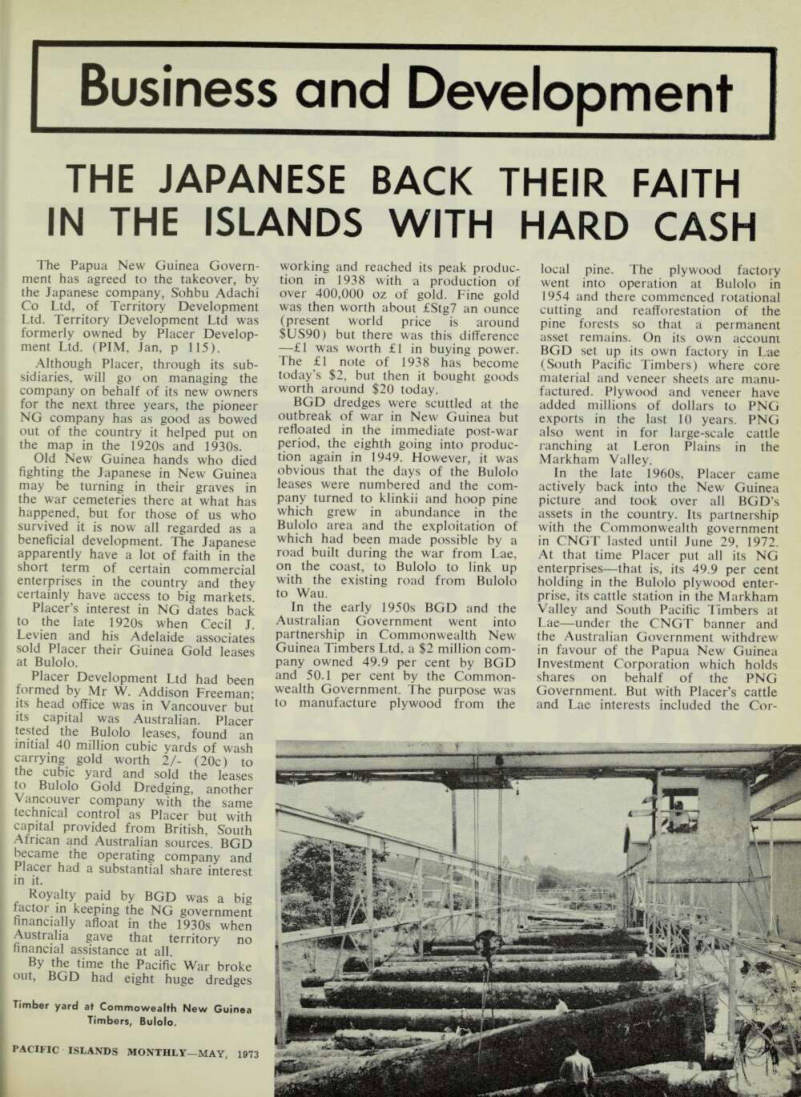
Timber yard at Commowealth New Guinea Timbers, Bulolo.
poration’s interest in the new setup was reduced to a holding of 35 per cent.
Placer had formed Territory Development Ltd a considerable time previously but the company was dormant until the mid-1972 re organisation when it became the holding company for Placer’s various interests in Papua New Guinea. As well as a 65 per cent interest in CNGT, Territory Development Ltd included Territory Fisheries Pty Ltd which originally was not wholly owned by Placer, although the minority shareholding was later acquired.
It is the shares of Territory Development Ltd which the Japanese company, Sohbu Adachi Co Ltd, has now bought. The sale was ap proved by the PNG government in February subject to approval of plans for continuing Bulolo reafforestation, plywood marketing and output, etc.
The PNG government also has the option of buying, through its invest ment corporation, a further 14 per cent of shares in CNGT within the next five years. This would bring its holding in that company to 49 per cent.
Although there will be no change in management of the New Guinea companies for some time, the only real interest Placer Development Ltd will have in the country in future will be in mineral exploration. It has been engaged in the search for a variety of minerals in a number of PNG districts.
Japanese
timber takeover
Shin Asahigawa Co Ltd, of Japan has acquired full control of Complex (Commercial Pacific Lumber Exports Pty Ltd), a big West New Britain logging company and an associated company has signed an agreement to buy Bialla Plantation from a Rabaul businessmen. Bialla Plantations houses many of the Complex buildings and owns the wharf from which timber is shipped.
Complex went into receivership in 1972 and now Shin Asahigawa has put in more than $1 million in work ing capital to pay off creditors. Shin Asahigawa was one of the original shareholders in Complex on a 50-50 basis with Messrs Farid and Fouad Wakim.
The money from Shin Asahigawa will be used to pay off a mortgage on Complex and the receiver’s creditors, totalling more than $600,000. Shin Asahigawa is also putting in money to pay off secured creditors. It is proposed that un secured creditors be paid off over
the next two years as money becomes available.
The receiver, Mr K. Irish, said the original business was forced into receivership through under-capitalisa tion, pricing, weather and other factors.
Volunteers
follow the yen
The Japanese are comi,ng to West ern Samoa. They almost made it here during the Second World War. Now they arrive, not as Samurai warriors, but as businessmen.
Though Japanese influx into Samoa is mere peanuts as compared with other parts of Asia and the Pacific, it is sufficiently strong to make its impact felt in the Western Samoan economy.
For instance, the Japanese, with a group of local businessmen, already own the second largest timber milling company in Western Samoa, the New Samoa Industry group. And, there is also a Japanese-owned shoe manu facturing and repair shop. The Japan ese were also to have established a bank there some years ago but owing to language and other difficulties, the idea was scratched.
Japanese business involvement is, so far, minute, but it is likely that this will be expanded later on as the Japanese show more interest there. And this will be good for West ern Samoa—especially as industrial capital is so hard to come by these
days, and Japan has already proved itself to be a friend of many develop ing countries.
Now the latest Japanese involve ment is the Japan Overseas Co operation Volunteer scheme (JOCV), which already operates in many underdeveloped countries of the world in Latin America, South East Asia, Africa a.nd the Middle East. JOCV operates very much along the same lines as the United States Peace Corps except that instead of American values being offered, it is Japanese traditional and modern values. Japan ese aid is mostly in the technical field, said Mr Sadanori Taguchi, JOCV co-ordinator m Western Samoa.
The first of these volunteers, Mr Yamagawa, a civil engineer has already arrived and he was followed in April by another civil engineer, an architect and an outboard engine technician. The first JOCV office in Western Samoa was opened in April.
Hawaii is
getting nervous
Hawaii, which has attracted more than $2OO million in Japanese invest ments, is growing nervous at the thought that foreign capital may dominate the island group. It’s a nervousness which is being felt else where in the Pacific as foreign capital is poured into mining, deep sea fish ing and tourism.
Commodities, appliances, cars, food, real estate, tourism, ship-build
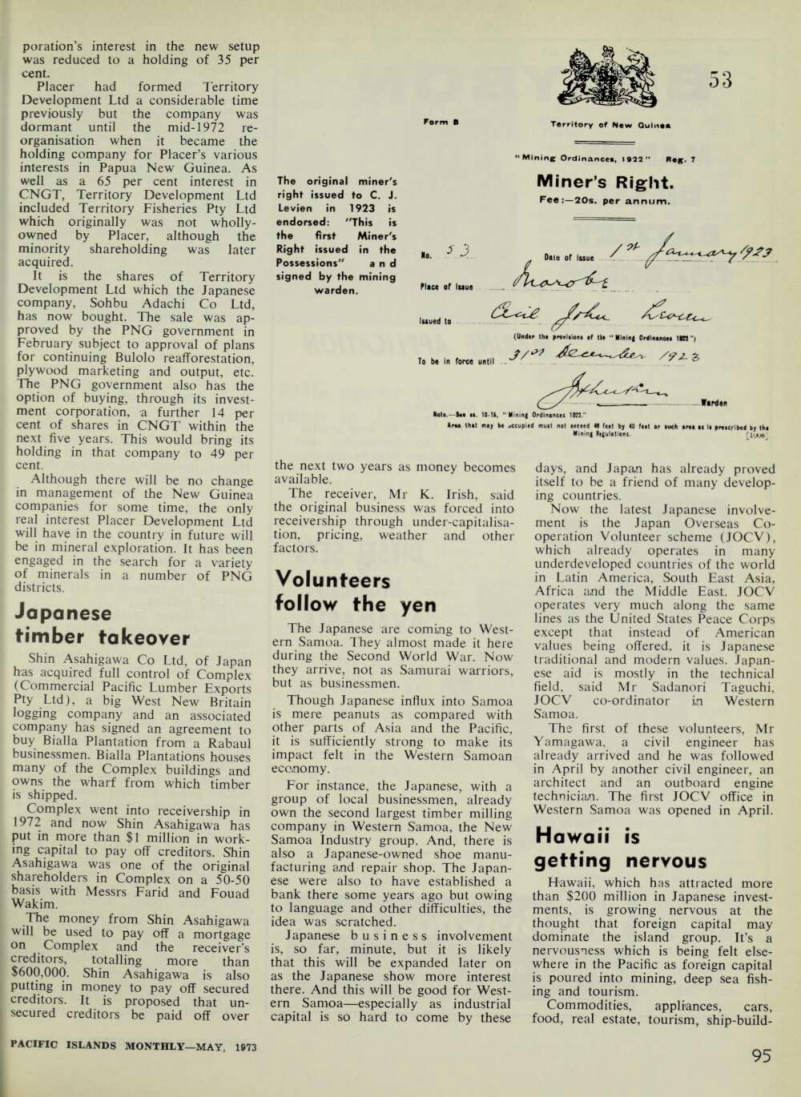
The original miner's right issued to C. J.
Levien in 1923 is endorsed: "This is the first Miner's Right issued in the Possessions" and signed by the mining warden.
ing, are some fields which Japanese interests are now starting to dominate, or which are attracting increasing Japanese investment. Dr Shelley M.
Mark, director of the Department of Planning and Economic Development in Hawaii, recently wrote in a Hawaii Overseas supplement of the impact of Japanese invesment in that group.
Much of what he wrote below could also apply to a number of other groups: “Hawaii, historically, has had close ties with Japan. More than 100 years ago the first group of Japanese im migrants came to our Islands. Since then our ties have grown, rather than diminished. Today, the effects of Japan’s economic miracle have reached Hawaii’s shores. Japan is the State’s largest foreign trading partner, with $101.2 million in total trade conducted with Hawaii in 1971.
This trade with Japan constitutes 58 per cent of Hawaii’s entire Asia- Pacific trade—6s per cent in imports and 27 per cent in exports.
“Since the late 1950 s a number of Japanese firms have invested in Hawaii. A survey conducted by the Hawaii International Services Agency of our State Department of Planning and Economic Development found that there are at least 80 Japanese firms currently doing business in Hawaii. Many more are expected to come in the near future. Although the exact value of the assets of these firms is difficult to determine, it is estimated to range from $lOO million to $2OO million.
“In addition to these investments, Hawaii has become a prime destina tion area for Japanese tourists, and Japanese tourism is big business in the Islands. The Hawaii Visitors Bureau estimates that 180,000 Japan ese visited Hawaii in 1971. It is predicted that by 1980, Japanese citizens will comprise at least 25 per cent of the total number of visitors to Hawaii.
“Hawaii disapproves of and dis courages land speculation: transac tions going through several inter mediaries with the end result of artificially inflating land values with out productive use of the land, or the payment of inflated prices based on anticipated zoning approvals not yet confirmed. Such transactions can play havoc with orderly planning and have other deleterious con sequences for the community at large. Land and housing prices are already too high for Hawaii’s people in the lower and middle income brackets, and such moves only serve; to worsen the situation.
“There is also community disap proval of extensive development of
foreign tours operating in a closed system in which visitors arrive on a foreign airline, are registered at a foreign-owned hotel and then are transported around to foreign-owned retail stores and restaurants with which special deals have been made.
Such practices have harmful effects on competition, lead to overpricing, and ultimately hurt tourism and the treasured reputation of Hawaii. They lead to a large portion of the tourist dollar being returned to the foreign country rather than providing ap propriate benefits to the local eco nomy, which provides basic—and costly—facilities making tourism so attractive in the first place.
“'Hiere are many areas in which outside capital can further benefit the Hawaiian community and economy.
Hawaii’s research and development industries, the solar and ocean sciences, education, international trade, transportation and finance, agricultural products, the diversifica tion of locally manufactured products and a Pacific Institute of Science and Technology—all these need investment funds. Hawaii would like to see more foreign investments in these areas and thus prevent overconcentration in the single area of tourism.
“The State encourages joint ven tures or employment of key Hawaii personnel by foreign firms for a number of reasons. However, joint ventures mean that there must also be a willing and creative partner on this side. This means Hawaii’s own people must raise their sights, over come short term speculative tempta tions, and come up with projects more conducive to the long-term growth of the State’s economy and well being.”
PNG opens its
shop in Japan ...
The export economy of Papua New Guinea was shown to a potential market of millions at trade fairs in three major cities in Japan in April —Osaka, Takamatsu and Wakayama.
The displays were accompanied by showings of a new film on New Guinea timber, with the premiere in Osaka, where PNG’s Minister for Trade and Industry, Mr John Poe, held a reception for leading Japanese businessmen and the media.
It was all there—coffee, tea, cocoa, coconut oil, copra pellets, desiccated coconut, coir fibre, coconut shell carbon, palm oil, palm kernels, car damon, and tuna. Coloured film showed tourists what they could see and do. Many artifacts and silk screen printed fabrics decorated the panels.
The “newcomer”, copper was not forgotten—there were samples of copper rocks from Panguna on Bougainville.
When the display was taken to Takamatsu the emphasis was on timber—ambexoi, kamarere, exima, malas, kwila, pencil cedar, klinkii pine and taun. This was supported by films on the hardwood industry and on Bulolo plywood development.
It was not enough to show some of the primary products. Visitors were invited to sample coffee and tea, Mr Poe said that in recent months PNG had sold coffee worth about $1 million to Japan and was hoping for a similar breakthrough for cocoa.
Those commodities, with timber, would supplement copra and coconut
products as major exports to Japan.
Japan bought 25,000 to 30,000 tons of copra a year from PNG.
Timber exports for 1970-71 were valued at about SAS million, and a similar return was expected for 1971-72. Most of the timber was exported in logs, but it was hoped soon to have more processing industries so that the percentage of sawn timber and other timber pro ducts would increase.
Japan was an important trading partner of PNG, second only to Aus tralia. The trade balance was in Japan’s favour, but it was being reduced. In the year ended June 30, 1971, PNG imports from Japan were valued at more than $43 million, against exports of less than $l2 mil lion—a balance of about $32 mil lion in favour of Japan.
Mr Poe said he thought the 1971- 72 figures would show the deficit was roughly halved through a reduction of imports with the completion of the building phase of the Bougain ville copper project, through copper exports, and increasing fish exports.
.. . And suggests
a partnership
New Guinea is looking for Japanese financial assistance to develop re sources, Chief Minister Michael Somare, said at a banquet for the Australian Prime Minister, Mr Whit lam. Mr Somare invited Australia to take part in a projected $l,OOO million hydro-electricity scheme for the Purari River, adding Japan would possibly be asked to join in as well.
He said Japan was obviously one country with which Papua New Guinea would need to have close ties. Japan was looking for markets and raw materials and there was already considerable Japanese in terest in Papua New Guinea.
But he made it clear PNG was not “up for grabs”. He had warned Japanese businessmen his country did not want foreign investment which either exploited resources with out substantial benefits to PNG, or which disrupted the social life of the country. Nor did she want foreign investors to dominate the country.
Mr Somare said his government hoped that the Purari scheme would start in the mid 1980’s, and that eventually smelters would be built there to process copper from Bougainville and other mines. A feasibility study for the scheme was made by a Japanese firm.
The PNG Trade Display in Osaka, Japan.