Australia jealous of France's Pacific?
p. 29 · Read in the full issue
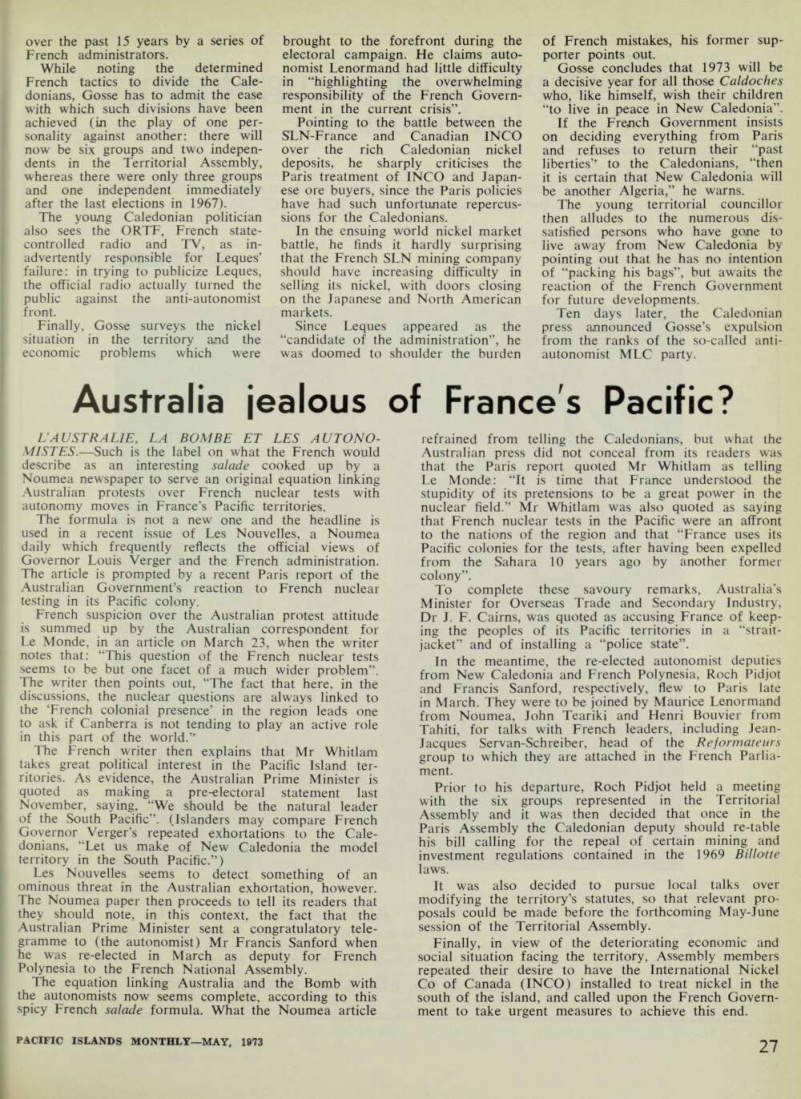
L’Australie, La Bombe Et Les Autono
MIST ES. —Such is the label on what the French would describe as an interesting salade cooked up by a Noumea newspaper to serve an original equation linking Australian protests over French nuclear tests with autonomy moves in France’s Pacific territories.
The formula is not a new one and the headline is used in a recent issue of Les Nouvelles, a Noumea daily which frequently reflects the official views of Governor Louis Verger and the French administration.
The article is prompted by a recent Paris report of the Australian Government’s reaction to French nuclear testing in its Pacific colony.
French suspicion over the Australian protest attitude is summed up by the Australian correspondent for Le Monde, in an article on March 23, when the writer notes that: “This question of the French nuclear tests seems to be but one facet of a much wider problem”.
The writer then points out, “The fact that here, in the discussions, the nuclear questions are always linked to the ‘French colonial presence’ in the region leads one to ask if Canberra is not tending to play an active role in this part of the world.”
The French writer then explains that Mr Whitlam takes great political interest in the Pacific Island ter ritories. As evidence, the Australian Prime Minister is quoted as making a pre-electoral statement last November, saying, “We should be the natural leader of the South Pacific”. (Islanders may compare French Governor Verger’s repeated exhortations to the Cale donians, “Let us make of New Caledonia the model territory in the South Pacific.”) Les Nouvelles seems to detect something of an ominous threat in the Australian exhortation, however.
The Noumea paper then proceeds to tell its readers that they should note, in this context, the fact that the Australian Prime Minister sent a congratulatory tele gramme to (the autonomist) Mr Francis Sanford when he was re-elected in March as deputy for French Polynesia to the French National Assembly.
The equation linking Australia and the Bomb with the autonomists now seems complete, according to this spicy French salade formula. What the Noumea article
refrained from telling the Caledonians, but what the Australian press did not conceal from its readers was that the Paris report quoted Mr Whitlam as telling Le Monde: “It is time that France understood the stupidity of its pretensions to be a great power in the nuclear field.” Mr Whitlam was also quoted as saying that French nuclear tests in the Pacific were an affront to the nations of the region and that “France uses its Pacific colonies for the tests, after having been expelled from the Sahara 10 years ago by another former colony”.
To complete these savoury remarks, Australia’s Minister for Overseas Trade and Secondary Industry, Dr J. F. Cairns, was quoted as accusing France of keep ing the peoples of its Pacific territories in a “strait jacket” and of installing a “police state”.
In the meantime, the re-elected autonomist deputies from New Caledonia and French Polynesia, Roch Pidjot and Francis Sanford, respectively, flew to Paris late in March. They were to be joined by Maurice Lenormand from Noumea, John Teariki and Henri Bouvier from Tahiti, for talks with French leaders, including Jean- Jacques Servan-Schreiber, head of the Refonnateurs group to which they are attached in the French Parlia ment.
Prior to his departure, Roch Pidjot held a meeting with the six groups represented in the Territorial Assembly and it was then decided that once in the Paris Assembly the Caledonian deputy should re-table his bill calling for the repeal of certain mining and investment regulations contained in the 1969 Billotte laws.
It was also decided to pursue local talks over modifying the territory’s statutes, so that relevant pro posals could be made before the forthcoming May-June session of the Territorial Assembly.
Finally, in view of the deteriorating economic and social situation facing the territory, Assembly members repeated their desire to have the International Nickel Co of Canada (INCO) installed to treat nickel in the south of the island, and called upon the French Govern ment to take urgent measures to achieve this end.