The Game Is Anything But
pp. 28-29 · Read in the full issue
Cricket In New Caledonia
Caledonian soccer fans are warming up to expect some tension-packed matches this season, with some particularly intriguing encounters in store now that several of the island’s star players have changed side. Of course, many matches, both local and international, will be staged in the Olympic stadium at Megenta. But the most fiercely contested events are likely to be those scheduled for the politball championship in the Territorial Assembly.
Among the most anxious observers will undoubtedly be members of the French administration and directors of the four French banks installed in Noumea. For both parties the stakes are high, since they rest upon the assembly’s decision whether or not to continue opposing Governor Verger’s call for the territory to undertake a second mammoth private bank loan from France, at a time when the local budget is being almost wholly consumed by the running expenses of a growing public service.
Since any new loan for development works could be up to SA9 million, the potential prize is being jealously watched by the four French banks, three of which have only come to the island in the past four years, attracted by the promised nickel expansion.
Concern at the situation has mounted as far as French Governor Verger’s administration is concerned: no sooner had the anti-autonomist, pro-administration side finished crowing the Gallic coquerico over their claimed 18 to 17 victory in the last
September territorial elections, than they find themselves now facing a 20 to 15 majority in favour of autonomy. With players changing allegiance like that, the Caledonian polit-ball game obviously just isn’t cricket!
Perhaps the best way to sum up the situation would be to quote latest side-swinger, Fredy Gosse, who claims that “There are no anti-autonomists in New Caledonia, there are only autonomists”.
Gosse, former supporter of Jean Leques’ MLC party, published a fullpage article mid-March in the SLN evening daily Noumea-Soir, Bulletin du Commerce, in which he tried to explain the recent defeat of Leques’
Anti-Autonomist Front in the March national elections. From the administration’s front defence line, Les Nouvelles daily paper instantly appeared with a front-page charge of Infidelite against Gosse. However, the territorial councillor’s reply, tucked away on the back page, pointed out that old personal rivalries and animosities weigh too heavily on Caledonian society, but that the leaders of the two rival clans—autonomist ex-deputy Maurice Lenormand and Noumea Mayor Roger Laroque— are now both over 60 years old, so that in five years time there will be many changes on the Caledonian political scene.
Fredy Gosse is a successful young Caledonian businessman. After studying law in France he joined the French administration in Noumea and has since become partner in a
Noumea real estate and business agency.
In his original full-page article, im mediately after Roch Pidjot’s victory over Leques, Grosse wonders why “over the past 15 years, all the gov ernors who have passed through New Caledonia have failed in their struggle against Lenormand”—Pidjot’s running mate and master-mind behind the Union Caledonienne autonomist party, Gosse also asks how Leques failed when he had the combined support of all three anti-autonomist groups and when the electoral body had been modified (with several thousand new voters registered, presumably mostly newcomers from France), It has taken Gosse six months in the Territorial Assembly to come out publicly and say he now realises he’s been playing for the wrong side. But six months of watching internal team tactics has convinced him of his past errors.
Gosse likes to call a spade a spade or, in typical Gallic culinary terms, refuses to put the “mustard label on what is really jam”. The principal reason for Leques’ defeat, he claims, was the choice of the label Anti-Auto nomist Front, since all the electoral platform, but for the label, was autonomist. Gosse believes that all Caledonians are autonomists at heart and that all groups are virtually aiming at internal self-government.
But the Caledonians have been divided and confused by misguided catchwords (decentralisation, econo mic autonomy) and other subtle terms which he alleges have been introduced
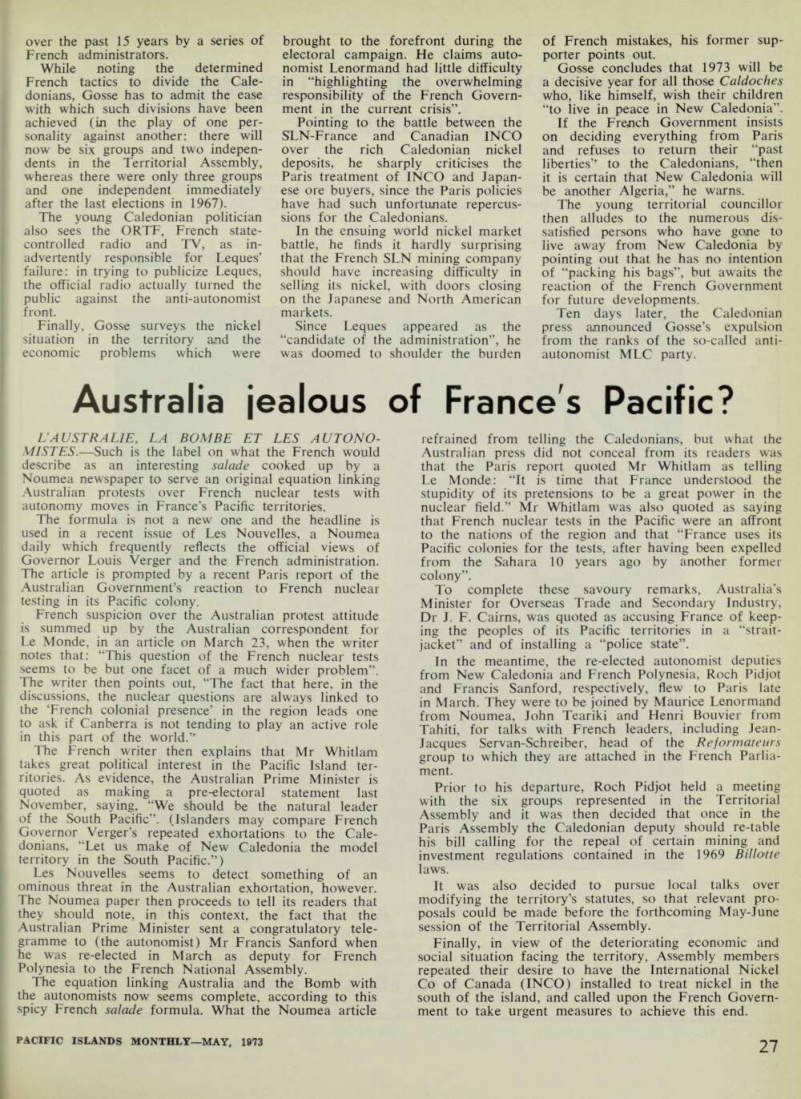
Tonga's ex-Finance Minister Mahe Tupouniua and his family who are in Suva. Mahe is the first Director of the South Pacific Forum's Bureau of Economic Co-operation. With Mahe and his wife Elenoa, who is a sister of Queen Mata'aho, are (standing) lesina, Mahe jnr and Eugene, and kneeling are, left, Nicolette and Sela.
over the past 15 years by a series of French administrators.
While noting the determined French tactics to divide the Caledonians, Gosse has to admit the ease with which such divisions have been achieved (in the play of one personality against another: there will now be six groups and two independents in the Territorial Assembly, whereas there were only three groups and one independent immediately after the last elections in 1967).
The young Caledonian politician also sees the ORTF, French statecontrolled radio and TV, as inadvertently responsible for Leques’ failure: in trying to publicize Leques, the official radio actually turned the public against the anti-autonomist front.
Finally, Gosse surveys the nickel situation in the territory and the economic problems which were
brought to the forefront during the electoral campaign. He claims auto nomist Lenormand had little difficulty in “highlighting the overwhelming responsibility of the French Govern ment in the current crisis”.
Pointing to the battle between the SLN-France and Canadian INCO over the rich Caledonian nickel deposits, he sharply criticises the Paris treatment of INCO and Japan ese ore buyers, since the Paris policies have had such unfortunate repercus sions for the Caledonians.
In the ensuing world nickel market battle, he finds it hardly surprising that the French SLN mining company should have increasing difficulty in selling its nickel, with doors closing on the Japanese and North American markets.
Since Leques appeared as the “candidate of the administration”, he was doomed to shoulder the burden
of French mistakes, his former sup porter points out.
Gosse concludes that 1973 will be a decisive year for all those Caldoches who, like himself, wish their children “to live in peace in New Caledonia”, If the French Government insists on deciding everything from Paris and refuses to return their “past liberties’’ to the Caledonians, “then it is certain that New Caledonia will be another Algeria,” he warns, The young territorial councillor then alludes to the numerous dis satisfied persons who have gone to live away from New Caledonia by pointing out that he has no intention of “packing his bags”, but awaits the reaction of the French Government for future developments, Ten days later, the Caledonian press announced Gosse’s expulsion from the ranks of the so-called anti autonomist MLC party.