Book Reviews
p. 85 · Read in the full issue
All The Way With Dad And
National Geographic
Life increasingly is not what it ; seems. High adventure that turns out to be commercial gimmickry is I so common that we have lost our [ capacity to be disillusioned about it.
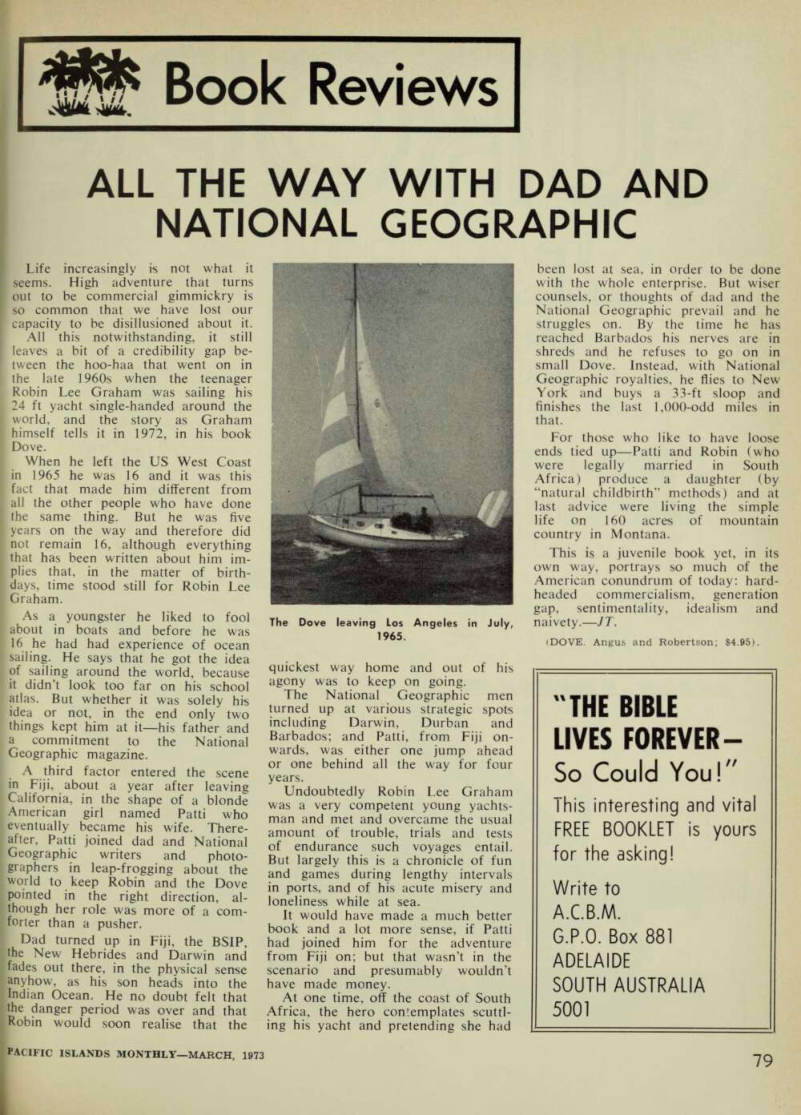
All this notwithstanding, it still leaves a bit of a credibility gap be tween the hoo-haa that went on in the late 1960 s when the teenager Robin Lee Graham was sailing his i 24 ft yacht single-handed around the world, and the story as Graham j himself tells it in 1972, in his book Dove.
When he left the US West Coast in 1965 he was 16 and it was this I fact that made him different from i all the other people who have done the same thing. But he was five years on the way and therefore did not remain 16, although everything that has been written about him im plies that, in the matter of birth days, time stood still for Robin Lee Graham.
As a youngster he liked to fool about in boats and before he was 16 he had had experience of ocean sailing. He says that he got the idea of sailing around the world, because it didn’t look too far on his school atlas. But whether it was solely his idea or not, in the end only two things kept him at it—his father and a commitment to the National Geographic magazine.
A third factor entered the scene in Fiji, about a year after leaving California, in the shape of a blonde American girl named Patti who eventually became his wife. There after, Patti joined dad and National Geographic writers and photo graphers in leap-frogging about the world to keep Robin and the Dove pointed in the right direction, al though her role was more of a com forter than a pusher.
Dad turned up in Fiji, the BSIP, the New Hebrides and Darwin and fades out there, in the physical sense anyhow, as his son heads into the Indian Ocean. He no doubt felt that the danger period was over and that Robin would soon realise that the
quickest way home and out of his agony was to keep on going.
The National Geographic men turned up at various strategic spots including Darwin, Durban and Barbados; and Patti, from Fiji on wards, was either one jump ahead or one behind all the way for four years.
Undoubtedly Robin Lee Graham was a very competent young yachts man and met and overcame the usual amount of trouble, trials and tests of endurance such voyages entail.
But largely this is a chronicle of fun and games during lengthy intervals in ports, and of his acute misery and loneliness while at sea.
It would have made a much better book and a lot more sense, if Patti had joined him for the adventure from Fiji on; but that wasn’t in the scenario and presumably wouldn’t have made money.
At one time, off the coast of South Africa, the hero contemplates scuttl ing his yacht and pretending she had
been lost at sea, in order to be done with the whole enterprise. But wiser counsels, or thoughts of dad and the National Geographic prevail and he struggles on. By the time he has reached Barbados his nerves are in shreds and he refuses to go on in small Dove. Instead, with National Geographic royalties, he flies to New York and buys a 33-ft sloop and finishes the last 1,000-odd miles in that.
For those who like to have loose ends tied up—Patti and Robin (who were legally married in South Africa) produce a daughter (by “natural childbirth" methods) and at last advice were living the simple life on 160 acres of mountain country in Montana.
This is a juvenile book yet, in its own way, portrays so much of the American conundrum of today: hard headed commercialism, generation gap, sentimentality, idealism and
naivety.
JT.
(DOVE. Angus and Robertson; $4.95).
The Dove leaving Los Angeles in July, 1965.