Aloi Pilioko and
pp. 79-80 · Read in the full issue
Pacific personality Aloi Pilioko and Pacific art
By NICOLAI MICHOUTOUCHKINE, interviewed by Marjorie Crocombe
Aloi Pilioko is a young artist from Uvea (or Wallis Island). He lives and works in the New Hebrides and travels extensively, researching, painting, decorating and exhibiting his work in the South Pacific as well as in Australia and Europe. Pilioko was born 35 years ago in the small village of Hihifo, the 13th of a large family.
His father was a Tufunga (or ta’unga or kahuna or what ever you like to call it in the various island languages)— a traditional craftsman with priestly and artistic roles. This is extremely interesting. As a Tufunga, he had developed a great sensitivity and his son Aloi Pilioko has inherited this same quality.
Pilioko worked as a plantation labourer in the New Hebrides and then in New Caledonia. In 1959 when I opened the first art gallery in the South Pacific in New Caledonia, Pilioko was living close by and he became a regular visitor to the gallery. One day we found him be hind a crate trying to draw with colours. I encouraged him. Later he started doing artistic, creative designs and for the last 13 years he has worked, first under my guidance and then he developed himself independently. He has been able to use various media, he has travelled throughout the South Pacific, living in New Guinea, Solomons, Marquesas, Fiji, Rotuma, Samoa, Tonga and the Wallis Islands, doing his work and searching for various interesting inspirations from South Pacific subjects.
M. How did you recognise that Pilioko had artistic talent?
N. Well, you see, I felt it straight away. First of all, he was an extremely shy boy, could hardly speak French but from the way he was spending hours, standing and gazing with his wide open eyes at all this new world that he was discovering, I could tell that he was moved by something. It was a kind of magic discovery for him and something similar I believe to that experienced by the first people who had the chance to discover that they could make designs, with mud and clay, on the walls of caves where our ancestors used to live. Pilioko got exactly the same fascination, that desire to express himself, and I feel that this was a wonderful thing to encourage. Most for tunately Pilioko also had that power, that tenacity in him self and whatever he has achieved he has not done it under my direction.
I have merely created a climate for him, but he has been searching for himself and in doing so he has tried various media to express himself. That’s how he has developed.
Furthermore, people have been discovering him and his kind of art, and have commissioned him to do various works in Tahiti, New Caledonia, the New Hebrides and Fiji. Also, his creative work is so deeply inspired by the South Pacific that he has been able to continue in that style.
M. Has Pilioko had art training outside the South Pacific?
N. A few years ago he was granted a scholarship to Europe by one of the visiting French Ministers who felt that this young man should be encouraged, but fortunately
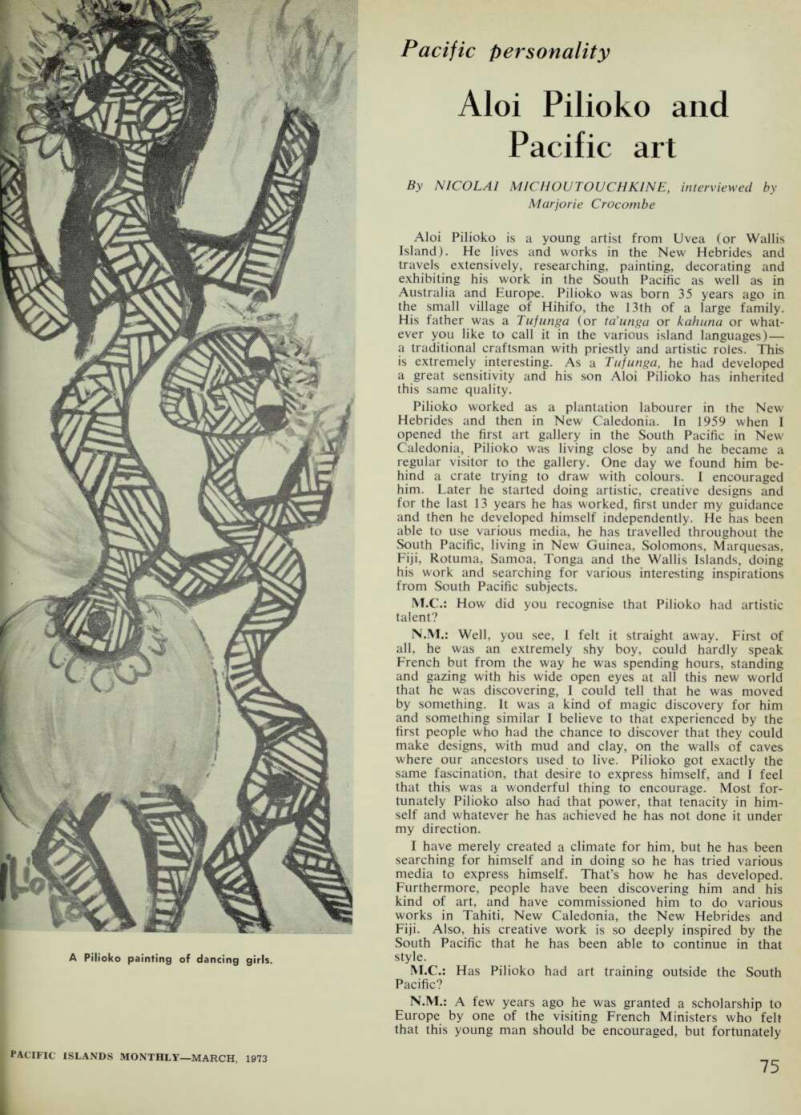
A Pilioko painting of dancing girls.
he didn’t just study the arts in Paris.
You see, Pilioko didn’t want to be come a European painter or artist.
He wanted to preserve that traditional South Pacific spirit and inspiration within himself. So he travelled with me to visit various places in the South Pacific, meeting both Mela nesian and Polynesian peoples, seeing their art and keeping in close contact with his own country. Later, when I was invited to have an exhibition in the Modern Art Museum in Paris.
Pilioko was invited too, because at the time he had already reached a kind of maturity and his work was extremely interesting. That was soon after he had started his tapestry work which is extremely original. There are not many people doing the same kind of work.
In Paris he got the chance to work in various studios with creative artists such as Lyn Vautrin in particular.
She is a lady who for many years has been doing research and trying to help craftsmen to discover new media, even using cellulosic things and carving jewellery. Pilioko under went training in making jewellery and he became one of her really brilliant students.
She was absolutely fascinated and much taken with Pilioko because he had the personality and at the same time he could adapt immediately to the new medium and he made jewel lery that was inspired mainly by the jewellery and ornaments found in the South Pacific; things like bracelets having the shape of a tooth or pig’s tusks, jewellery inspired by the shape of a whale’s tooth. Other jewellery drew their inspiration from Mela nesian and Polynesian shell ornaments.
Also, when travelling he has been
able to visit museums and many places of interest in keeping with the idea of preserving or respecting his traditions and his South Pacific spirit.
M. What is representative about Pilioko’s art?
N. First of all he started draw ing animals —fowls mainly, and then fish. Why fowls? He was very often questioned so one day he said, “Well, for me, fowls are like human beings.
I know these fowls, so I have been drawing something that 1 know”.
Very often therefore Pilioko has embodied fowls or hens with human spirit, so very often they have elon gated necks. The fowl is therefore something that is typical of Pilioko.
Gradually, as he has travelled, people have been introduced into his paint ings, drawings and tapestry. These people are mainly tattooed women from the New Hebrides, women from the markets, and from Malaita in the Solomons. Then gradually he has been painting some New Guinea people. Pilioko likes dancing and music, so he has often drawn dancing girls from Tahiti, Rarotonga, Samoa or Wallis and traditional ceremonies like the Kava ceremony. Market scenes feature a lot in his drawings and tapestry.
He started tapestry work in Rotuma. What kind of tapestry? It’s a little bit less than a tapestry and more than an embroidery. When we visited Rotuma in 1964 we ran short of paints and I asked him to let me have the paints for my work. So he looked around and found a big piece of copra sacking. The stores sold a lot of coloured wool which is used by Rotuman people to decorate their mats.
So Pilioko said, “What about if
I just take a copra bag needle and sew the wool on to the sacking?
I want to do some creative work.
That way I can leave you the paints.” 1 said, “Oh, well, try and see what happens”. And that’s how he made his first tapestry.
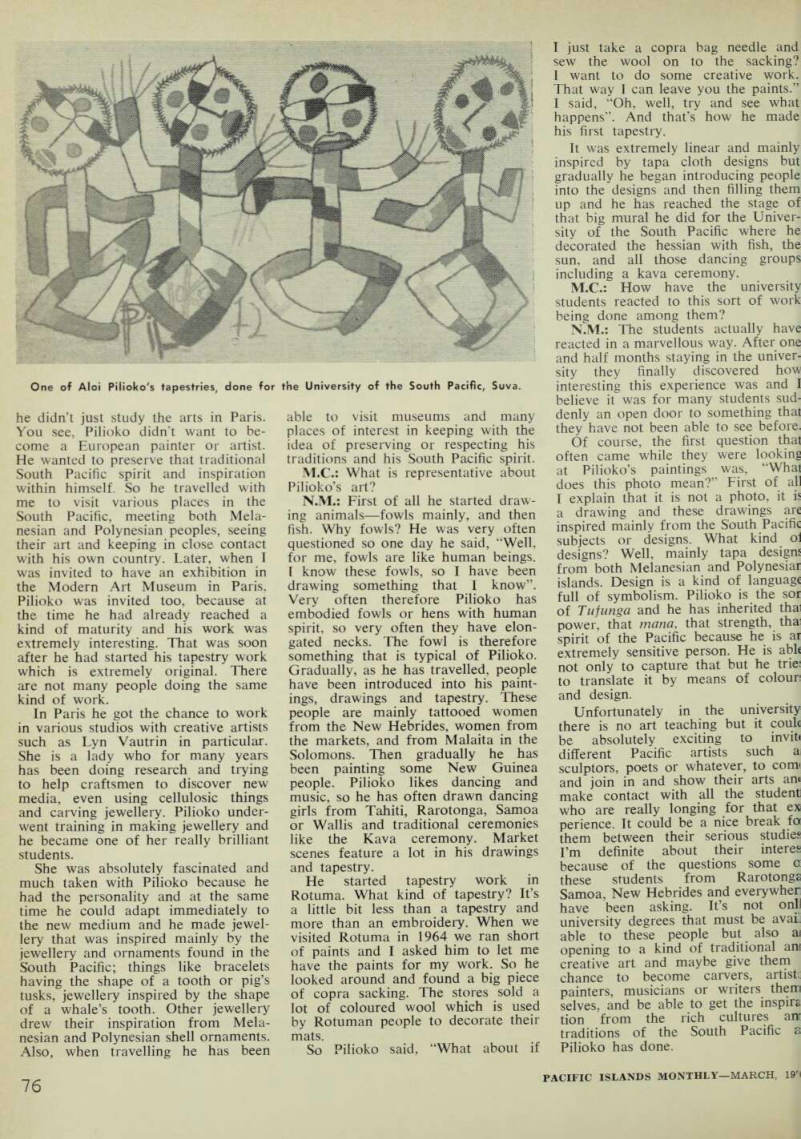
It was extremely linear and mainly inspired by tapa cloth designs but gradually he began introducing people into the designs and then filling them up and he has reached the stage of that big mural he did for the Univer sity of the South Pacific where he decorated the hessian with fish, the sun, and all those dancing groups including a kava ceremony.
M. How have the university students reacted to this sort of work being done among them?
N. The students actually have reacted in a marvellous way. After one and half months staying in the univer sity they finally discovered how interesting this experience was and I believe it was for many students sud denly an open door to something that they have not been able to see before.
Of course, the first question that often came while they were looking at Pilioko’s paintings was, “What does this photo mean?” First of all 1 explain that it is not a photo, it is a drawing and these drawings are inspired mainly from the South Pacific subjects or designs. What kind ol designs? Well, mainly tapa designs from both Melanesian and Polynesia! islands. Design is a kind of language full of symbolism. Pilioko is the sor of Tufunga and he has inherited thai power, that mana, that strength, thai spirit of the Pacific because he is ar extremely sensitive person. He is able not only to capture that but he trie; to translate it by means of colour: and design.
Unfortunately in the university there is no art teaching but it coulc be absolutely exciting to invite different Pacific artists such a sculptors, poets or whatever, to comi and join in and show their arts ant make contact with all the student who are really longing for that ex perience. It could be a nice break fo them between their serious studies I’m definite about their interes because of the questions some a these students from Rarotonga Samoa, New Hebrides and everywher have been asking. It’s not onll university degrees that must be avail able to these people but also ai opening to a kind of traditional am creative art and maybe give them chance to become carvers, artist; painters, musicians or writers them selves, and be able to get the inspirs tion from the rich cultures anr traditions of the South Pacific s Pilioko has done.
One of Aloi Pilioko's tapestries, done for the University of the South Pacific, Suva.