specials
pp. 94-100 · Read in the full issue
Nauru's schoolkids' specials
From Christopher Beck
in Melbourne Operating much like the special train and plane services put on by Australia’s railways and airlines to take country children to their out back homes at holiday time, the
Nauruan Pacific Shipping Line used two of its ships in early December to take Nauruan students home for the Christmas vacation and later, back again.
In shipping circles the voyag have been dubbed the “schoolk; specials”.
The first vessel to sail was i 9,994-ton Rosie D (ex-Triast British Phosphate Commissioner She sailed from Melbourne straij for Nauru on December 13, carry' 23 students. As well she earn general cargo, including what couldl described as “Christmas tonnage”' The Enna G, 9,341 tons, saii from Melbourne for Sydney with Nauruan students aboard the o before. In Sydney she picked another 34 Nauruan students. B< the Rosie D and Enna G were o at Nauru well before Christmas DE On their return voyages to At tralia they brought home, for tfci Christmas holidays, schoolteach: who have been working on the isls for the last year. At the end January, the Enna G was to fc; teachers on at Australian ports s transport them to Nauru and pick Nauruan students and the childreni Europeans who work on the isls republic to bring them back to A tralia in time for the beginning of 1973 school year in February.
NPSL officials are quick to po out that these are special moveme and for the rest of the year the shi operate on a cruising/general cai schedule from Australia through Pacific Islands, The cruising activities of the shi are well-developed. The Enna built in 1961 and operated by Holland-Amerika Line as the Prim Margriet until purchased for NPSL, has accommodation for passengers. She is a luxury vessea all her cabins have private facility Smaller, but no less comfortah the Rosie D, built in 1955 for BPC, has accommodation for people in private berths. A featf of the vessel is a special 100winch which, with other maintenar facilities, is used to overhaul intricate deep-sea mooring system j the Nauru coast.
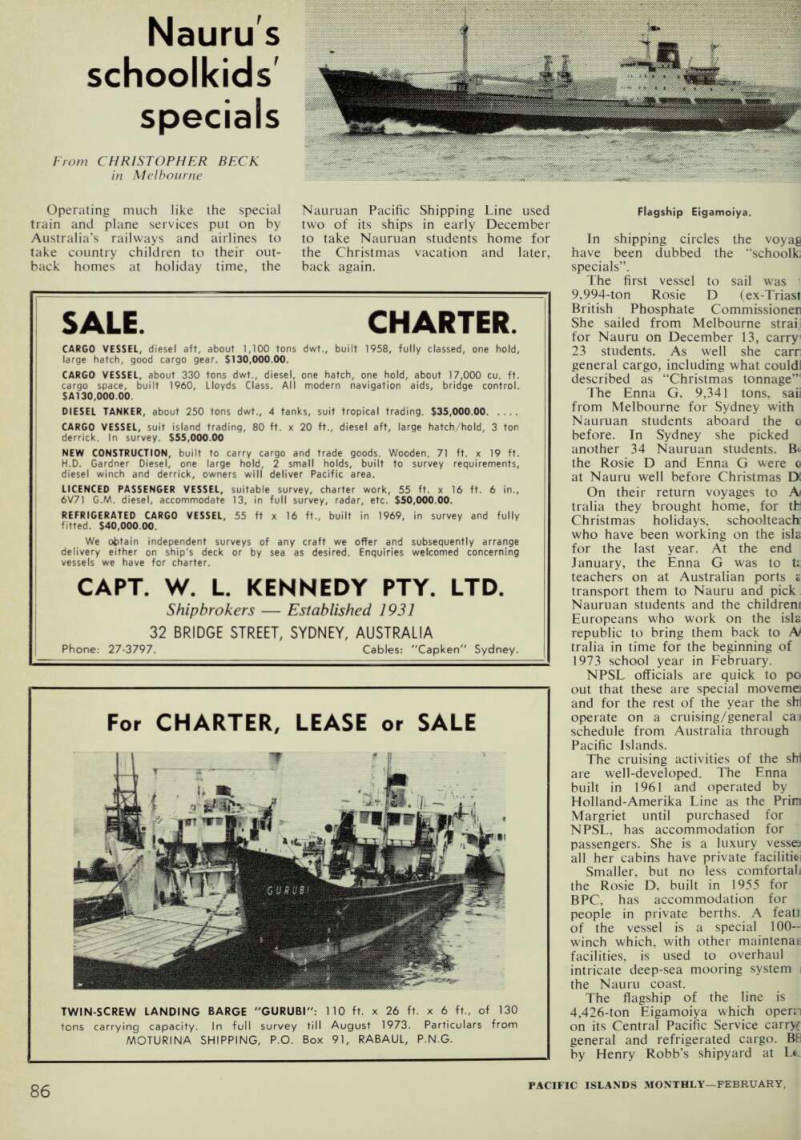
The flagship of the line is 4,426-ton Eigamoiya which opern on its Central Pacific Service carry{ general and refrigerated cargo. B 8 by Henry Robb’s shipyard at L^
Flagship Eigamoiya.
for the Nauru Local Government Council, the ship can carry 12 pas sengers in berths with private facilities.
The republic’s latest acquisition, the Cenpac Rounder, is mainly involved in trading in the Central Pacific area, taking transhipment cargo to Majuro in the Marshall Islands and carrying passengers within eastern Micronesia.
Suva will be her main cargo handling port.
From time to time the ship will be used on recruiting trips to the GEIC for labour for the phosphate mining and loading operations at Nauru.
Occasionally she will make trips to Hong Kong and Taiwan to pick up Chinese labour.
In March the line will take delivery of a new 31,000 tons bulk carrier, the Kolle D. The vessel was launched at the Namura Shipyards, in Osaka, Japan, by Madame Deßoburt, the wife of Nauru’s President on Dec ember 9.
Named in honour of Madame Deßoburt, the Kollie D will be used to transport phosphate from Nauru.
Built at a cost of S 7 million, the ship will have accommodation for eight people and a trial speed of 17.2 knots.
The line also operates two other vessels on charter, the 6,631-ton Hydra and the 2,178-ton Vavajo. The Hydra is used on the six-week Aus tralia-Papua-New Guinea-Guam run.
Its voyages begin in Melbourne and the ship calls at Burnie, Sydney, Brisbane, Port Moresby, Lae, Rabaul and Guam.
Operating on a short-term charter, the Vavajo carries cargoes of pine apples from Dadiangas in the Philip pines to Guam. The Hydra is a Norwegian-registered vessel while the Vavajo flies the Singapore flag.
Except for these two vessels, the rest of the fleet is owned by the Nauru Local Government Council.
They are all registered at Nauru and are managed by the Melbourne based Nauru Pacific Shipping Line, which is a management body for the Council. The NPSL’s head office is at 227 Collins Street, Melbourne.
Safia Flies The
Tongan Flag
The Pacific Navigation Co Ltd, of longa, has chartered the Safia from Narlander for three years, with an option to purchase at the end of the charter (PIM. Jan, p 77).
She left Sydney on December 27 on her first voyage for Pacific Navi gation for Fiji, Samoa and Tonga, and will maintain a four-weekly ser vice between those grouns and Aus raha. She was expected to be flying [ oe Tongan flag, following completion 01 .registration formalities, when she arrived in Australia late in January.
She was registered in Port Moresby and is now about to be re-registered as the Tauloto in Tonga. She has a greater cargo capacity than the pre vious ship on the run, also the Tauloto, which has since resumed its former name of Island Chief. The Pacific Navigation Co is looking for an increase in cargo carried from Australia to Fiji.
Stranded Havannah
Fought To The Last
The ex-Brisbane River cruiser Havannah, which has been trading around the New Hebrides for several years—until she ran on a sandbank near Mele village on Efate early last year—is now off the sandbank and at the bottom of the sea. She was dragged off the sandbank, towed into deep water and blown up with dyna mite. But she didn’t go without a struggle. Several times the tow line broke while the tug Roimata was pull ing her off the sandbank. The two day job began with pumping opera tions to lighten the cruiser and a channel was dug around her at low tide to make the sandbank collapse at high water. Then, as a bulldozer pushed her from the beach side, the Roimata began the long haul.
Pago's Million
Dollar Harbour Plan
More marshalling space for con tainers, and extension of the main dock so that more than one ship may unload at the same time are included in a $1 million harbour improvement plan for Pago Pago. There will also be better berthing for government and inter-island vessels.
Governor John M. Haydon re cently received approval from the Federal Economic Development Agency for harbour improvements.
On a long-term basis, the American
Samoa Government is considering re moving the oil dock—to remove an eyesore and noisemaker too close to the new wing of the Intercontinental Hotel for comfort and to reduce the danger of pollution to the bay.
Dear Petrol—Answer's
In The Wind
Reverting to sail in a Fiji becoming more and more sophisticated is a real possibility for the islanders of Kadavu, about 60 miles south of Suva.
The latest budget sent the price of petrol there soaring to more than $1 a gallon. A number of islanders said they could not afford such a high price, so would have to use their out boards for emergency only, and make sail their main method of travel at sea. A gallon of outboard motor petrol now costs 51.20.
Big Squeeze Feared
At Vila Wharf
Vila expects about 34 cruise ships to call in 1973, but lack of facilities at the new wharf is worrying the New Hebrides Association for tourism. There is not enough park ing for buses, which will provide much of the transport for the ex pected thousands of visitors, and the access road to the wharf is not yet finished.
The Burns Philp Travel Service in Vila says that in addition to the 34 confirmed ship visits this year, there could be more when final travel ar rangements were worked out.
Training For Tt
Is For The Few
In the tradition of the Islands young Micronesians in the Trust Territory are keen to become seamen.
But practical training at the Micro nesia Maritime Centre is only for a
Fijians Man Nauru's 'Enna G'
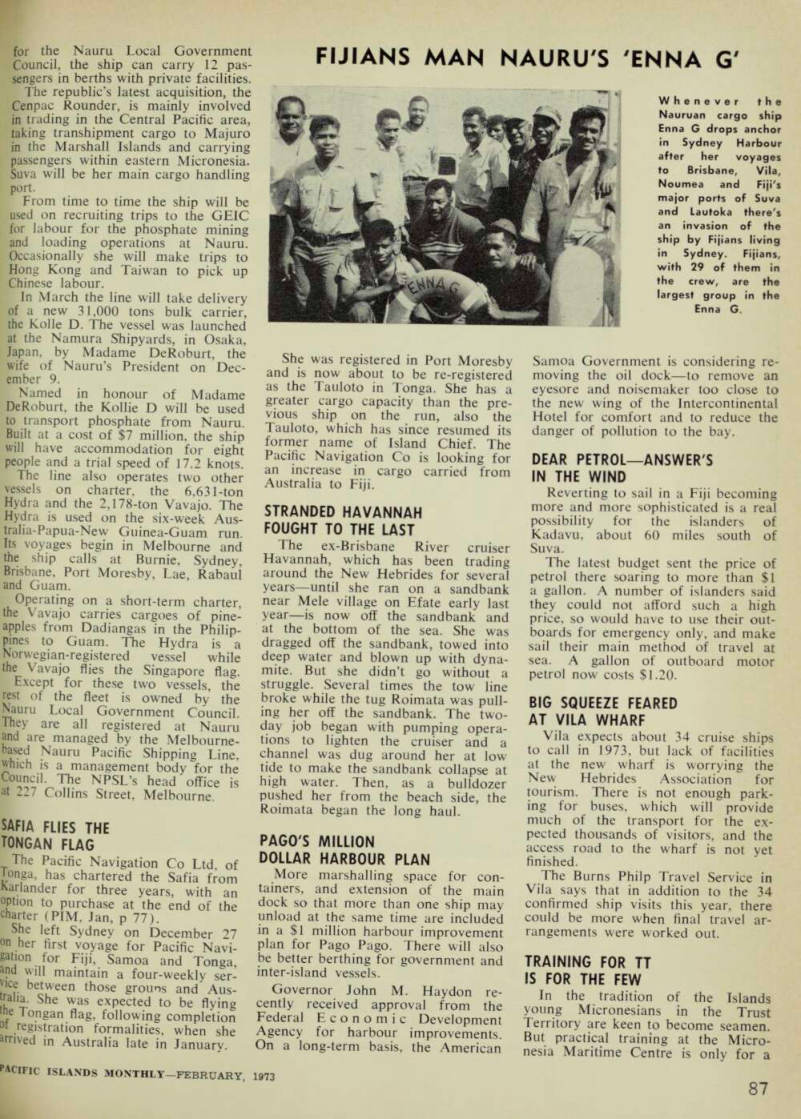
Whenever the Nauruan cargo ship Enna G drops anchor in Sydney Harbour after her voyages to Brisbane, Vila, Noumea and Fiji's major ports of Suva and Lautoka there's an invasion of the ship by Fijians living in Sydney. Fijians, with 29 of them in the crew, are the largest group in the Enna G.
few of them. Twenty trainees attend each graduating class. So far there have been four classes spread over two years, and more than 300 have applied for entry.
On graduation they work in TT and Transpac ships. They join as ordinary seamen. Some have become able seamen, while others have pro gressed to bosun mates.
The centre operates mainly aboard the m/v Pugh, formerly a US navy reefer vessel, which operated in the Vietnam rivers. In the first three graduating classes, 15 men were from Truk and one from each of the other five districts in the TT. In the fourth class the Truk contingent was reduced to 10, and other districts each sent two.
Mr Bill Williams, Truk District Vocational Education Supervisor, said he would like to include more men from other districts, but was limited by his budget. Selection of the students is based on the applicant having a genuine interest in the sea, scholastic records, references and interviews.
The course is comprehensive and covers tying knots, painting, operating masts and booms for loading and off loading, docking vessels, conducting lifeboat drills, firefighting, steering vessels, splicing cables and lines, learn ing how to anchor, learning about different types of anchors, seamanship terminology, first-aid at sea, and academic subjects such as English and mathematics.
Strike Upsets
The Three Bears
A five-week deck officers’ strike in November and December disrupted Pacific Far East Line schedules and the effects are still being felt. One Pacific Far East Freighter, Korea Bear, was laid up for several weeks, missing one planned voyage. Samoa Bear, expected in Auckland about mid-January was not due to arrive until the end of the month. America Bear, however, is expected to arrive on time on February 11.
Pacific Far East anticipates intro ducing its first LASH (lighter carry ing) vessel to the New Zealand run m mid-March, to be followed later by a second. Named the Thomas E. Cuff and the Golden Bear, they will re place three conventional vessels.
unionists clash
Over Greek Ship
The ACTU and the Victorian branch of the Australian Seamen’s Jnion are at issue over a proposal 0 use a Greek shipping line for Pacific [uises. The ACTU, supreme gov erning body of the trade union novement in Australia, and Thomas
Nationwide Transport, have set up a company to run Pacific cruises and plan to use ships from a Greek line, Chandris.
The Victorian secretary of the Seamen’s Union, Mr B. N. Nolan, said the union was opposed to the ruling junta in Greece. Any move to use Chandris ships would be re garded seriously. ACTU officials said a decision would not be made till maritime unions had been consulted.
Ironically, at the time of Mr Nolan’s statement, the ACTU presi dent, Mr Bob Hawke—with his wife and family and other prominent men in the trade union movement—was on a Pacific cruise in the Chandris ship, Patris.
Boat Drill Rules
Tightened In N. Hebrides
It is little use having a vessel adequately supplied with life-jackets if the passengers don’t know where they are or how to use them. That was the case when the New Hebrides launch, Good News, foundered re cently with the loss of two lives, an inquiry revealed.
Following the inquiry masters and bosuns of all British-registered ships in the New Hebrides have been told to hold life-jacket drill before leaving port. Crew and passengers have to be instructed how to use the jackets and other life-saving equipment on board.
Port Party For
The Capitaines
Sofrana-Unilines placed emphasis on “five” on January 16. It was the fifth anniversary of the founding of the company, and the schedules of the company’s five ships were ar ranged for them to be in Noumea that day for a celebration dinner. The dinner embraced all managements from Australia, New Zealand and the Pacific Islands, ships’ masters, officers and crews. And the five ships in Noumea for the occasion were the Capitaine Bougainville, Capitaine Tasman, Capitaine Scott, Capitaine Cook and Capitaine Wallis.