Pacific Shipping
p. 93 · Read in the full issue
Tarawa Talks Save Geic Training
Scheme And Lift Seamen's Wages
The seamen’s training scheme at Tarawa, which was menaced by boy cott threats from Australian and New Zealand maritime unions over a wage issue, has been saved. A conference at Tarawa between maritime unions, the GEIC Government and shipping firms, has ended in an agreement which gives a hefty lift to the Gil bertese seamen’s wages, and meets the Australian and New Zealand seamen’s objection to ships, working from Aus tralian and NZ ports, employing crews at cheap rates.
The new agreement, affecting 600 Gilbertese employed around the world by nine German shipping companies and sending home each year about half a million dollars, gives a five per cent pay increase across the board, higher overtime payment and two further increases in overtime rates to come during the three-year life of the agreement. They also get 35 days holiday for each year of service.
The minimum base rate for an ordinary seaman, fresh out of the traming school at Tarawa, is about S7O a month. The highest base rate, for a qualified able seaman is about 5162 a month. It has been estimated that the average amount remitted to u- * s a fi° u t $7O a seaman which, in a largely copra and fish economy—not to mention Ocean Island phosphates—adds up to quite a substantial sum.
Mr Charles Blithe, general sec retary of the International Transport Workers’ Federation, went from Lon don to Tarawa in December to help negotiate the new agreement. With him was Mr Tasnor Bull, a Federal organiser of the Australian Waterside Workers’ Federation.
Mr Blithe later told PIM in Aus tralia that he first became interested m the Gilbertese seamen about a year ago, when he learned a number of cm were working for German ship ping companies. They worked under an agreement similar to that for As, an seamen, and he thought it
should be bettered. The agreement had been negotiated for the seamen by a GEIC government officer.
Although he considered the officer had done quite a fair job, he thought a new agreement should be negotiated by a union officer, and made his views known to the UK Government. The UK Government then suggested that Mr Blithe should go to the GEIC to negotiate the new agreement. He agreed provided someone from the Australian WWF familiar with mari time conditions in the area, also attended.
Before sitting down with the ship ping companies’ representatives at Tarawa, he and Mr Bull had a quick look over the various islands. They soon decided there was little there except coconuts and fish, and copra prices were low. Therefore, he said they decided they would do nothing to jeopardise the seamen’s employ ment. Mr Blithe was satisfied with the result, which saw the pay far in advance of Hong Kong rates.
He described the Gilbertese as “bloody good seamen”. The German companies would like more of them, but there was a limit to the number the training school at Betio could handle.
During the negotiations a new union, the GEIC Overseas Seamen’s Union, was formed. It has since been registered in Tarawa.
The training school for the seamen was set up by United Nations and is financed partly by UN and partly by the UK Government. The German shipping companies involved, there are nine of them, make available at least two permanent instructors. The students have to take the German able seamen class examination, which is a prior condition of employment. This is quite a high standard.
After passing through the school they go to Germany, where they are “processed”, and allocated to ships which take them all round the world —container ships, tankers, etc.
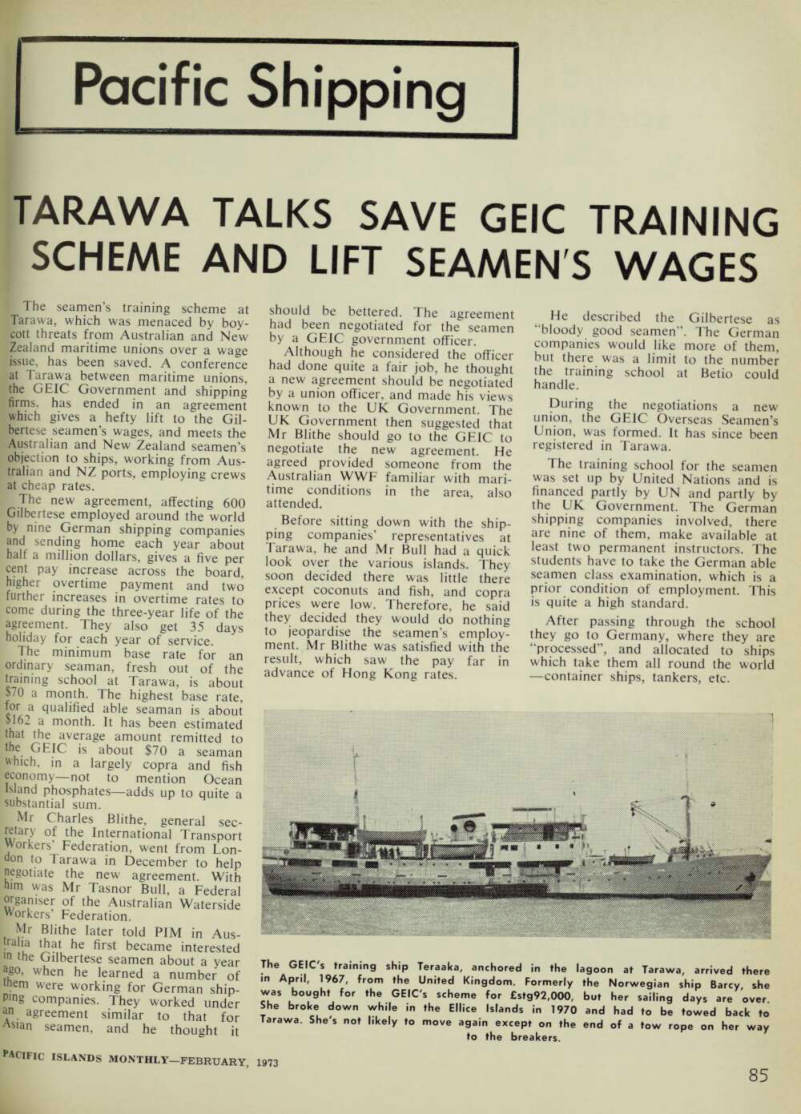
The GEIC's training ship Teraaka, anchored in the lagoon at Tarawa, arrived there in April, 1967, from the United Kingdom. Formerly the Norwegian ship Barcy, she was bought for the GEIC's scheme for £stg92,000, but her sailing days are over She broke down while in the Ellice Islands in 1970 and had to be towed back to Tarawa. She's not likely to move again except on the end of a tow rope on her way to the breakers.