Finding a[?]
pp. 28-29 · Read in the full issue
grass roots[?] government[?]
From a Port Moresby correspondent Constitutional or not, Papua Ne 1 Guinea’s Constitutional Plannir Committee—comprising 14 membei of the House of Assembly—i February will begin recording tl views of Papua New Guineai throughout the country.
A product of the third House ( Assembly, the committee is set n under neither Standing Orders nc any existing ordinance. But with a Australian Labor Government pre sing for self-government and indepei dence even more enthusiastically tha its predecessor, perhaps it was nece sary for constitutional niceties 1 be brushed aside in the interests < urgent constitutional reform.
The committee will glean the viev of the people in two ways: discussic groups comprising acknowledge leaders (about 20 to 30 groups : each local government council area will formulate their views and subm them to the Constitutional Plannir Committee; people also will be ab to send their views in written fori for the committee’s consideration.
It seems—according to a series < papers released by the Governmei Liaison Branch of the Office of tl Chief Minister—that as well : listening to the people’s thoughts, tl committee will be putting across i own views on what an independe: Papua New Guinea Constitutic should read like.
The committee’s attitude on tl ticklish question of “dual citizenshij is already firm—it rejects it, becaus as a statement from the Office of tl Chief Minister says, a dual citize “is a person who is a citizen of tv? countries, would have rights in tv? countries and owe loyalty to tv? countries.” i It notes in passing that whi Papuans “have the legal status • Australian citizens” very few ha T the right to enter Australia—a norm privilege of citizenship —so the Australian citizenship is “mere: nominal”.
It also states that people of wholl Papua New Guinea descent —havir parents and grandparents born in tl country—would automatically becon citizens. A problem it foresees is whr should be done with people with or
parent or one or more grandparents born in another country and holding another citizenship. As it says, if dual citizenship is not permitted, they would be excluded from citizenship.
And, it points out, some of these people, whatever their family back ground or citizenship, see themselves as New Guineans.
The committee offers no view in case of the product of a mixed marriage—of a New Guinean to a foreigner. “It seeks the views of the people on this question,” says the statement. And on naturalisation, the committee warns: “. . . Papua New Guinea should be careful about giving citizenship to foreign-born residents. ...”
In the committee’s deliberations over the next year special considera tion will be given to Papua New Guineas future relations with Aus tralia. The announcement in early January, by Labor’s Minister for Externa! Territories, Bill Morrison, mat Australian aid to Papua New Guinea after independence would be maintained at its present rate, suggests mat reciprocal “favoured nation” upon" 16111 haS already been a B r eed Other items the public is being
t 0 comment on include: an
ombudsman and tribunals of admini strahve review; a bill of rights; and protection of minority rights.
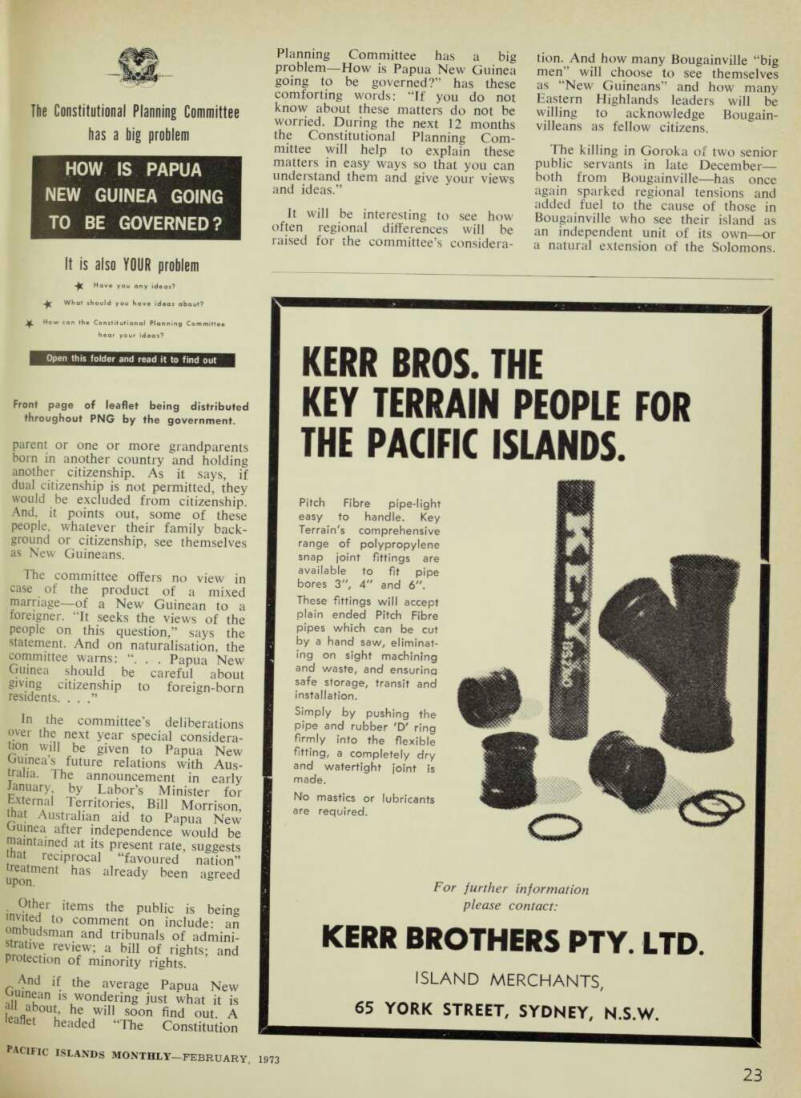
And if the average Papua New uumean is wondering just what it is kafl^° U K h ,f wi " soon find out - A 'eaflet headed “The Constitution
Planning Committee has a big problem—How is Papua New Guinea going to be governed?” has these comforting words: “If you do not know about these matters do not be worried. During the next 12 months the Constitutional Planning Com mittee will help to explain these matters in easy ways so that you can understand them and give your views and ideas.”
It will be interesting to see how often regional differences will be raised for the committee’s considera
tion. And how many Bougainville “big men” will choose to see themselves as “New Guineans” and how many Eastern Highlands leaders will be willing to acknowledge Bougain villeans as fellow citizens.
The killing in Goroka of two senior public servants in late December— both from Bougainville—has once again sparked regional tensions and added fuel to the cause of those in Bougainville who see their island as an independent unit of its own—or a natural extension of the Solomons.
Front page of leaflet being distributed throughout PNG by the government.