For But It's Sp Vagie Fpr The Villagers
pp. 23-27 · Read in the full issue


Ellice Separatists Put A Bold Case
By An Ellice Islander
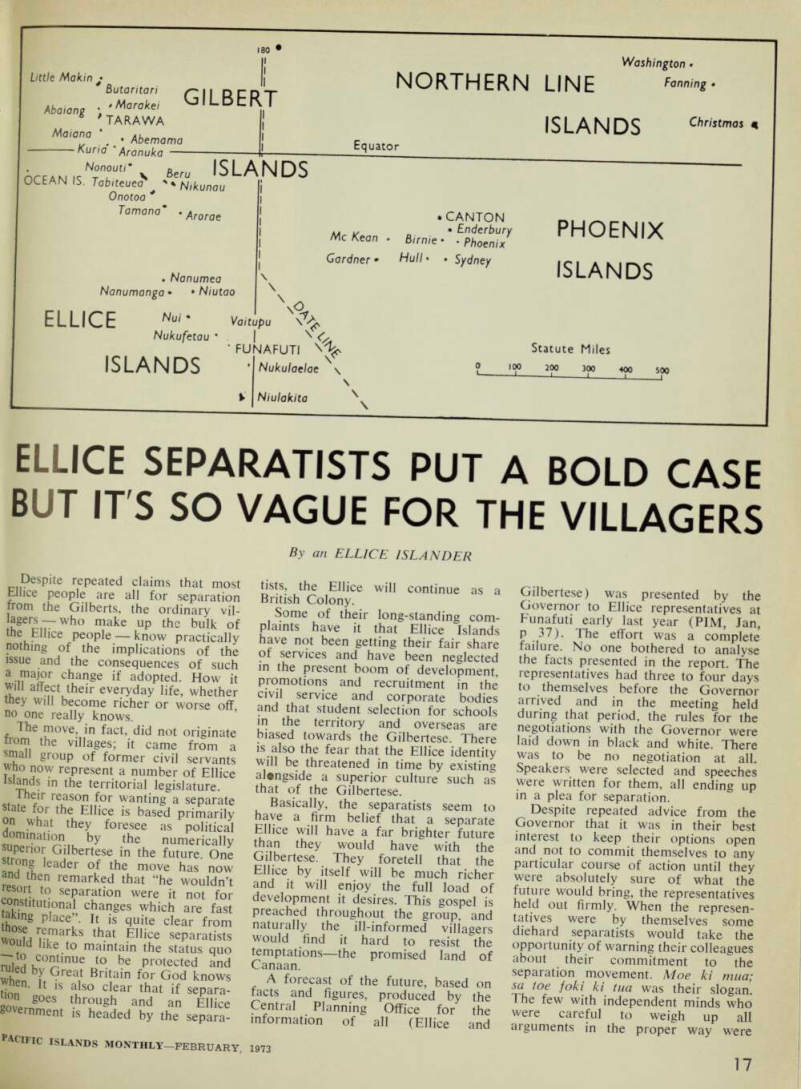
repeated claims that most Ellice people are all for separation irom the Gilberts, the ordinary vil lagers—who make up the bulk of the Ellice people know practically nothing of the implications of the issue and the consequences of such a ™ a £ r change if adopted. How it Wl affect their everyday life, whether they will become richer or worse off no one really knows.
The move, in fact, did not originate irom the villages; it came from a small group of former civil servants who now represent a number of Ellice istands m the territorial legislature. then- reason for wanting a separate state for the Ellice is based primarily on what they foresee as political k y numerically superior Gilbertese in the future. One f?9 n £ leader of the move has now ana then remarked that “he wouldn’t £® S n 0 c ? to separation were it not for ~H° na changes which are fast taking place”. It is quite clear from woiiH n?* a f ks that ? lllce separatists d like to maintain the status quo miln , co " tinue J°. be protected and whpn b rl reat Britain for God knows tinn 18 ¥ so c^ear that if separa oo"g®es f through and an Ellice government is headed by the separa
tists, the Ellice will continue as a British Colony.
Some of their long-standing com plaints have it that Ellice Islands have not been getting their fair share of services and have been neglected in the present boom of development, promotions and recruitment in the civil service and corporate bodies and that student selection for schools in the territory and overseas are biased towards the Gilbertese. There is also the fear that the Ellice identity will be threatened in time by existing alongside a superior culture such as that of the Gilbertese.
Basically, the separatists seem to have a firm belief that a separate Ellice will have a far brighter future than they would have with the Gilbertese. They foretell that the Ellice by itself will be much richer and it will enjoy the full load of development it desires. This gospel is preached throughout the group, and naturally the ill-informed villagers would find it hard to resist the temptations—the promised land of Canaan.
A forecast of the future, based on facts and figures, produced by the Central Planning Office for the information of all (Ellice and
Gilbertese) was presented by the Governor to Ellice representatives at year (PIM ’ Jan ? ~3 7)< 7116 eff ° rt was a complete failure - No on e bothered to analyse the faCtS presen . ted in the report. The representatives had three to four days l ° . th^ mselv / s . before the Governor srn5 rn . ved and in the meeting held during that period, the rules for the negotiations with the Governor were la,d d ° Wn in black and white - T^re was to be no negotiation at all.
Speakers were selected and speeches ™ ere Y ntt r Cn for the ™’ all endin g U P m a plea for separation, Despite repeated advice from the rnor that it was in their best interest to keep their options open and • n °i t t 0 commit themselves to any Particular course of action until they , were Cutely sure of what the f ut , are would bring, the representatives held out firmly. When the represen were by themselves some diebard separatists would take the o PP ortu nity of warning their colleagues about their commitment to the separation movement. Moe ki mua; tu % °! foki - & T Was thei f few with independent minds who were care f ul to weigh up all arguments in the proper way were
almost discarded. The gathering, ; a few saw it, was to foster the coun of a few diehard radicals and not proper representation of opinion fro a wide, cross section of the Elli< community.
The Ellice separatists would lil to part with the Gilbertese b certainly not with revenues that con from phosphate deposits at Ocej Island. They want to get their fa share of colony reserves which a invested (savings from phospha revenues). Presumably they wou also like to maintain employment f Ellice workers at Ocean Island ai the Republic of Nauru (a state mui closer to the Gilberts geographical and ethnically).
As if asking for a stick of tw tobacco from a friend, the separate make it a term of separation that t Line Islands become part of ai owned by the Ellice.
The full load of developme funds they hope to get depends < the mood and the willingness of t British aid-donors. Already t British Government has put a lin to the aid allocation available to t territory and the indications are th the restrictions will continue.
Undoubtedly the decision to wa out of the Gilberts will, in the er rest with the Ellice people. In f< they can walk out tomorrow shor they wish. But things are not goi to be just a matter of walking o like that, and one wonders if any the separatists realise this. Eve single term of separation the separati; wish to negotiate is clearly d advantageous to them. An exp< negotiator like Henry Kissinger wor hardly be expected to negotiate su terms, even if he were offered twi as much as he gets as president adviser.
Ocean Island from which revemi earning phosphate is extracted part of the Gilberts in all respec The island has ceased to be a sepan district; quite rightly it has becoi part of the Gilbert Islands Distr for administrative purposes with district officer (no longer comm sioner) in charge. By virtue of thi association with the Gilbertese, t Ellice Islanders have not on benefited from phosphate revenu but also have had access to jobs Ocean Island and Nauru. (It won be considerably cheaper to recr: from the nearby Gilbert Islands a surplus labour force). Nor has t Ellice a better claim on reserves fro phosphate revenues.
Parties to the negotiations would the British Government, the Gilbert; and the Ellice (or the separatist!
Would the Gilbertese leaders give i so easily to the Ellice demand tl
they continue to be benefited from phosphate earnings, even after separation? It’s a tough deal for the Ellice.
The Line Islands are going to play an extremely important role in future, separation or otherwise.
Gilbertese leaders are well aware of this. Fisheries and acquacultural schemes in the Lines have a better potential than either the Gilberts or the Ellice group. A resource survey is anticipated to take place soon covering all aspects of potential economic activities. Here again, would any reasonable Gilbertese bow down so readily to a suggestion that the Line Islands be taken away from them?
Although the British Government has made it plain on many occasions that it will be the Ellice people themselves who will determine their own future, it is most reluctant to see separation eventuate. It will cost the British taxpayer twice as much to ran two entirely separate administrations. Whether or not a separate Ellice government gets a share of phosphate revenues and reserves, it will be heavily grant-aided just to provide very modest services. If the money does not come from elsewhere, it must come from Britain.
'tl ft, . . tnTh* pnv er ese , ha , ve 9° objection to the Ellice people leaving provided
they don’t take away any of what the Gilbertese consider to be theirs.
The British are reluctant to bless the Ellice course because it will cost them more; (no one would like to pay twice as much for a tin of corned beef). It seems then that the separatists are struggling stubbornly against B r ® at odds, and with that goes the bulk of innocent villagers in the Ellice. What could the villagers do?
They are at the mercy of an allegedlyinformed elite, the separatists.
The allegation that the Ellice has been neglected in regard to essential services and development for ethnic reasons is unfounded. If the Ellice is Ce s ta ? n *o tr V e t* l6 bert Islands outside South Tarawa H 8?; Nukulaelae, in the southern tip tb e Ellice, is just as underdeveloped vui Tarawa. Like elsewhere in tne world, development has been con- Junr ° n headquarter stations on f “r 1 Tarawa which serves the rest 01 i . W k constltutl °nal progress there has b f en ve J[ y strong P°htical pressuie to push development out into r £ ra * areas > A™ thls is taking place effectively. 1 he survey carried out ? wh ere the two ethnic groups stand in regard to services provided, employment, educational opportunities and so on, in proportion to popu-
lations, was heavily in favour of the hard-working Ellice people And where does political domina tion fit in? It is said that as long as the Ellice and the Gilberts stay as one country, no Ellice Islander would hope to become Leader of Govern ment Business, or Chief Minister, or whatever you wish to call the future political heads. Democracy is going to get a firm footing in this country, The people are going to vote for the qualities of the candidate whether he is blue, violet or spotted. Opportunity is open to all. National policy on education, employment and the like is based on merit. There is no indica tion that these policies will be reserved, independence or no indepen dence. There is a handful of reliable, fair-minded people (Gilbertese and Ellice) who, if kept in power, will make sure that those values of democracy are entrenched in the roots of society, The Ellice demand to have equal representation of both ethnic groups in the territorial Legislature is un reasonable and undemocratic. The present system of island representa tion with two representatives for more populous islands (only three) is the fairest one can exnect to hnvp in the circumstances of this territory
ortfon to
population of the two groups is very much in favour of the Ellice. Eight people represent 7,000 people in the Ellice while 20 represent some 48,000 Gilbertese. Nukulaelae with 350 people is represented by one member compared with one for 2,408 at Nonouti, two for 4,419 at Tabi teuea and two for 12,600 in South Tarawa and Ocean Island.
The Ellice people of today cannot be blamed for associating the Ellice with the Gilberts from the beginning.
Both Gilbertese and Ellice Islanders of the day agreed blindly to the British proposal to administer the islands as one entity, entirely for the convenience of the British Govern ment, without regard to the differences of the two ethnic groups. Some people today see this to be extremely ad vantageous culturally, despite the fact that this was more or less forced upon their ancestors by the foreigners.
Fiji, with a far more complicated multi-racial situation than that of the Gilbert and Ellice Islands, enjoys a very healthy multi-racial culture.
The same can be said of the Gilbert and Ellice Islands.
Why is it that the Ellice separa tists want to part with the Gilberts but remain steadfastly with Great Britain? The Gilbertese did not press for constitutional changes because they wanted to dominate the numerically inferior Ellice politically or otherwise. Like their neighbours all over the Pacific, the Gilbertese, quite rightly, are conscious of the fact that these islands belong to them and so they should have the final say in everything which affects their lives, and shake off the blunt sword of colonialism.
It is clear that while they deplore political domination by the Gilbertese, the separatists would love to continue to be politically dominated by the British who, in the main, know nothing about their existence. While the dominated people of the world today work towards freedom from their masters and have everything their way, the separatists would bow to colonialism. Is that because the separatists put more value on the £ sterling than on their own values and pride?
The separatists have been putting forward their case very boldly, but their case has been based entirely on their own personal emotions and personal grudges rather than on hard facts. One wonders, however, whether the separatists themselves realise how weak their case looks at one end of the bargaining stick, and whether they are aware of their full responsibility should the villagers find out that they are worse off with a separate Ellice Government.