Tropicalities
pp. 12-17 · Read in the full issue
PAG liberates women's Lib
By A New Guinean
Correspondent It could prove more difficult than merely passing laws to make women men’s equals in Papua New Guinea.
Throughout the length and breadth of the country the tradition is that women should only be seen but not heard; that women should be seen to do things for the family and husbands such as work in the gardens, carry firewood, prepare food, rear and care for children and, in general, obey every command of their husbands.
The man’s role has always involved use of his strength and muscles: tak ing part in tribal warfare, hunting for pigs and other wildlife, fishing, build ing houses—activities a woman would normally hesitate to undertake.
And in tribal discussions, women normally keep in the background, preparing food for the men. Women normally do not talk at Local Gov ernment Council meetings or other village public meetings. They are ex pected to agree with decisions taken by the men even if it means sacrific ing their own interests to please the men.
In some Asian countries women have equal rights with men and in India and Ceylon they even hold the most important jobs. Australia’s recent move toward granting women equal pay for equal work is another example of growing equality for women.
But in Papua New Guinea many expatriates doubt that the local women will ever be regarded as equals by their menfolk.
However, the passage through the last House of Assembly of three bills aimed at raising the status of married women in the PNG Public Service is a great step forward. But, signific antly, their passage was not plain sailing. They met stiff opposition from the opposition United Party rank and file, particularly from the more con servative Highland members who claimed the only useful purpose for
women was to “karim lek na lukau tim pik (make love and care for the pigs)”.
Mr Joe Paul Langro, the official spokesman for the United Party and the Member for West Sepik Regional, bluntly said that a woman’s job was in the kitchen.
He said: “As far as Papua New Guinea is concerned, women are always regarded as the lowest in the family. I do not want this concept of Western civilisation to give equal rights to women as are given to men.
Men must get first priority in the society and not women.”
The only woman parliamentarian, Miss Josephine Abaijah, put up a very strong case for women’s rights amid interjections and heckling from both sides of the House. The bills, she said, were a “big step forward in casting out some of the discrimination against women in the Public Service.”
Said Miss Abaijah: “In our country we want to see men and women work together in nation building and make our manpower resources and educa tion resources as productive as pos sible.”
Said an interjector: “A woman’s place is in the kitchen and the bed room.”
There have been several unsuccess ful earlier attempts in the House of Assembly to give the women some status. In the second House of Assembly sitting in 1968-69 there was a move to give women some role in the political development of the country.
Some of the strongest opposition on that occasion came from Mr Kaibelt Diria, now Minister for Post and Telegraphs. Mr Diria said then that women should never be allowed to become equal because it would be against the social culture and tradi tion of the people.
In pidgin he said: “Meri i-no save go pas long pait. Man tasol i-save go pas long pait. Meri em wok bilong em lukautim pikinini na givim susu long pik, na biling karim lek tasol (Women do not lead tribal warfare.
Only men lead tribal warfare. Women are meant to raise children, feed the piglets and to make love).”
When the laughter subsided and the debate ended, the Highlanders’ vote swayed the issue against the reformers.
Now that the latest move to im
prove the lot at least of the female Public Servant has succeeded, “foreigners” in PNG, who viewed the steps taken by Chief Minister Michael Somare to give women a “fair go”, are wondering just how far the male dominated legislature will go along the road to total equality.
The process they feel may continue while the Public Service is under the Australian Government’s umbrella.
But whether the same treatment will be given to women in a Papua New Guinea under the “Black Colonialists” is something for which we’ll have to wait and see!
When the bank
broke at Rarotonga
Everyone’s heard of Australia’s famous Pub with no Beer, but not many have heard of Rarotonga’s bank with no money.
This is what happened there over the Christmas period when everyone descended on the National Bank of New Zealand to withdraw their savings and wages for the holidays.
Recently, the government intro duced the Cooks’ own coins to the currency, the New Zealand coins in use being phased out. This meant that as coins of the two currencies went into the bank, they were separated and only the “Tangaroa” currency remained in circulation.
Unfortunately, it appeared that not enough new coins arrived and a week before Christmas the bank found itself very short of notes and began reissuing the old coins. A plane arrived from New Zealand with more new coins, but these went out of the bank soon after arrival, and the bank was back where it started.
After Christmas, the money started flowing in the opposite direction— back into the bank—and the staff was left once again with the unenviable task of sorting the two sets of coins.
Naur a enters
a new era Nauru celebrated five years ofl independence and prosperity on January 31 and looked forward to an even more prosperous five years in which it hopes to strengthen its business ties with Japan.
A decade ago Japanese crews of ships calling at Nauru would not have been allowed to land. Memories of World War II were strong, and many Nauruans remembered the hardships inflicted on them during the occupancy of the island by Japan’s military forces and the deportation of most of them to Truk, where a great many died.
The sailors would not, probably, have been in danger of life and limb from the Nauruans, who despite their history of violent romping among themselves in the last century, are a very hospitable people. Until recent years, though, they would rather not have been reminded of World War 11.
Not that you can escape being reminded of that war if you visit or live in Nauru. The captured British guns re-installed in Nauru by the Japanese for their own defence are still rusting quietly away. Excavations for new buildings are still fraught with the possibility of digging up another unexploded American bomb.
The island fringe has, in addition to the airport now in use and much im proved on its wartime beginnings, several useful flat areas marking where the Japanese had started to build a whole series of airstrips around the island.
But now a new age has dawned.
Japan buys a substantial part of Nauru’s phosphate output. She pro vides maintenance for Nauru’s grow ing shipping line. She is soon to deliver Nauru’s first large ship, the 30,000 ton Kolle D, built at Osaka at a cost of $7 m.
To handle the increasing flow of dealings with Japanese business firms and the Japanese Government, Nauru maintains a resident consul, Mr Theodore Moses, in Japan. And early in December, Mr Shizuo Saito, who is the Japanese Ambassador to Australia, presented credentials to President Hammer Deßoburt in Nauru, establishing him also as Japanese Ambassador to Nauru. At
a luncheon given by the new ambas sador at the Beneng Hotel in Nauru, reference was made to increasing ties between the two countries, especially with the air service provided by Air Nauru to Kagoshima. In reply to a toast, President Deßoburt said; “We, the Nauruan community look forward to many years of warm and close relationships with our friends, the people of Japan.”
Hell’s not so
bad after all
Interpretations of life hereafter are many in the present technological world of ours. Here’s one from the village people of Angoram in the East Sepik District of Papua New Guinea.
Assistant District Officer, F. B.
Donovan, at Angoram recently, talked to some people in the Angoram area and the topic of life hereafter, heaven, or hell was raised.
Donovan said that in Primary School he said he had been told that hell was a place of fire in the earth’s centre. Similarly, heaven was a place in the clouds.
Intently, Donovan listened as vill agers told him of their interpretation of hell.
The people said they had seen their “Hell" and it was a lovely island with a volcano, their idea of hell being a place of fire. This fitted well with the fiery volcano on Manam Island,
a few miles from New Guinea’s north coast.
The volcano on Manam Island erupts and for the most part this was a good sort of hell. Therefore, they were not perturbed at spending their hereafter on Manam Island if they left for the hereafter in a “state” that warranted their spirits going to hell.
They told Donovan they were proud of the fact that they knew the pros and cons of their Papua New Guinea hell whereas other expatriates and Donovan did not.
Donovan described this as a case of a well-intending missionary bring ing religion and descriptive adjectives a little too close to grass roots level.
Cakobau to
Cakobau
Ratu Sir George Cakobau, KCMG, was sworn in as the first Fijian Governor-General of Fiji on January 13. As the Fiji Times said: Once more a Cakobau heads the nation.
Although there have been numerous outstanding Cakobaus in between, the newspaper was referring to the first Cakobau who, in 1874, ceded Fiji to Queen Victoria and who, for 40 years before that, had been the most power ful man in Fiji.
According to Derrick, Fiji historian and geographer, that Cakobau was born Seru, son of Ratu Tanoa who became chief of Bau, but who was deposed and exiled in 1832. Seru
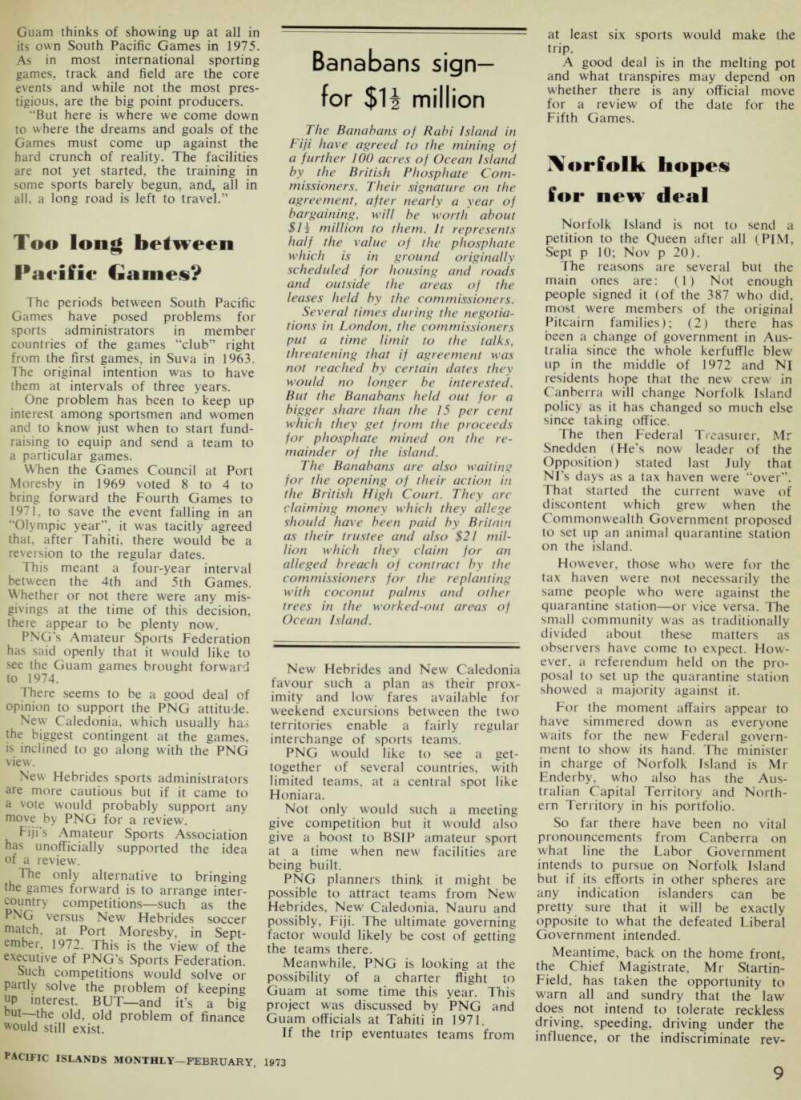
Nauru's new stamp to mark its fifth year of independence.
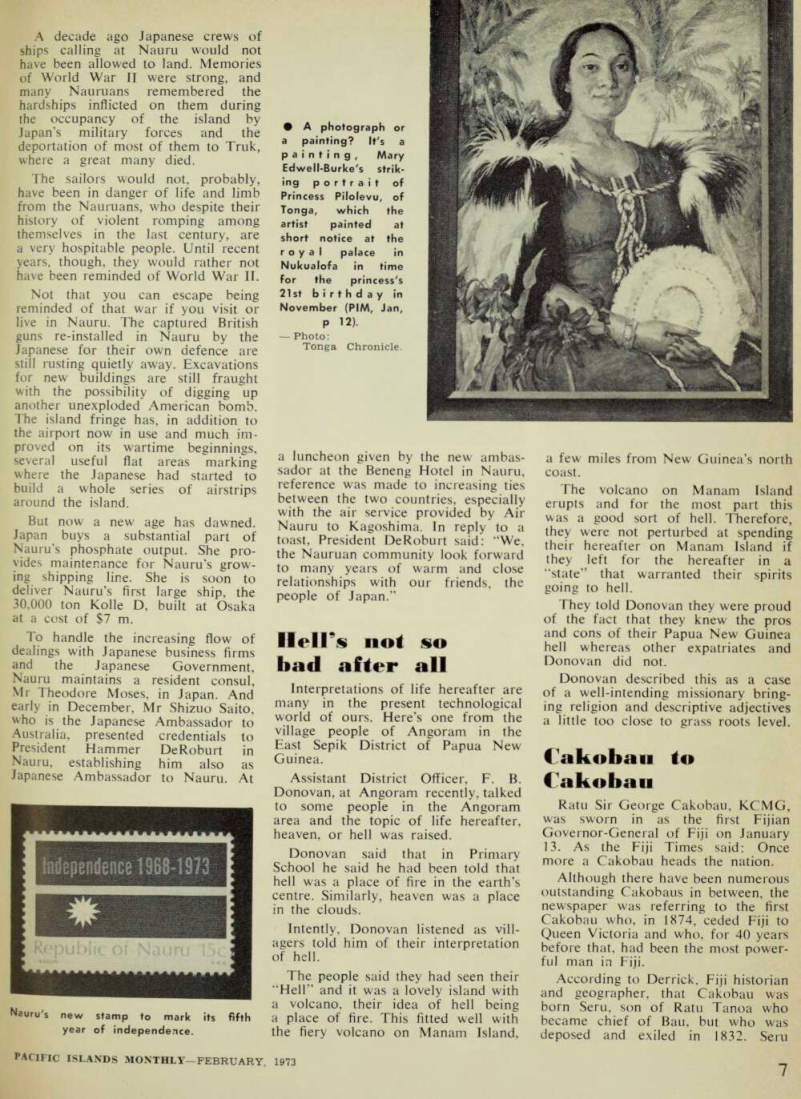
A photograph or a painting? It's a painting, Mary Edwell-Burke's strik ing portrait of Princess Piiolevu, of Tonga, which the artist painted at short notice at the royal palace in Nukualofa in time for the princess's 21 st birthday in November (PIM, Jan, P 12).
Photo: Tonga Chronicle.
remained in Bau and bided his time and when aged about 18 staged a bloody coup of his own and restored his father to his old position. Seru thus acquired the name of Cakobau —“destroyer of Bau.”
The new Governor-General is a great-grandson of the first Cakobau.
He was born in 1912, educated in Fiji and at Newington College, Sydney and entered the Fiji Civil Service in 1936. War service took him to the Solomons in 1944; and in 1960 he was installed as Vunivalu at Bau—the Paramount Chief of Fiji.
Before his installation as Governor- General, he went to London where in December, 1972, he was knighted by the Queen.
The main speech at his inauguration on January 13, was made by Fiji’s Prime Minister, Ratu Sir Kamisese Mara, one of whose ancestors, also Kamisese Mara, was hanged by the first Cakobau in 1859.
The appointment of Ratu Sir George has pleased all Fijian traditionalists who feel that the wheel has now come full circle and that it is fitting that the highest chief in the land should have the top job.
Ratu Sir George succeeded Sir Robert Foster, KCMG, who became Governor of Fiji in 1969 and who stayed on after independence on October 10, 1970, as first Governor- General of the new Dominion of Fiji.
Sir Robert and Lady Foster left Fiji on January 12. They plan to spend a couple of months in England and then iive permanently in Portugal’s Algarve, where they are building a house. They were respected and liked not only in Fiji but in the Solomons, New Hebrides and the Gilbert & Ellice Islands. From 1964- 1968 Sir Robert was High Commis sioner of the Western Pacific, with headquarters in Honiara.
Fashions Pasefika
parade in Pa^o
Original fashions with a Polynesian air were seen in Pago Pago recently.
Fashions Pasefika was the title of the show presented by the Pago Pago chapter of the Pan Pacific South East Asia Women’s Association in Decem ber. The showing, held in Samoa’s historic Government House, included a historical review of Samoan dress as well as modern uses of Polynesian prints and designs.
Traditional Samoan tapa prints were widely used, not only in the Samoan puletasi, the most popular form of everyday dress for Samoan women, but also in pants suits and even a Polynesian version of a Mexi-
can poncho. All fashions in the show were designed and made by PPSEAWA members and modelled by local models.
Inter-mixed with the original creations were examples of Polynesian dress from the past, including the traditional pandanus—cloth dress of the Samoan taupou as well as dresses of real tapa.
The fashions were sold to some of the 200 persons who viewed the affair.
The money will be used to send Samoan delegates to PPSEAWA’s convention in Korea.
Head plant«-viru§,
hormone or bomb?
It’s a virus, it’s a hormone, it’s a . . . it’s time to try again to decide just what it is that is killing off a variety of plants including the papaw on New Hebrides’ Tanna Island. And
while agricultural officers remain con fused on Tanna, there’s something more akin to fear on Pitcairn Island where banana palms and melon vines are turning black and shrivelling.
After all, by Pacific standards, Mururoa is not all that far away— about 600 miles to the north-west.
Back on Tanna, they sent samples of ailing plants to Noumea and Kew Gardens in Britain for analysis.
Said Noumea, firmly: It’s a virus, it’s carried by a minute black insect and the best thing for it is white oil.
Said Kew, equally firmly: It’s the result of the use of a hormone weed killer and here’s a couple of hormones we think have been used. . . .
A third opinion, maybe?
In the meantime the prescription on Tanna remains white oil. And on Pitcairn, last year’s nuclear tests will continue to get the blame until the analyst comes up with another reason —if there is one.
Guam thinks of
1975 Games
Tentative plans for a multi-million dollar sporting complex for the 1975 South Pacific Games in Guam have finally been revealed. The new com plex, which will drastically alter the sporting environment on Guam, is expected to cost from SUSS to SUS 7 million.
Plans call for a sports arena which will seat over 5,000 spectators, a football/soccer field surrounded by a running track, a regulation baseball/ softball field, six to eight tennis courts and lighted outdoor basketball and volleyball courts.
But planning for the much needed facilities leaves “much to be desired”, according to a Guam correspondent.
In the financing area, Dennis Zer meno, chairman of the facilities com mittee, said their hopes are pinned or a planning appropriation from the Guam Legislature so that planning can begin early 1973. If an architect is hired, he said, the complex woulc be finished by February, 1975, abou: five months before the Games are scheduled to begin. But ideas are stil being raised about off-island financia sources for the complex, and some hasty organising is underway to se; up a governing body to oversee the Games.
In Guam’s Pacific Daily News re; cently, sportswriter Jim Eggenspergei shed some light on how Guam sports; men are themselves preparing for the events: “Some system of training track ano field athletes is desperately needed ii
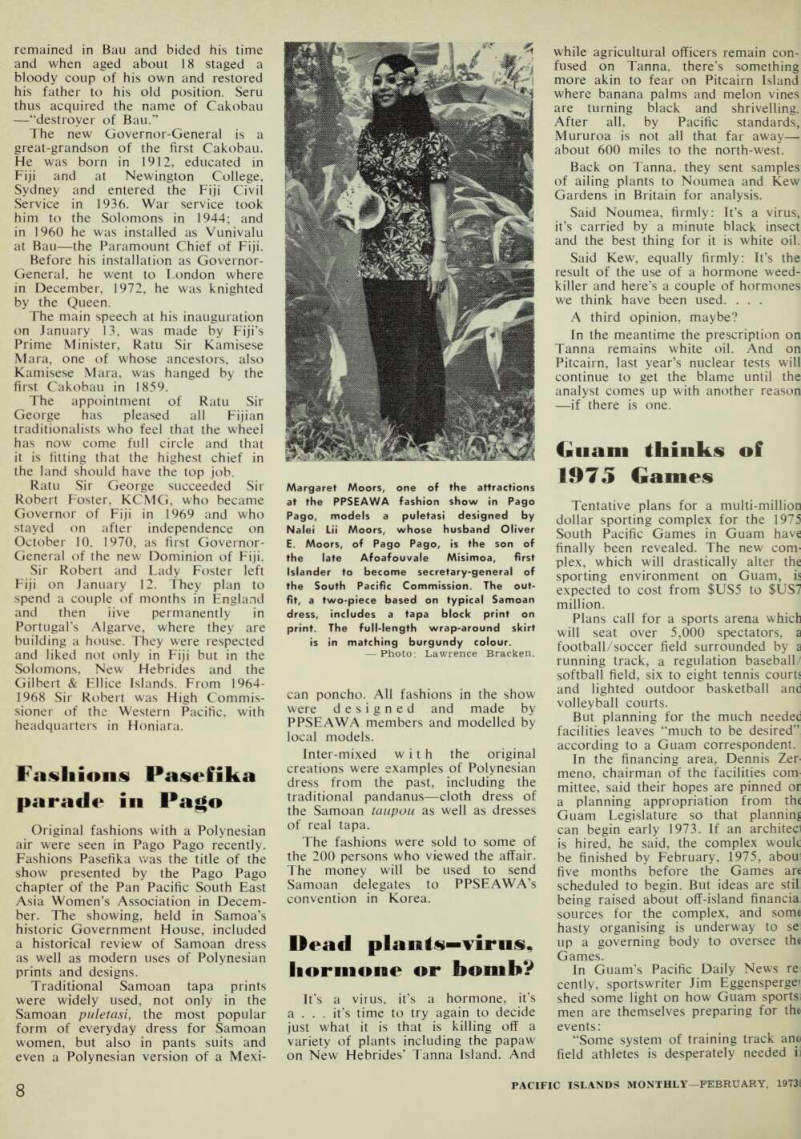
Margaret Moors, one of the attractions at the PPSEAWA fashion show in Pago Pago, models a puletasi designed by Nalei Lii Moors, whose husband Oliver E. Moors, of Pago Pago, is the son of the late Afoafouvale Misimoa, first Islander to become secretary-general of the South Pacific Commission. The out fit, a two-piece based on typical Samoan dress, includes a tapa block print on print. The full-length wrap-around skirt is in matching burgundy colour.
Photo: Lawrence Bracken.
Guam thinks of showing up at all in its own South Pacific Games in 1975.
As in most international sporting games, track and field are the core events and while not the most pres tigious, are the big point producers.
“But here is where we come down to where the dreams and goals of the Games must come up against the hard crunch of reality. The facilities are not yet started, the training in some sports barely begun, and, all in all, a long road is left to travel.”
Too long between
Faeifie Games?
The periods between South Pacific Games have posed problems for sports administrators in member countries of the games “club” right from the first games, in Suva in 1963.
The original intention was to have them at intervals of three years.
One problem has been to keep up interest among sportsmen and women and to know just when to start fund raising to equip and send a team to a particular games.
When the Games Council at Port Moresby in 1969 voted 8 to 4 to bring forward the Fourth Games to 1971. to save the event falling in an “Olympic year”, it was tacitly agreed that, after Tahiti, there would be a reversion to the regular dates.
This meant a four-year interval between the 4th and sth Games.
Whether or not there were any mis givings at the time of this decision, there appear to be plenty now.
PNG’s Amateur Sports Federation has said openly that it would like to see the Guam games brought forward to 1974.
There seems to be a good deal of opinion to support the PNG attitude.
New Caledonia, which usually has the biggest contingent at the games, is inclined to go along with the PNG view.
New Hebrides sports administrators are more cautious but if it came to a vote would probably support any move by PNG for a review.
Fiji’s Amateur Sports Association has unofficially supported the idea of a review.
The only alternative to bringing the games forward is to arrange inter country competitions—such as the PNG versus New Hebrides soccer match, at Port Moresby, in Sept ember, 1972. This is the view of the executive of PNG’s Sports Federation.
Such competitions would solve or partly solve the problem of keeping up interest. BUT—and it’s a big but—the old, old problem of finance would still exist.
New Hebrides and New Caledonia favour such a plan as their prox imity and low fares available for weekend excursions between the two territories enable a fairly regular interchange of sports teams.
PNG would like to see a get together of several countries, with limited teams, at a central spot like Honiara.
Not only would such a meeting give competition but it would also give a boost to BSIP amateur sport at a time when new facilities are being built.
PNG planners think it might be possible to attract teams from New Hebrides, New Caledonia, Nauru and possibly, Fiji. The ultimate governing factor would likely be cost of getting the teams there.
Meanwhile, PNG is looking at the possibility of a charter flight to Guam at some time this year. This project was discussed by PNG and Guam officials at Tahiti in 1971.
If the trip eventuates teams from
at least six sports would make the trip.
A good deal is in the melting pot and what transpires may depend on whether there is any official move for a review of the date for the Fifth Games.
Norfolk hopes
for new deal
Norfolk Island is not to send a petition to the Queen after all (PIM, Sept p 10; Nov p 20).
The reasons are several but the main ones are: (1) Not enough people signed it (of the 387 who did, most were members of the original Pitcairn families); (2) there has been a change of government in Aus tralia since the whole kerfuffle blew up in the middle of 1972 and Nl residents hope that the new crew in Canberra will change Norfolk Island policy as it has changed so much else since taking office.
The then Federal Treasurer, Mr Snedden (He’s now leader of the Opposition) stated last July that NTs days as a tax haven were “over”.
That started the current wave of discontent which grew when the Commonwealth Government proposed to set up an animal quarantine station on the island.
However, those who were for the tax haven were not necessarily the same people who were against the quarantine station—or vice versa. The small community was as traditionally divided about these matters as observers have come to expect. How ever, a referendum held on the pro posal to set up the quarantine station showed a majority against it.
For the moment affairs appear to have simmered down as everyone waits for the new Federal govern ment to show its hand. The minister in charge of Norfolk Island is Mr Enderby, who also has the Aus tralian Capital Territory and North ern Territory in his portfolio.
So far there have been no vital pronouncements from Canberra on what line the Labor Government intends to pursue on Norfolk Island but if its efforts in other spheres are any indication islanders can be pretty sure that it will be exactly opposite to what the defeated Liberal Government intended.
Meantime, back on the home front, the Chief Magistrate, Mr Startin- Field, has taken the opportunity to warn all and sundry that the law does not intend to tolerate reckless driving, speeding, driving under the influence, or the indiscriminate rev
ving of motor cycles. Importation and registration of motor vehicles on Norfolk Island have increased to the extent that a great deal of the time of the court is taken up hearing motoring offences.
Probably it is just coincidence but at the same time that the Chief Magistrate was saying his piece, it was announced that a new gaol will be built on the island. The old gaol and police station were burnt down 2i years ago and the three-man police force has operated from tem porary premises ever since.
Those hot pa nts
Ourselves we rather like the hot pants being worn by some receptionists at the new Americana Beachcomber Hotel at Deuba, Fiji. But regular PIM readers will know there has been quite a controversy as to whether hotpants are suitable uniform for Fijian receptionists in hotels. We mentioned this in a paragraph in the From the Islands Press page in December, but now we’ve heard from Rudi Fabian, general manager of The Fijian Hotel, near Sigatoka, assuring us that the receptionists at the Fijian don’t wear hotpants. He doesn’t want people to confuse the word Fijian used in our December para graph with The Fijian. Happy to oblige (although, as we said, we rather like hotpants ourselves).
1973 stamp
flood (starts
In the Pacific Islands anything is a good enough excuse for issuing new postage stamps—Scouts, football players, anniversaries of assorted kinds —you name it and you can bet someone will whip up a stamp for it.
It’s all a good healthy way of adding revenue to the local coffers.
So far as stamp collectors are concerned, you can say that 1973 opened with a bang with five separate territories doing their best to pander to their interests.
Nauru issued a 15c overprint to mark the fifth anniversary of indepen dence on January 31, 1968. It was on sale in Nauru or Australia from January 31.
Papua New Guinea issued a new set of six stamps on January 24, all marking the completion of the PNG Dept of Posts and Telegraphs’ tele communications project which covered the years 1968-72 and cost S2O mil lion. There are four 7c stamps in the set, showing the four repeater stations, located on some of the country’s highest peaks.
Pitcairn Island issued a 50c stamp, their highest denomination yet. It shows the island’s coat of arms — which is a surprise to many people who did not know that the tiny island had one. Release date was January 2.
Western Samoa issued four new stamps on January 29, in denomina tions of two, three, eight and 20 sene (or cents) and all commemorating the Scout movement. Advance notice of four new airmail stamps has also been given by Western Samoa. These will be in denominations of eight, 10, 12 and 22 sene and will be released on March 1. All show aircraft on the country’s recently upgraded Faleolo international air port.
The Fiji post office will release three commemoratives on March 9, 1973—a1l honouring the 60th an niversary of the formation of the Fiji Rugby Union and illustrated with football players.
Finally, the Gilbert and Ellice Islands has also got into the act and will release four stamps on March 5 —in denominations of three, 10, 25 and 35 cents and illustrating legends connected with the atolls of Funafuti, Butaritari, Tarawa and Abemama.
French recipe
for N. Hebrides
It’s not that we disagree. It’s just that we want to do the same thing different ways. Yet again this seems to be the prevailing attitude in Anglo- French goings on in schizoid New Hebrides.
The latest verbal evidence that Britain and France have essentially the same view on political develop ment in the New Hebrides came across the dinner table in Paris recently— pretty well straight from one of the horses’ mouths. The speaker was French Minister for Overseas Ter ritories Xavier Deniau. Talking to a British journalist, he said that each condominium partner wanted to ad vance New Hebrideans to true demo cratic representation. It was just that
France wanted to work from the bottom upward—establishing local government at community level and building up towards a governing assembly—while Britain wished to establish representative bodies with important powers straight away.
In answer to the British questioner who observed the need for an elec toral roll to make the Advisory Council more representative, the minister replied: “It is difficult at the moment to give very extensive powers to the members of the Advisory Council since they are not democratically representative. We want, I repeat, to create the demo cratic system first through the com munes and later to create an
assembly.”
Perhaps giving an insight to what the French are really aiming for in the New Hebrides, Deniau added: “That is what we have done in New Caledonia and in Polynesia—and il works very well.”
Melanesian travel
easier for some
New Caledonia has stolen a march on its big neighbour Papua New Guinea, and has its new air terminal at Tontouta functioning. There wa; a gala opening in November, com plete with Noumea’s marching girls At present only two channels an operating for incoming passenger: although there is provision for four Reason for the smaller number i: given as staff shortage. Its a pity thi: had to happen as most facilities at th< new terminal are really good.
Port Moresby’s new terminal is stil building but work goes ahead apac< and on present indications the targe date for completion of June, 1973 should be met.
Unlike the Tontouta building i will be a single storey structure sav( for the observation deck which hope fully will be patronised by th( hundreds of “welcomers” and “fare wellers” who make the existing ter minal at Jacksons a nightmare fo the bona-fide traveller.
Incoming passengers will be wel catered for with five health channel (and provision for an extra three i
required), eight immigration channel
and 10 customs channels.
And there’s even better news fo travellers to Papua New Guinea. Oi January 1 new style disembarkatio: (and embarkation) cards came int< use. The new cards provide fo names of children under 16 ac companying parents to be listed o one of the parents’ cards. Having t make out separate cards for eac member of the family has long bee
The GEIC is issuing, on March 5, a set of stamps called "The Legends of Islands Names".
This is one of the designs.
a bugbear to many residents—and visitors too.
The new immigration cards are soon to be followed by a much sim plified customs declaration, doing away with the old “green monster” at present in use.
The customs form is patterned on the Australian one and will require an answer to only three questions.
In format it’s like the Australian and with the immigration card inserted in its fold the whole lot will fit neatly into a shirt pocket.
With oral customs procedures at Honiara and Vila the traveller through the Melanesian “coral chain” is now getting a better deal than ever before.
One development, however, has worried the Melanesian Tourist Federation. It’s a recent joint regula tion in New Hebrides relating to visa requirements.
While making things easier for some nationals, it makes it really tough on others.
The federation was dismayed to find that Japanese will now need the approval of both British and French Resident Commissioners in Port Vila before the issue of a visa. Other nationals disadvantaged are those from Malaysia, Nauru, Singapore and the Philippines. Approaches have been made to the Resident Commis sioners and the federation hopes for relaxation, at least for tour groups.
Political (hugger?
in Samoa Kissing babies may be all very well for electioneering politicians in England or in Australia, but in Western Samoa it’s a much rougher game.
Methods of campaigning vary.
Some candidates believe in presenting gifts of food and money to the voters (the matai or chiefs), while others merely depend on their good name.
Some dirty tricks are also played, principally the spreading of un favourable, or even untrue, stories about the opposition, but this is usually done secretly by agents. For tunately, however, even with the bitterness of the political battle, the candidates have not found it neces sary to resort to violence though re ports of threats against recalcitrants are not uncommon.
Another unsatisfactory aspect of the Western Samoan elections is that the chiefs of each village usually back up only a candidate or candidates trom their own village, and the candi dates of the villages with the highest number of matai usually are returned again and again.