champagne
pp. 11-135 · Read in the full issue
In between champagne and the alka-seltzer
By Helen Rousseau
In between their end-of-year cham pagne and alka seltzer. New Cale donia’s Territorial Assembly voted in the island’s 1973 budget at a late night session on December 26. Ex penditure of SA6O million (7,000 million CFP) was approved. In view of the continuing uncertainty over the nickel market, this was a drop of $2O million over last year’s budget.
The whole budget session provided plenty of kick and sparkle for the public gallery which included police who were there during the debate over a strike by public works em ployees. In their party clashes and wrangling with the French adminis tration, members were no doubt pre paring the ground for the island’s next elections, since Caledonians vote in March to send a deputy to the French National Assembly in Paris.
Budget debate reports struck an incongruous note in late December, as the local press was crammed with double-page advertisements for French champagne and numerous menus provided by rival restaurants to attract clients for the biggest feasts of the year—Christmas Eve and the night of St. Sylvestre, on December 31. Top hotels offered guests their bands and gastronomic delicacies at up to SA4O per head, not including wines, although one thoughtful chef concluded his menu with nothing less sumptuous than “alka seltzer”. Paris cooks seemed to have invented if not new dishes, at least new names for them, out in tropical France, so one noted “Caledonian ice cream slice”, Dumbea salad” and “the Pebble at 40 degrees C”, presumably a sizzling hot dish representing the island at 104 deg F.
A study of budgetary statistics
could hardly have aided digestion at this time, but the administration needed funds for the new year. It was the first budget adopted by the new Assembly elected last September, and from the outset there were more than purely financial hurdles. On the labour front, public works employees from the Noumea City Council and the public service went on strike for over a month claiming an extra allowance of $l3 monthly. The French administration held out against the men’s claims, even though the Territorial Assembly voted over whelmingly in support of them. When autonomist leader Maurice Lenor mand urged that the assembly inter rupt its budget proceedings to settle the labour dispute, the representative of the French administration, Michel Levallois, warned that a decree could be passed in Paris to force acceptance of the budget.
As garbage mounted in the Noumea streets, Governor Verger called out the army to operate muni cipal garbage trucks and police stood by with truncheons to supervise.
When the matter began to raise tem pers at the assembly, police were called out again to attend the debate, much to the annoyance of some mem bers who protested against the pre sence of such inspectors in the House.
Finally, as the Christmas pay period approached, the workers were per suaded to return to their jobs, on the understanding that the French admin istration would reopen negotiations in March.
The state of the territory’s nickel industry had earlier provoked sharp criticism of the administration from all sides of the House. Another mat ter arousing opposition, particularly
from the autonomist camp, concerned the recruitment of metropolitan French civil servants. Finally, one of Governor Verger’s most cherished projects, to have the territory raise a second private bank loan to finance development works, was roundly dis approved and rejected by a majority vote grouping around the autono mists.
The debate on education was not particularly novel in that it revived a long-standing sore point over the recruitment of public servants from France, in face of local pressure for more responsible jobs to Caledonians.
The heated exchange on metropolitan school teachers came after an earlier attack on the recruitment of retired French gendarmes and military men to fill high posts in the public ser vice. However, as on previous occa sions, the assembly members were re minded that it was not for them, but the French administration alone, to judge the eligibility and performance of public servants.
The administration was thereupon charged with being “colonialist” and criticised for allegedly discriminating in matters of salary and special allow ances, favouring the “metros” over the locals. The metropolitan recruits were, however, strongly defended by Secretary-General Michel Levallois, representing the French administra tion, who pointed out that it was not until 1961 that the first local Melan-
Continued on p 124
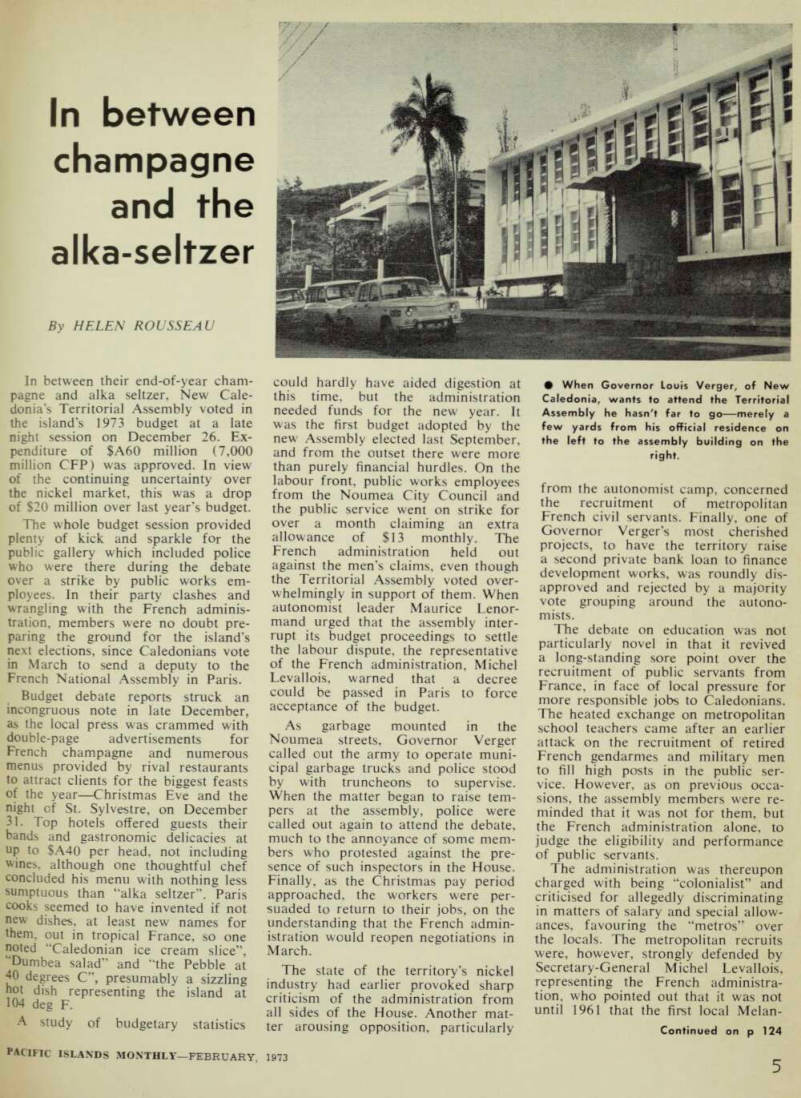
When Governor Louis Verger, of New Caledonia, wants to attend the Territorial Assembly he hasn't far to go—merely a few yards from his official residence on the left to the assembly building on the right.
esian passed the baccalaureat exam equivalent to end of secondary school and university entrance.
The other sphere of state influence which caused some lively debate con cerned sport. France has lagged be hind other powers in gaining interna tional recognition through sport.
However, French winners of Olympic gold medals and other international championships are now promptly awarded the Legion of Honour and even Caledonian sportsmen who shine in the Pacific receive glowing con gratulatory telegrams from French government ministers.
As the state takes a greater con trolling interest in training and organ ising club teams, certain clashes have occurred with the “old hands” who have given their time voluntarily. Per haps there is even a tinge of envy over how much money the state
now seems to have available to international prestige from sport.
The latest debate on the subjec the assembly arose over the adm; tration’s proposal to allocate al $lOO,OOO towards an Institute Youth Work Leaders. Defending project, Administration Secret General Michel Levallois had assure members that this was noi attempt to have youth activities * by the public service”.
But as far as island budgets concerned, the French franc is. more magical than any other cum and in the present nicket recesi territorial coffers have earned revenue than earlier ambitious Fre plans had prepared for. Govei Verger for some time has been i licly urging the need for the assen to raise extra loans to keep up velcpment projects. This was » one of the battle cries before September elections: that it necessary to vote for men who w« agree to this form of finance to I the island riding high in confideir The administration was, howe defeated on this when the assen majority rejected the principle of barking on a second loan, of arc SAIO million, similar to the million loan contracted through PARIBAS bank last year.
The administration pleaded that, extra finance was necessary to susj the level of employment and keep firms in operation. Assen members, however, protested they refused to grant the adminii tion an “open cheque”, that eno investment money was already at able (about $l3 million, excluc the Paribas loan) and that further loan at private bank intd rates would only help the Frl banks and big companies, rather the territory. The assembly urged the French administration invite to Noumea a mission t
cheaper lending sources—the Euro pean Development Fund (FED) and the European Investment Bank, although the administration voiced its reluctance to invite these international financial institutions to study the island's economy. It must be remem bered that New Caledonia is forced to go through the French Govern ment for loans, despite the islanders’ own deposits in local agencies such as the $2O million currently held by (he Post Office bank in New Cale donia.
There was one cheery thought after the budget and that, ironically, came from the decision to revalue the Australian dollar. The higher cost of Australian imports was seen as a means of gaining increased territorial revenues from import taxes. In the meantime, French financial journalists put a singularly original interpreta tion on this revaluation move. With out pointing out the strength of the Australian dollar among world cur rencies and highlighting the problem faced by the increasing rush of foreign funds into Australia, one pro- Paris daily stressed that New Zealand had not followed the Australian move and thereby illustrated its growing independence away from its powerful neighbour! (A split in the Anglo- Saxon conspiracy in the Pacific?) Back on the home political scene, two groups announced the formation of an anti-autonomist front to pre sent joint candidates at the coming national election of deputies to Paris, elections scheduled for two rounds on March 4 and 11. The Mouvement Liberal Caledonien (MFC—five seats) and George Chatenay’s Union Democratique (UD—four seats, out of 35) have thus proposed former assembly president Jean Deques as candidate for New Caledonian deputy.
Outgoing deputy is Melanesian Roch Pidjot of the Union Cale uonienne. in which former deputy Maurice Lenormand has now re turned to party leadership. As has been predicted the Union Multiracial leader, Melanesian Yann Celene V r cgei, is also standing. Such a situa tion could well split the Melanesian jole and favour the election of Jean Leques.
Beyond the local deputy struggle, Je overall outcome of the French elections could have far-reaching confor New Caledonia. The present “Gaullist” government of esident Georges Pompidou and ; n rime Minister Pierre Messmer faces opposition from the socmlists. who favour reappraising e statutes of French overseas terri tfltes.