Yesterday
p. 79 · Read in the full issue
Mr R. W. Robson, the founder of PIM was right about Ratu Sir Kamisese Mara, the Prime Minister of Fiji when he said in the December, 1952, issue that Fiji was watching, with interest and pleasure the way Ratu Mara (before he was knighted) was coming to the fore as a leader of the Fijians and the Fiji Government too. He said that Ratu Sir Kamisese had great natural ability; he had been very well educated and was held in high favour by the Great Council of Chiefs.
Twenty years ago the occupants of No 2 Administration Hostel, Rabaul, were surprised to find their habitat a matter of interest to groups of natives who would walk slowly past, staring at the verandah. Then one evening the
houseboy inquired whether Missus would like sell "sampela samting" to the visitors who stated they came from Misima. The desired object was a shell, faded and chipped and though the boys offered £2 for it they were happy enough to accept it as a present.
Mr and Mrs Ronald Berndt, anthropologists of Sydney University visited Kainantu, New Guinea in early November where they spent six months among natives who ate their dead. The natives were located about two days walk from Kainantu and were already known to the Berndts who had suspended a study of them in May the same year.
There was a warning to Solomons copra planters by Dr J. S. Phillips, the entomologist appointed to conduct research into coconut pests in the BSIP, who was concerned about the possibility of the Rhinoceros Beetle being introduced from Rabaul into the British Solomons. Dr Phillips asked the planters to keep a close watch for palm leaves which may have triangular sections bitten out of them, and to forward any doubtful-looking Rhinoceros beetles to him for examinations. The beetle had been introduced to Samoa 40 years before as a stowaway in a bundle of rubber plants from Ceylon.
"In New Britain it was introduced by the Japanese during the war years,"
Dr Phillips said.
A small single column item said, "The most succesfull military unit in Malaya in November was the Suffolk regiment, which skittled 12 terrorists.
Next was the Fiji Battalion, with a bag of 7".
Talking about love, RIM reported that Mrs Kazuko Higa, a woman who spent five years alone on Anahatan, 70 miles north of Saipan, with 31 obviously woman-crazy Japanese, lived tell the tale—and was going to be paid for it at one of Tokyo's largest theatres.
It was said that six men were killed because of her while they were on the island—but she denied it. She said there were only two. When her husband disappeared at sea she went to live with No 1. This lasted three years— until someone shot him. She then lived with No 2 but this lasted only 20 days—then he was drowned while out fishing. Then she lived with No 3 for two years but did not love him.
No 4 entered her life, and as No 3 was an embarrassment. No 4 stabbed him to death. She lived with No 4 for nine months until she surrendered to the Americans. For about six years after the end of the war the handful of Japs who defended it refused to believe that the fighting was over. They just sat around picking one another off, for love of Mrs Higa.
Cook Islands residents were asking why, since the suspension of the NAC air service, mail to islands of the Cook Group other than Aitutaki was not being accepted for air delivery by TEAL (old name of Air New Zealand) as far as Aitutaki. An Auckland post office spokesman said there was no regular sea connection between Aitutaki and Rarotonga, therefore it was just as reliable to send by direct surface mail. This, they said, was ridiculous. There was a more frequent service between Rarotonga and Aitutaki than between Auckland and Rarotonga.
In December 1952, PlM's correspondent in Suva reported that dry conditions which had existed in parts of Viti Levu and other islands of Fiji since the January hurricane were becoming a full scale drought in some areas.
This was the second consecutive dry year. The report continued, "Suva's water shortage, which threatened to become acute early in October was recently relieved by a series of the short but very heavy thunderstorms. In other districts, however, the driest October
PIM staff writer Manoa Rasigatale was a four-year-old Fijian boy in Nabuli village in the Rewa area when PIM came out in December, 1952. So the “Yesterday” page this month is not just a matter of recollection, for what we present is Manoa’s selection of the significant and the interesting from the twenty-year-old issue. History is really seen as history!
on record has created a serious situation.
Fijian villages in the coastal regions of eastern Viti Levu report that in some places coconuts, which had been reserved for copra production, are being used as drinking nuts."
Looking back a further 20 years RIM said that in 1932 popular brands of cigarettes in sealed tins of 50 were 23/- a 1,000 for Army Club, 29/6 per 1,000 for De Reszke and 15/- a 1,000 for Gold Flake. But if you ask them again today you will be surprised at the prices. They are double or three times up—its a change of time!
It is good to remember that the first shipment of Fiji bananas to Australia under the reciprocal clause of the Ottawa Agreement was expected at the end of December, 1932. Melbourne fruit agents had already threatened to boycott them and the Federal Government was taking a "serious view" of the matter.
It was feared also that some local bananas would be offered as "full flavoured-Fiji". The then Director of Agriculture, Fiji, was coming to Sydney with the first shipment.
Considered on a stowaways-per-ton basis, the record of A. B. Donald & Co's Cook Islands trader Charlotte Donald must never have been equalled.
A day after the vessel left Aitutaki, on November 12, 13 stowaways were discovered on board. The ship took them to Manihiki, where it was some days later announced that they had been released from custody. As Manihiki had one policeman and one goal "custody" seemed rather an exaggeration.
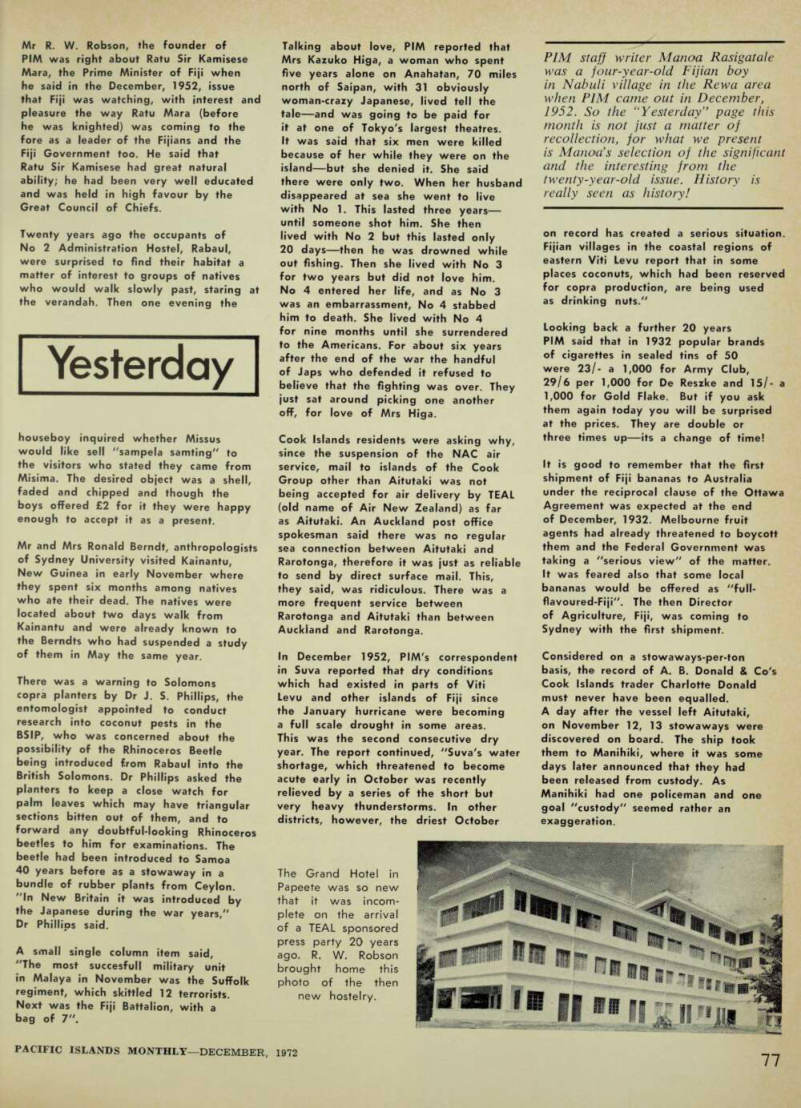
The Grand Hotel in Papeete was so new that it was incom plete on the arrival of a TEAL sponsored press party 20 years ago. R. W. Robson brought home this photo of the then new hostelry.