Forgotten Grave On
p. 78 · Read in the full issue
Lonely Penrhyn
By Nihi Vini
The village is Omoka, the island is Penrhyn and the group is the Cook Islands. Behind the church is a cemetery. A hundred yards to the left of this, facing the ocean is another cemetery—the chiefly burial ground which is marked by white stones protruding about six inches from the sand around each grave.
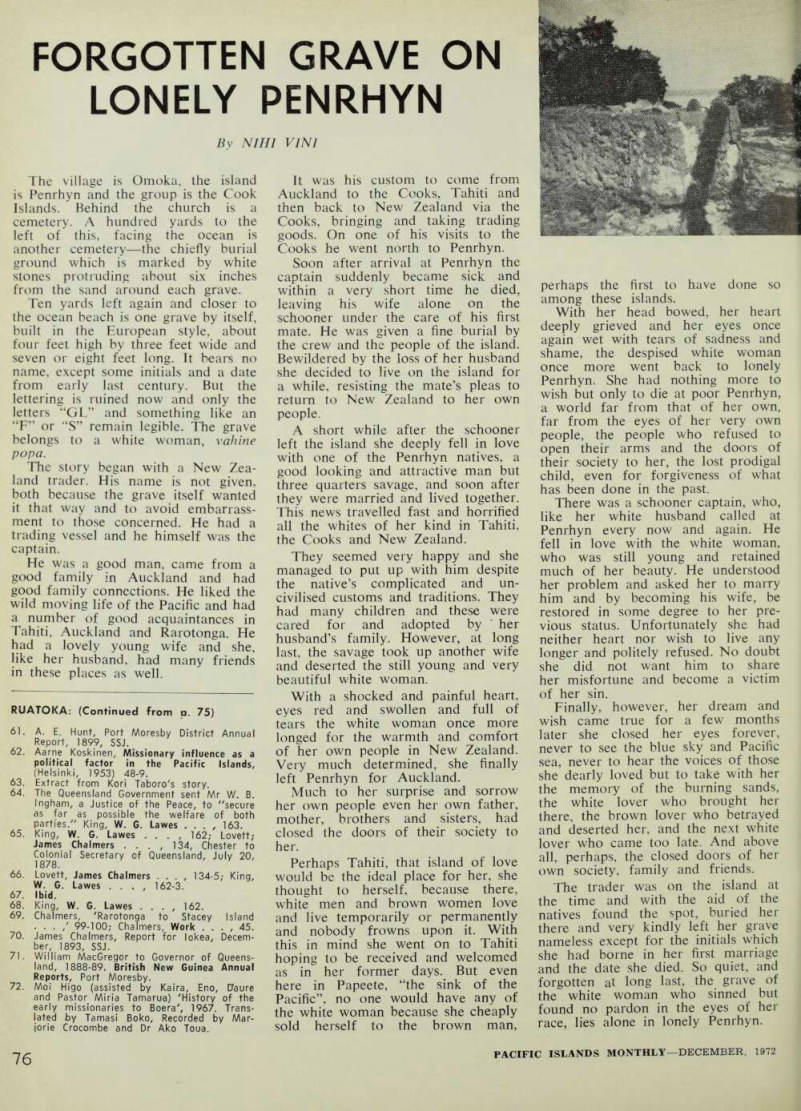
Ten yards left again and closer to the ocean beach is one grave by itself, built in the European style, about four feet high by three feet wide and seven or eight feet long. It bears no name, except some initials and a date from early last century. But the lettering is ruined now and only the letters “GL” and something like an “F” or “S” remain legible. The grave belongs to a white woman, vahine popa.
The story began with a New Zea land trader. His name is not given, both because the grave itself wanted it that way and to avoid embarrass ment to those concerned. He had a trading vessel and he himself was the captain.
He was a good man, came from a good family in Auckland and had good family connections. He liked the wild moving life of the Pacific and had a number of good acquaintances in Tahiti, Auckland and Rarotonga. He had a lovely young wife and she, like her husband, had many friends in these places as well.
It was his custom to come from Auckland to the Cooks, Tahiti and then back to New Zealand via the Cooks, bringing and taking trading goods. On one of his visits to the Cooks he went north to Penrhyn.
Soon after arrival at Penrhyn the captain suddenly became sick and within a very short time he died, leaving his wife alone on the schooner under the care of his first mate. He was given a fine burial by the crew and the people of the island.
Bewildered by the loss of her husband she decided to live on the island for a while, resisting the mate’s pleas to return to New Zealand to her own people.
A short while after the schooner left the island she deeply fell in love with one of the Penrhyn natives, a good looking and attractive man but three quarters savage, and soon after they were married and lived together.
This news travelled fast and horrified all the whites of her kind in Tahiti, the Cooks and New Zealand.
They seemed very happy and she managed to put up with him despite the native’s complicated and un civilised customs and traditions. They had many children and these were cared for and adopted by ' her husband’s family. However, at long last, the savage took up another wife and deserted the still young and very beautiful white woman.
With a shocked and painful heart, eyes red and swollen and full of tears the white woman once more longed for the warmth and comfort of her own people in New Zealand.
Very much determined, she finally left Penrhyn for Auckland.
Much to her surprise and sorrow her own people even her own father, mother, brothers and sisters, had closed the doors of their society to her.
Perhaps Tahiti, that island of love would be the ideal place for her, she thought to herself, because there, white men and brown women love and live temporarily or permanently and nobody frowns upon it. With this in mind she went on to Tahiti hoping to be received and welcomed as in her former days. But even here in Papeete, “the sink of the Pacific”, no one would have any of the white woman because she cheaply sold herself to the brown man,
perhaps the first to have done so among these islands.
With her head bowed, her heart deeply grieved and her eyes once again wet with tears of sadness and shame, the despised white woman once more went back to lonely Penrhyn. She had nothing more to wish but only to die at poor Penrhyn, a world far from that of her own, far from the eyes of her very own people, the people who refused to open their arms and the doors of their society to her, the lost prodigal child, even for forgiveness of what has been done in the past.
There was a schooner captain, who, like her white husband called at Penrhyn every now and again. He fell in love with the white woman, who was still young and retained much of her beauty. He understood her problem and asked her to marry him and by becoming his wife, be restored in some degree to her pre vious status. Unfortunately she had neither heart nor wish to live any longer and politely refused. No doubt she did not want him to share her misfortune and become a victim of her sin.
Finally, however, her dream and wish came true for a few months later she closed her eyes forever, never to see the blue sky and Pacific sea, never to hear the voices of those she dearly loved but to take with her the memory of the burning sands, the white lover who brought her there, the brown lover who betrayed and deserted her, and the next white lover who came too late. And above all, perhaps, the closed doors of her own society, family and friends.
The trader was on the island at the time and with the aid of the natives found the spot, buried her there and very kindly left her grave nameless except for the initials which she had borne in her first marriage and the date she died. So quiet, and forgotten at long last, the grave of the white woman who sinned but found no pardon in the eyes of her race, lies alone in lonely Penrhyn.