France Explains Its
pp. 61-62 · Read in the full issue

Attitude To Spc
By HENRI NETTRE, Senior French Commissioner, South Pacific Com mission, especially written for PIM.
I would first of all like to say that, having participated in the South Pacific Commission for 15 years, I have seen great progress in the standing of the conference and in the ability of the delegates, and I have noticed that there is a more reasonable and thoughtful atmo sphere. It is now less emotional and reflects the subjective ideas of the majority of the delegates who have become aware of what is reasonable to expect of the commission and of its limitations, although, like every assembly, there will always be some who favour sensational declarations, especially if these are to be pub licised.
I have also found, with pleasure, the greatest desire among most of the delegates to seek common ground with the representatives of the West ern metropolitans; to listen to their advice and consider that advice even at times when they do not share the metropolitans’ opinions, at least at the beginning.
Several times I have found that constructive remarks I have made, suggestions of changes, propositions to ameliorate some situation which I have formulated, have been criticised by the delegates. Then they have considered them and returned to the discussions holding the same views as I have advanced. This shows the greatest maturity of thought on their part.
As has been pointed out, the com mission is celebrating its 25th birth day. She is getting older and the economic and social conditions have changed in the territories like every where else, but the administrative services and even the techniques of the secretariat-general tend, like every where else, to change more slowly.
They are crystallised in their methods of action and activities so as to be unable to renew and adapt their programme to the changed condi tions. Instead, they make their routine a kind of lazy rule, a “perpetuation of errors’’ as we say in France, a passive acceptance of things. This is a situation we must try to break.
This explains why certain criti cisms, which have been heard some times, are unduly magnified and rejected by those to whom the
criticism is addressed; criticism of some of the projects in the work programme that are not entirely adapted to the new situation, of certain administrative habits which achieve few results beyond estab lishing a kind of Parkinson’s Law as far as work and personnel are concerned, the non-stop proliferation of documents and the excessive use of dilatory procedures.
This does not mean that nothing useful is being done by the SPC.
By next year, it will have achieved some profitable results.
This criticism is not directed at the secretary-general the directors of the work programme or personnel officers even if some of them have ceased to be as important as they used to be, but, in any organisation in which the financial means are always restricted, even though they are increased from time to time, it is a good thing after travelling a long way to shake the dust from our shoes or even to change them.
It is my personal opinion that recognition of these facts will make for a valuable future for the com mission which must now concentrate its efforts on technical assistance in a limited number of sectors common to the needs of all the region which are not satisfied through any other means.
This brings us to the point where we must define the limits of the sectors of activities between the com mission and the other international organisations which are working for the economic, social, cultural and hygienic development of the region.
These organisations, which have greater means, have collaborated with the SPC in the past but they are now tending to deny the commission its rightful position and want to take over despite the fact that they do
not cover all the needs of the area, especially when those needs are regional or sub-regional and not con fined to a territory or government.
Their system of centralising every thing is not always suitable for the practical needs of the countries or territories having only a few thousand or even a few hundred inhabitants.
On the other hand, generous offers of financial or technical aid received by the commission from national organisations or from governments which are not participants in the commission can help very much to increase the SPC’s efficiency.
The future of the commission depends very much on the happy solution of all these problems.
Now a final word to explain as I did at the conference, but was not always understood or reported, the very reasonable decision by France not to increase its 1973 contribution by more than five per cent. She had three excellent reasons. (1) She had every reason to be surprised to see that the recommenda tion of the 1971 South Pacific Con ference and the resolution of the 34th session had not been entirely respected, and that some parts of the work programme in which she was particularly interested, and which concerned mainly French ter ritories, had not been executed or had been delayed sometimes by the unilateral decision of the PNUD (programme directors) despite the agreement signed by the collaborators in the common projects. (2) She noted that, in the projects planned for 1973 and discussed at the conference, there were still very few practical activities of high value
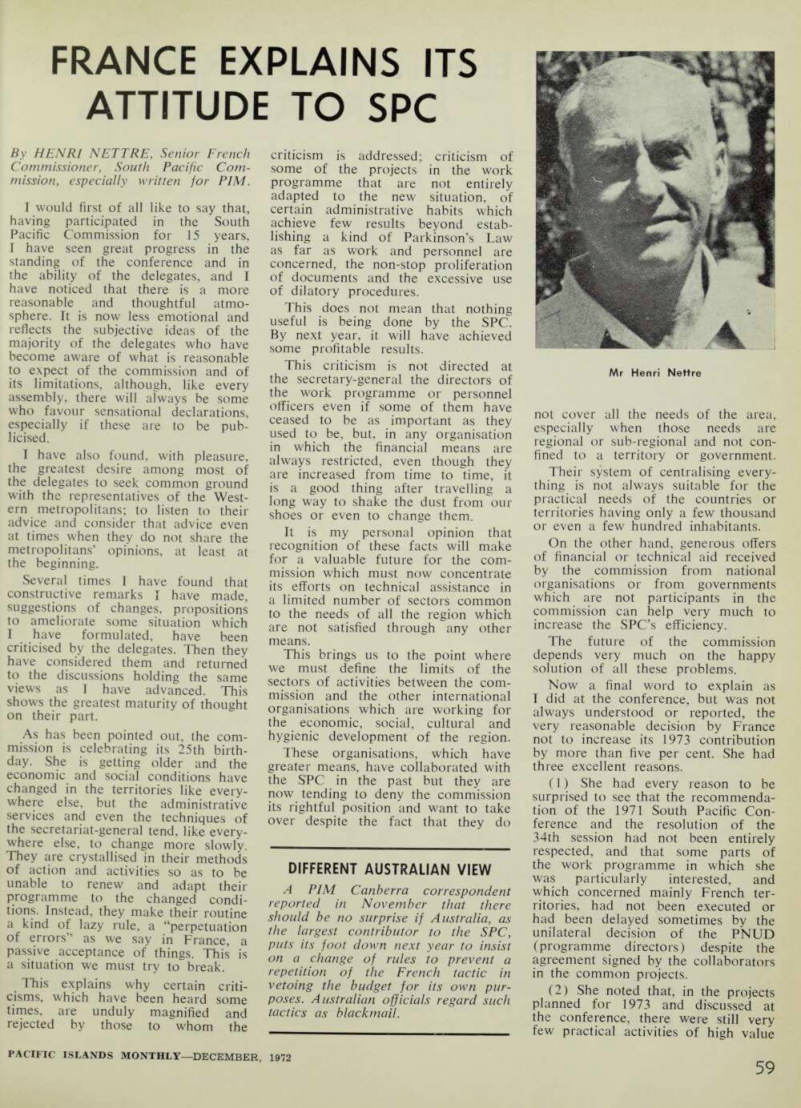
Mr Henri Nettre
and long duration, but a great number, even for the secretariat, of meetings, conferences, seminars and travel which were of questionable value, and which have been questioned for several years by most of the ter ritories and the member-governments.
The inclusion of these limited the number of worthwhile projects. (3) Finally, and above all, the budget showed that at the end of 1972 the sum of $A 104,000 will still be unspent. Of this, $65,000 comes from uncompleted projects and $39,000 from incidental income, which is equal to 10 per cent of the total income.
Also, with a five per cent increase in contributions, the 1973 budget will already have resources of $A 1,342,611 instead of the $A 1,217,000 originally budgeted for in 1972, which means an increase of 10.4 per cent covering the cost of all useful planning projects, and representing a 37 per cent in crease on the 1972 work programme ($A1,199,379 instead of $A875,101).
In addition, the commission has requested the secretary-general to make certain savings on personnel and administrative expenses during 1973. This should increase the amount available for the execution of the work programme.