Perhaps Vavauans May Change
pp. 55-59 · Read in the full issue
The Rest Of The World
From PATRICIA MATHESON in Vavau
One night soon after I came to live in the Vavau village of Utulei, my husband, the late Dr Farquhar Matheson, had to go across the harbour to the hospital in Neiafu to perform an emergency operation. I went along, too, as I liked to watch him and he thought I might be useful to hold the torch while he was operating.
As it happened, I did not have to do so that night as the driver of the truck that gave us a lift up to the hospital offered to park outside and shine his headlights into the theatre for as long as the operation lasted.
He must have had new batteries.
His lights illumined the whole of the cottage that was the hospital and shone like twin spots on the operating table where the patient, an elderly man suffering from a massive tumor that was causing obstructions, was lying.
The patient was already “out”. He had been anaesthetised by the old “rag and bottle” method and the theatre, as we entered it, was heavy with the sick sweet smell of ether.
It was crowded, too, for in addition to my husband who was operating, there was his assistant, Dr Lutu’i Fonua.
Nurses were a luxury the Vavau hospital did not have, but Isaleli Falemahafu, the male attendant, ably replaced them while the dispenser, Peni Latu, ran about with a cloth with which he sometimes swatted the flies and other insects that swarmed in through the unscreened windows and sometimes wiped off the sweat that poured from the working doctors.
I sat perched on a high stool in the corner where I could watch without getting in the way, while lining the walls all around the room, sat the patient’s family, friends and neighbours. They said nothing, but with every cut of the scalpel, leaned forward breathing heavily with sup pressed excitement.
Only when the operation had been completed and Peni paraded triumph antly in front of them holding the excised tumor aloft in a kidney dish for all to see, did they relax and break into murmurs of satisfaction.
But that was almost 25 years ago. The old hospital building has long since been moved and converted into a comfortable nurses home—in which the theatre with its single sky light serves as a most elegant dining room. In its place is the Ngu Hos pital, a modern 70-bed concrete building which contains in addition
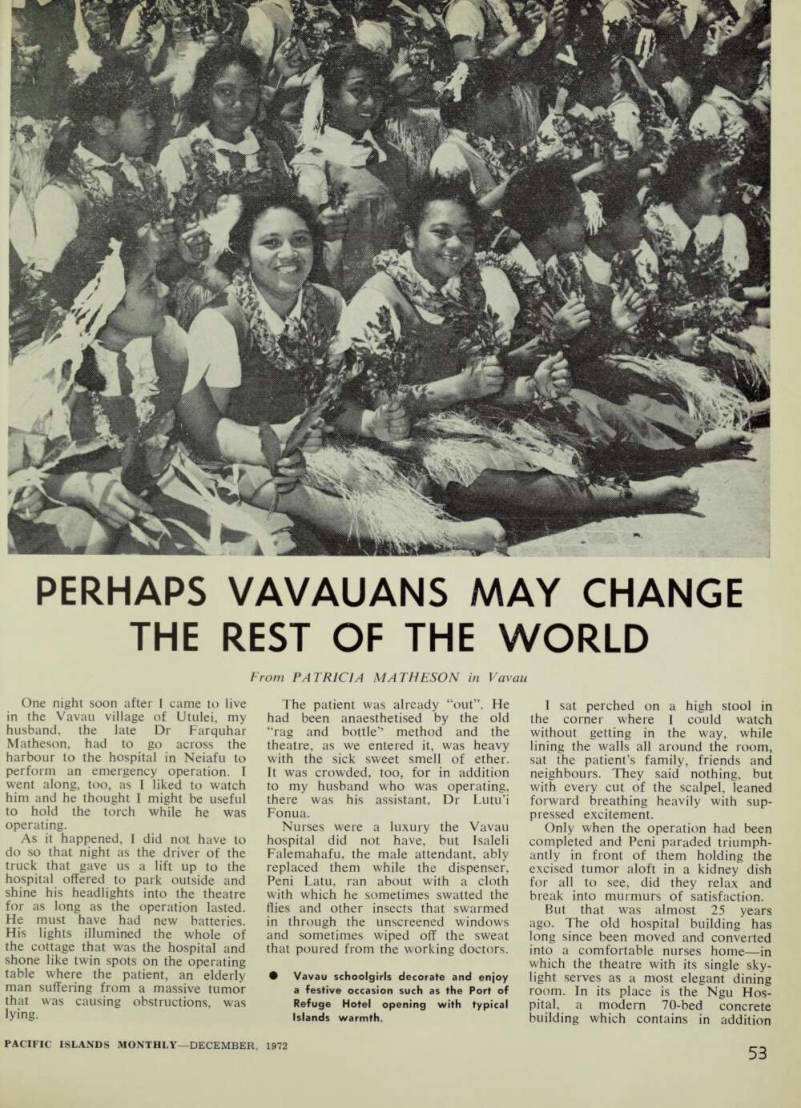
Vavau schoolgirls decorate and enjoy a festive occasion such as the Port of Refuge Hotel opening with typical Islands warmth.
to spacious wards, a dental clinic, outpatient’s department, pharmacy, X-ray and laboratory. It is lit by electricity and the theatre, equipped with a modern anaesthesia machine, is air-conditioned.
Its large grounds are kept in order by a gardener and wards maids keep the interior clean. The professional staff includes not only doctors, but also a dentist, a pharmacist, laboratory and X-ray technicians and a group of well-trained nurses.
There are Land Rovers to transport patients and doctors and a Child Welfare bus which services all the main island.
Faced with such progress, it is perhaps ungracious to bemoan the fact that the theatre no longer puts on shows for the patient’s family, friends and neighbours—nor for doctors’ wives!
The changes that have taken place in the Medical Department have counterparts in every government department and in churches and private enterprises as well.
Nowadays, opposite the Neiafu post office there is an open grassy field where once stood the governor’s residence—a wide verandahed old house, Veitatalo. The scene of many great feasts and dances given in honor of Queen Salote, it is gone now, like our beloved queen, but half a mile away, high on the brow of a hill overlooking Vavau harbor is a new residence for the governor. It has big airy rooms, includes a royal suite, and the large playing field at its rear provides space not only for athletic contests, but for royal and national events.
The Copra Board, when first I came to Vavau conducted all its business in a one-room office in the Govern ment Rest House. Now it dominates the Neiafu waterfront with its bright green building containing offices and an apartment for the manager, its storage sheds, stores, auto repair area and wide concrete yard that adjoins the main wharf.
A short way from the business centre is the new Wesleyan church, designed by a well-known Australian architect. It is famous for its stained glass window which depicts Jesus, John Wesley, and Queen Salote.
Indeed, Neiafu is full of new buildings. To name only a few of the others, there are the police station, the Catholic Boys Club and Peter Chanel High School.
In Utulei where I live, and in many of the other outer villages, there are new schools. Now the beautiful old Tongan fales with their woven reed sides and thick thatched roofs that used to blend into the landscape, have disappeared. In their place are timber houses which all
too often are built in the “box with lean-to” style of architecture.
If they leave something to be desired aesthetically speaking, it must be admitted that they are more healthy than the old fales which, picturesque though they were, were often in the rainy season so damp that they became breeding places for rheumatic fever, respiratory diseases and a host of other ills.
The new houses offer the people who live in them more privacy than the old ones ever did—and what is equally important, they provide space for books and papers, for dishes and tools and for all the other things of the modern world which are be coming as important to Tongans as they are to people elsewhere.
I have been writing of the obvious changes that meet the eye of the most casual tourist, but there have been others that are vastly more important and more far-reaching.
Undoubtedly the greatest political change that has taken place since I have been here is a fairly recent one— the proclamation by King Taufa’ahau Tupou IV in 1970 of the indepen dence of Tonga. Previously the country had been bound to Great Britain by a Treaty of Friendship which made it virtually a British protectorate. The ties with Great Britain have been maintained as Tonga has become a member of the Commonwealth.
Perhaps because of that and because the changeover was a thoroughly peaceable one, some people have said it makes no real difference. They could not be more
wrong. The difference is the same as that in the life of an individual when, leaving behind the dependency of childhood, he “comes of age” and accepts the full responsibility of adulthood.
It would be both false and futile to pretend that Tonga has moved into the wider world with unfailing grace. Like every other young country, it suffers growing pains. Even in Vavau, traditionally one of the most conservative parts of the country, the old people claim the young are forgetting their Tongan customs. The generation gap widens, crime in creases and we are occupied, along with the rest of the world, by worries about the exploding popula tion and about the pollution of natural resources.
Both the Tongan government and the Tongan people recognise the problems and are working hard at their solutions. In this task they have the help of many dedicated papalangis and I must say that not all the changes that have come, have been Tongan ones.
Twenty five years ago, there were still a good number of “Empire builders” about—people who spoke of the “white man’s burden” and who, however useful, however kind, nevertheless felt that they were members not only of a different, but of a superior race. Happily such people are now as extinct as the dodo—and as little missed.
In their place have come skilled consultants and advisers— not to tell the Tongans what to do, but to think with them, about what should be
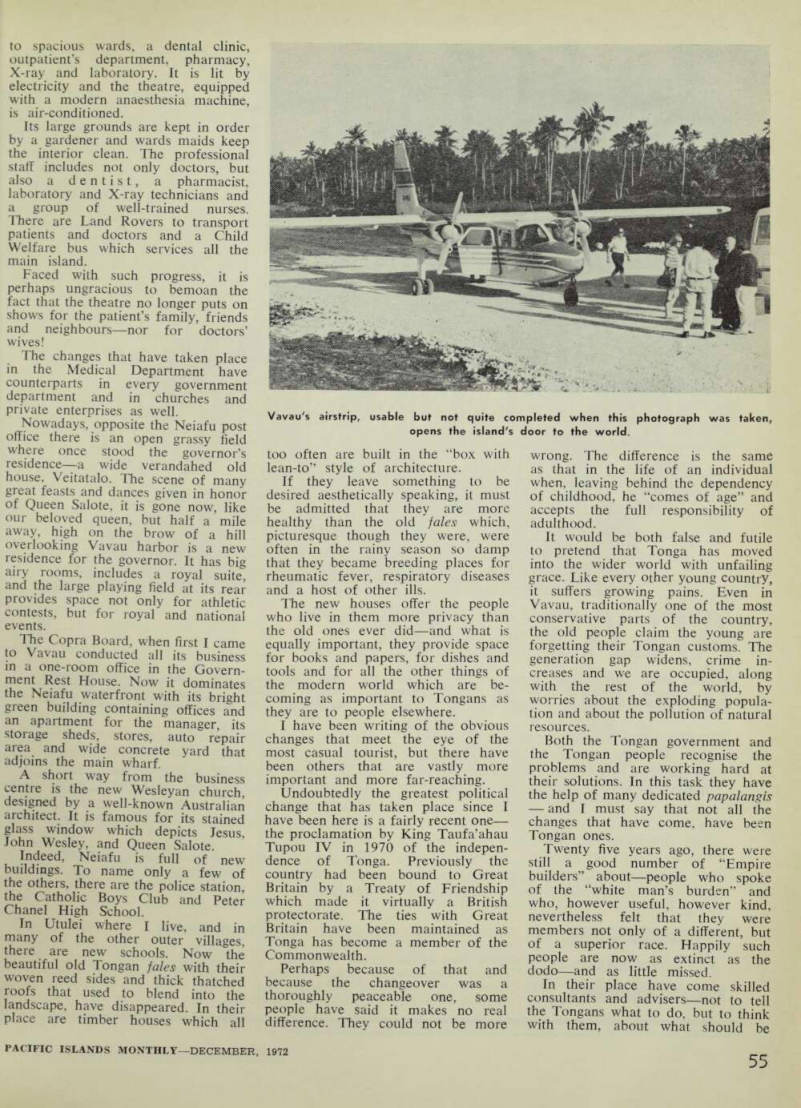
Vavau's airstrip, usable but not quite completed when this photograph was taken, opens the island's door to the world.
Peace Of Vavau
done. Both work and play have ceased to be purely Tongan or purely papalangi as people of both races have come to recognise that neither brains nor personality depend on skin colour.
Perhaps the greatest force toward increased friendliness and understand ing between peoples has been the presence in the country of the US Peace Corps and the New Zealand VSAs. These young people have both given and received much from their stay here. Coming as they do from more industrially advanced countries, they bring new skills, new concepts’ new methods which they are anxious to share with their island friends.
Because they live with the people not above them or apart from them, they are able to share. From their Tongan hosts, they learn that the materialistic values of modern society are meaningless, that better “things” are useless unless they are put to work for the common good and that IS n the relati °nship that should bind all peoples together.
Many good people have come to help Tonga, but Tongans have in recent years, also grown more able to help themselves. When I came to the country only two Tongans held univereity degrees—the present King and Dr Amanaki Havea, the President of the Free Wesleyan Church. Now hundreds of young men and women have been graduated from universities al! over the world, and other hundreds have been overseas for technical training. Some of them have stayed to work in foreign places, but he majority have returned to help world the,r h ° me,and into the modern I was asked to write this article about some of the changes I have n Y ava " a day that was nr!L o u f ! reat importance, October 2, when the Port of Refuge Hotel was opened and the new air field was put into operation. The people who view it all with alarm were out in force that day, convinced hat tourists would overrun us, that Tie quiet simple life we enjoy here k mi dlsa PP ear > tha t our skies would be filled with noise, that the cost of living would soon soar so high that lone of us could go on living. aJ belon 8 with those people.
Admittedly every change brings fresh Drob lems but I rely on the Vavau DeopJe—both Tongan and papalangi, o be able to solve them. I like to , m k that the airport will bring us Toser to the good things of the and will enable more young
Tongans to go forth to learn and adventure in distant lands. And I like to think that the tourists who come will explore these beautiful islands of Vavau, meet the friendly people and take away some of the peace and the joy of life that abounds here.
Many things have changed in the years I have been here, but some very important ones have not. Malo thank you and of a, love , are still h m ° St h F o? Ue k 1 Tongan words and the best indication of Tongan character.
The people are open, friendly, happy. They speak of love easily and express it in every smile they flash
at strangers, in every song they sing, in every dance they perform. They have, too, a reverent attitude toward all life which makes them say “thank you” not merely for presents offered them, but for the health they enjoy, for the copra they cut, for the floors they sweep, the flowers they string into leis and for each new day that dawns.
Q f course I miss the old days, mainly because so many people I loved, both Tongans and papalangis, have g Gne w hh them, but both the changes that have come and the things that have not changed, make the future challenging and Vavau the best of all places in which to meet it.