Yesterday
p. 79 · Read in the full issue
Jndoubtedly today political development
akes the lion's share of the "hard" tews in PlM's pages. Twenty years ago, ransport problems and produce prices vere of more interest. Transport specially was a subject which in all Is facets got an airing month after Tenth in PIM, and the issue of lovember, 1952, was no exception. i New Guinea there was excitement ver the announcement that the lew Guinea Australia Line, using ships ailed the Shansi and the Sinkiang, 'ould begin a new service between
ustralia and the territory so as to ve the Burns Philp ships a run for eir money. Everybody suspected that *'s was making a fortune over its rtual monopoly of the service, despite *'s own insistence that the shipping isiness was a pain in the neck not orth the capital outlay. The fact that • years later the famous BP Line s disappeared from the Pacific seems bear out the company's view, but
ose were heady days,
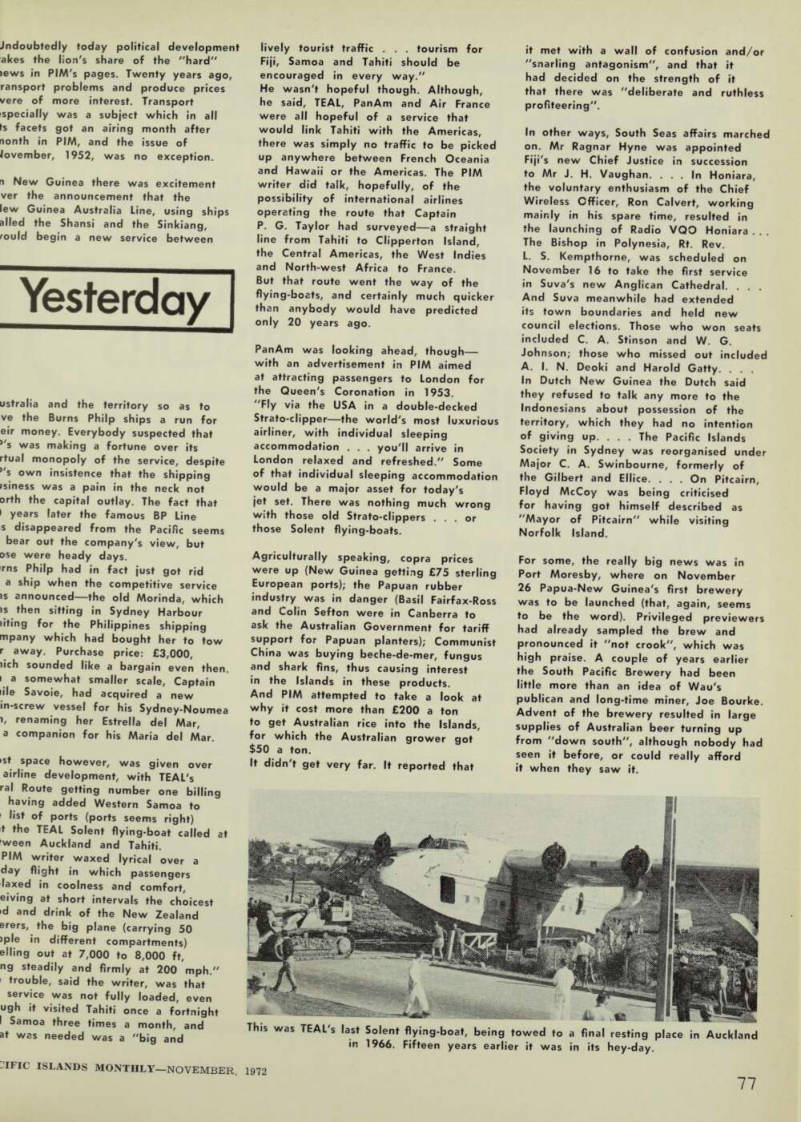
rns Philp had in fact just got rid a ship when the competitive service is announced—the old Morinda, which is then sitting in Sydney Harbour liting for the Philippines shipping mpany which had bought her to tow r away. Purchase price: £3,000, lich sounded like a bargain even then, i a somewhat smaller scale, Captain n'le Savoie, had acquired a new in-screw vessel for his Sydney-Noumea i, renaming her Estrella del Mar, a companion for his Maria del Mar. •st space however, was given over airline development, with TEAL's ral Route getting number one billing having added Western Samoa to list of ports (ports seems right) t the TEAL Solent flying-boat called at ween Auckland and Tahiti.
PIM writer waxed lyrical over a day flight in which passengers laxed in coolness and comfort, eivmg at short intervals the choicest id and drink of the New Zealand erers, the big plane (carrying 50 >ple in different compartments) elling out at 7,000 to 8,000 ft, ng steadily and firmly at 200 mph." * trouble, said the writer, was that service was not fully loaded, even ugh it visited Tahiti once a fortnight I Samoa three times a month, and at was needed was a "big and
lively tourist traffic . . . tourism for Fiji, Samoa and Tahiti should be encouraged in every way."
He wasn't hopeful though. Although, he said, TEAL, PanAm and Air France were all hopeful of a service that would link Tahiti with the Americas, there was simply no traffic to be picked up anywhere between French Oceania and Hawaii or the Americas. The PIM writer did talk, hopefully, of the possibility of international airlines operating the route that Captain P. G. Taylor had surveyed—a straight line from Tahiti to Clipperton Island, the Central Americas, the West Indies and North-west Africa to France.
But that route went the way of the flying-boats, and certainly much quicker than anybody would have predicted only 20 years ago.
PanAm was looking ahead, though— with an advertisement in PIM aimed at attracting passengers to London for the Queen's Coronation in 1953.
"Fly via the USA in a double-decked Strato-clipper—the world's most luxurious airliner, with individual sleeping accommodation . . . you'll arrive in London relaxed and refreshed." Some of that individual sleeping accommodation would be a major asset for today's jet set. There was nothing much wrong with those old Strato-clippers ... or those Solent flying-boats.
Agriculturally speaking, copra prices
were up (New Guinea getting £75 sterling European ports); the Papuan rubber industry was in danger (Basil Fairfax-Ross and Colin Sefton were in Canberra to ask the Australian Government for tariff support for Papuan planters); Communist China was buying beche-de-mer, fungus and shark fins, thus causing interest in the Islands in these products.
And PIM attempted to take a look at why it cost more than £2OO a ton to get Australian rice into the Islands, for which the Australian grower got $5O a ton.
It didn't get very far. It reported that
it met with a wall of confusion and/or "snarling antagonism", and that it had decided on the strength of it that there was "deliberate and ruthless profiteering".
In other ways. South Seas affairs marched on. Mr Ragnar Hyne was appointed Fiji's new Chief Justice in succession to Mr J. H. Vaughan. ... In Honiara, the voluntary enthusiasm of the Chief Wireless Officer, Ron Calvert, working mainly in his spare time, resulted in the launching of Radio VQO Honiara . . .
The Bishop in Polynesia, Rt. Rev.
L. S. Kempthorne, was scheduled on November 16 to take the first service in Suva's new Anglican Cathedral. . . .
And Suva meanwhile had extended its town boundaries and held new council elections. Those who won seats included C. A. Stinson and W. G.
Johnson; those who missed out included A. I. N. Deoki and Harold Gatty. . . .
In Dutch New Guinea the Dutch said they refused to talk any more to the Indonesians about possession of the territory, which they had no intention of giving up. . . . The Pacific Islands Society in Sydney was reorganised under Major C. A. Swinbourne, formerly of the Gilbert and Ellice. ... On Pitcairn, Floyd McCoy was being criticised for having got himself described as "Mayor of Pitcairn" while visiting Norfolk Island.
For some, the really big news was in Port Moresby, where on November 26 Papua-New Guinea's first brewery was to be launched (that, again, seems to be the word). Privileged previewers had already sampled the brew and pronounced it "not crook", which was high praise. A couple of years earlier the South Pacific Brewery had been little more than an idea of Wau's publican and long-time miner, Joe Bourke.
Advent of the brewery resulted in large supplies of Australian beer turning up from "down south", although nobody had seen it before, or could really afford it when they saw it.
This was TEAL's last Solent flying-boat, being towed to a final resting place in Auckland in 1966. Fifteen years earlier it was in its hey-day.