Magazine Section
pp. 71-77 · Read in the full issue
Ruatoka: A Polynesian In
New Guinea History
By Marjorie Tuainekore Crocombe
Pacific islanders travelled a lot more last century than most people realise. Some went as crew on sailing ships, some as migrant workers and some as missionaries.
The London Missionary Society (LMS) moved into the Torres Strait Islands in 1871 and New Guinea in 1872, partly because Captain Banner, who owned shell diving stations in Torres Strait, offered to carry any island missionaries on his vessel free of charge, and to look after them. l He made the offer to the Rev. J.
Jones in the Loyalty Islands in 1866, but the LMS directors in London did not act on it until the long-stand ing animosity of French officials forced them to move.
Polynesian missionaries of the LMS had been in the Loyalty Islands since the early 1840 s. European mis sionaries came in the following decade. After French Marist priests arrived in 1857, there was constant bickering between the Protestant and Catholic missionaries. This worsened after French annexation of the Loyalties in 1866.
Such difficult conditions were im posed upon the LMS by the French authorities that the directors in London decided in 1870 to send the Rev. S. M. McFarlane from the Loyalties to explore the possibility n setting up stations in the Torres Strait Islands and New Guinea. He vas accompanied by the Rev. A. W.
Murray, who had no sooner arrived n the Loyalty Islands then the French asked the LMS missionaries there to eave. 2 After an exploratory voyage by McFarlane and Murray, Loyalty slanders became the first mis lionaries to the Torres Strait Islands n 1871 and New Guinea in 1872.3 Phey were followed by Polynesians :rom the Cook Islands, also in the alter part of 1872, from Niue in 1874, the Society Islands in 1878 md Samoa in about 18847 Of the hundreds of Pacific Islands
This November is being celebrated by the United Church in Papua New Guinea and the Solomon Islands as the centenary of Christian missionary work in Papua. The first missionaries were in fact Pacific Islanders, the doyen of whom was undoubtedly the Rarotongan, Ruatoka. His story, told by another Cook Islander, Mrs Marjorie Crocombe, begins here. A final instalment will appear in December PIM.
missionariesS who have worked for the LMS in New Guinea, Ruatoka was one of the first and probably the most outstanding. 6 LMS influence on Ruatoka’s home island of Mangaia, in the southern Cook Islands, began in 1824, with two missionaries from the Society Islands. But progress was slow— there was tremendous internal rivalry
on the island, as well as between the missionaries and their wives.
From 1839, however, Mangaia was placed under the Rarotonga Mission so that significant changes had been made by the time Ruatoka was born in Tamarua village in 18467 Raro tongan, which was closer to Mangaian than Tahitian, became the language of instruction. Mangaians could now use the Rarotongan Bible, and the first of a series of resident English missionaries had arrived in 1841.
Ruatoka’s parents were among the first converts to Christianity on Mangaia, and they both wanted Ruatoka to become a missionary.
Being from a chiefly family assured him a place in the mission school, where children of rank had priority over commoners.
But there were also some personal factors. According to oral tradition, Ruatoka was a man of great courage (this became even more apparent during his career in New Guinea).
As a fearless young man he appointed
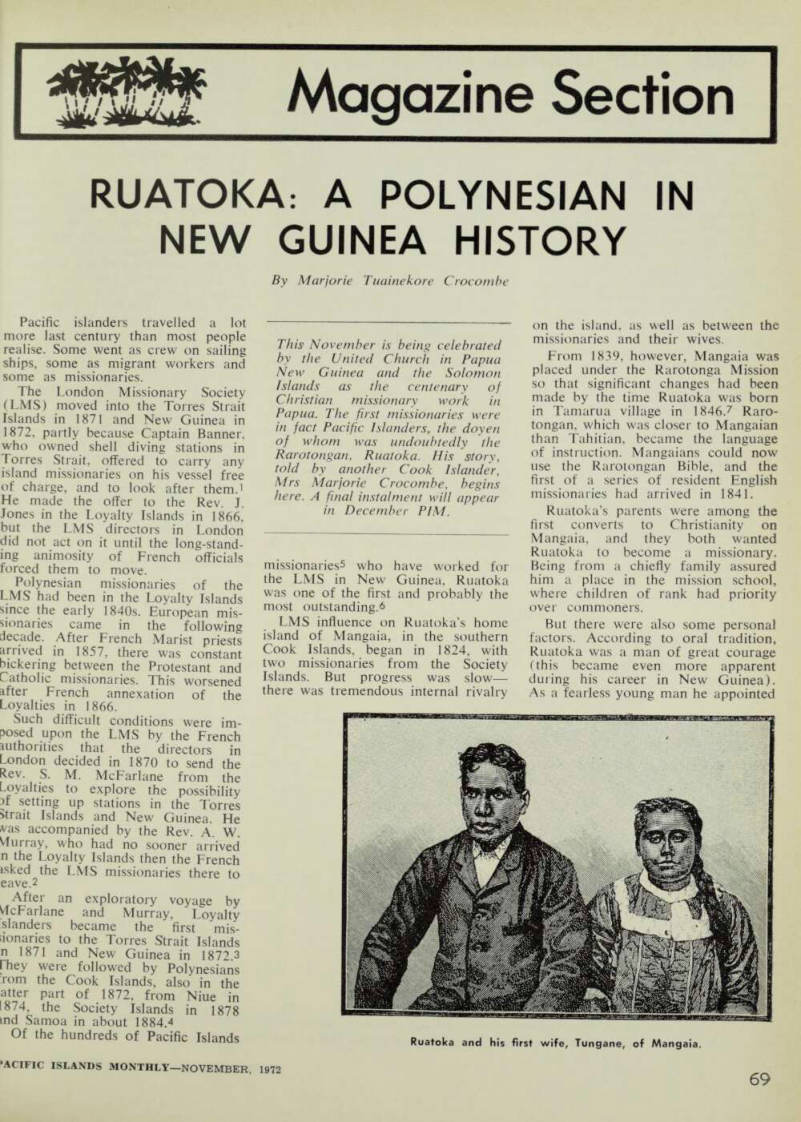
Ruatoka and his first wife, Tungane, of Mangaia.
Gamble With Sickness Paid Off
himself guardian to all missionaries, and acted as their guide when they visited the interior. B The earliest personal influence on Ruatoka was wielded by the Rev.
William Wyatt Gill who took charge of the Mangaia mission in 1852.
Although Ruatoka lived with Gill and his wife for some time, he never picked up more than “a little Pidgin English” all his life, though he made “fair progress” with vernacular studies at the mission school. 9 Ruatoka married Tungane, a Mangaian woman, whose parents were also Christians. lo Then in 1868, he was sent to study at the Rarotonga Theological Institution, 11 where he came under the influence of the Rev.
James Chalmers. Chalmers had always wanted to work in New Guinea, and for 10 years before he was permitted to go there by the LMS directors, he devoted his energies to training Cook Islanders for work in New Guinea.
Chalmers’ enthusiasm was such that church members on Rarotonga held special prayer meetings “that God might open the door, so that His Word should be known in New Guinea.” l2 These meetings had all the attributes of evangelical revivals,
and with Chalmers as the driving force behind them it was no wonder that so many Rarotongans, even elderly men and women, were imbued with zeal and offered to serve in New Guinea.
Chalmers was faced with the greatest difficulty of all in deciding whether Ruatoka should be allowed to go. He was a tall, thin young man who had suffered prolonged illness while at the theological college in 1871. Having recovered a little Ruatoka was able to preach in the villages of Rarotonga, but he was never really completely well at any time. Yet he and his wife wanted desperately to go to New Guinea, Chalmers realised that he would be blamed if he let Ruatoka go and he died on the way or soon after arrival. But he gambled against the possibility and, despite strong op position from colleagues, included the couple in the first band of missionaries to go to New Guinea in 1872.
Despite his weak constitution, Ruatoka was to outlive all his com panions, as well as subsequent mis sionaries, including Chalmers him self.
The pioneer group included mis sionaries from several islands of the
Cook group: Rau and his wife from Aitutaki; Heneri, Adamu and their wives from Manihiki; Anedera and his wife from Rarotonga. Piri, another Rarotongan, had been working with his Mangaian wife Maki as mis sionaries among Cook Islanders in Samoa, and they joined the mission ship John Williams, when it called there. l3 On August 31, 1872, the ship reached the Loyalty Islands, where they were joined by eight Loyalty Islanders, the Rev. A. W. Murray and his household, and the Raro tongan, Maka, with his wife and three children. Maka had been a missionary in Mare, Samoa and the Tokelau Islands, but had fallen into disgrace over women. Murray had taken him back as his interpreter. l4 The John Williams arrived at Cape York on October 11, 1872. The Queensland Government’s represen tative, Mr. John Jardine, had not received word to expect them, but he made two houses and a kitchen available at Somerset, a station near Cape York where five white and a number of Aboriginal police provided aid for ship-wrecked British subjects. l s The inadequacy of shipping in the Torres Strait Islands was all too apparent. Captain Turpie of the John Williams had instructions to take the mission party only as far as Somerset.
Murray then had to find another
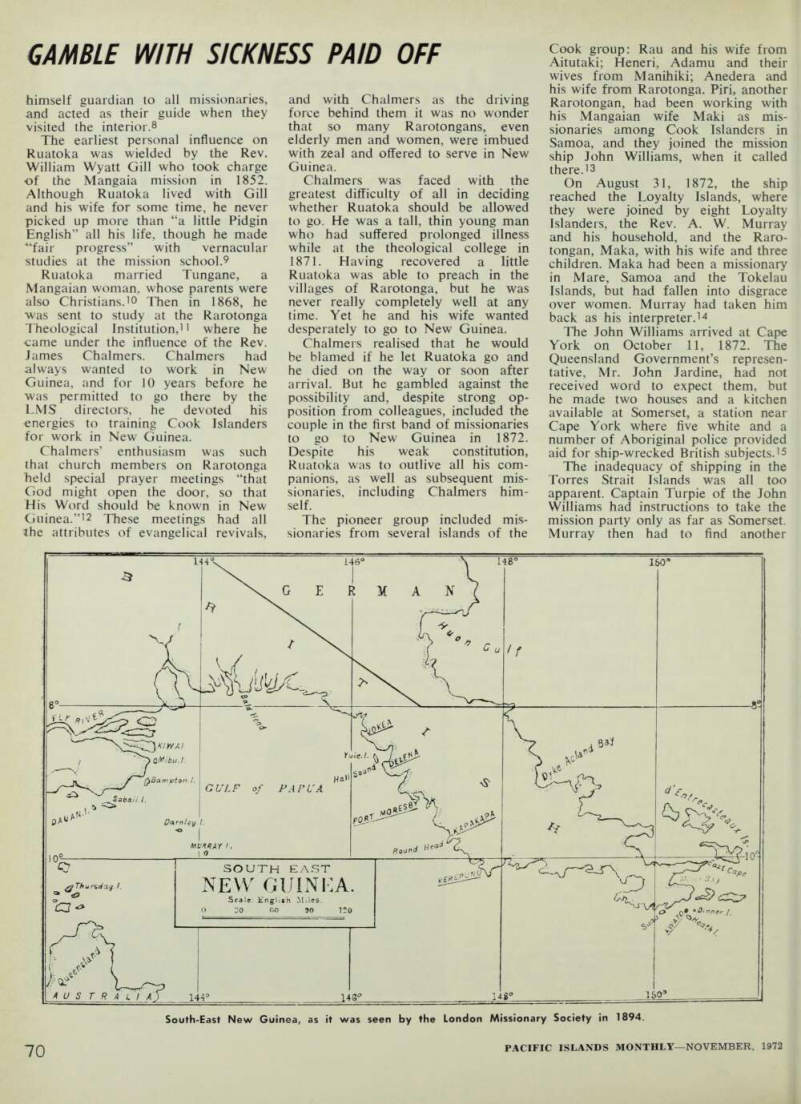
South-East New Guinea, as it was seen by the London Missionary Society in 1894
vessel to complete the voyage to New Guinea so it was fortunate that Mr Thorngren, on his small eight-ton cutter, Viking arrived the day after. 16 As in many similar situations, the assistance of sympathetic traders was welcomed. Murray chartered Mr Thorngren’s schooner to take the LMS party to Murray Island, 80 miles north-east of Cape York while he and Gill travelled there by the Melbourne Shipping Company’s steamer Wainui. The party then trans ferred toDauan Island to wait 10 days for the company’s 30-ton schooner, Loelia which eventually took Ruatoka’s party to the mainland.
Two Loyalty Islanders, Pethin and Elia, were placed at the village of Torotoram (sometimes called Ture ture) on the south coast, near Daru, on November 8, 1872, to become the first LMS missionaries to estab lish a station on mainland New Guinea. They were well received by the villagers because Elia and some of his companions at Dauan had visited Torotoram previously, but their mission later failed. 17
Manumanu : the
first beach-head
On November 22, 1872, the Loelia anchored in Redscar Bay to enable the missionaries to find out more about the area. Murray and McFarlane had been there in 1871, but had found only a few people. l B This time there were about 50 people, but as the village, Kido, was built in a low mangrove swamp, it was :onsidered unsuitable as a mission station.
However, some Kido men who had ?°ne on board the Loelia, kept epeating the name Manumanu, and pointed to the head of the bay. The Allowing day the missionaries set )ut to find Manumanu. They went )art of the way by boat, and the est of foot, with a Kido man named liru as their guide.
They were ecstatic to find the well milt village of Manumanu, with its >0 cool bamboo houses raised on files 10 ft high and ranged in two ows with a broad street in between, liere were large canoes nearby, each ibout 50 ft long, and each able to arry 50 people. Some of the canoes laden with sago and betelnut. durray and Gill estimated the popu ation to be between 900 and 1,000. mpressed by the order and cleanliness 'f the village, they “literally ran for ay into the evidently populous settle lent”.l9 Murray had seen no other illage like it on any part of the main and or the islands.2o The surrounding countryside also ppeared fertile, with banana groves
and other resources. Pigs of a “peculiarly shaggy kind” abounded.
One woman was cooking “yams and a half-sized pig. An immense lizard, measuring upwards of four feet, was roasting on live coals. ... In every dwelling we found some thing stewing over a fire”.2i The missionaries received a friendly welcome, and two village leaders, Aua and Koko, took them into a “kind of council-house”. The Manumanu leaders agreed to allow Ruatoka’s party to stay, and, to express their confidence, Aua and Koko slept on board the Loelia that night. 22 One wonders in what language they made the arrangements, for neither Murray nor Gill spoke Motu, the language of the Manumanu people, nor did they have an interpreter, as they did in the Torres Islands. 23 Murray and Piri spoke Samoan, and Gill and the others in the party spoke Rarotongan. Both are Malayo-Poly nesian languages, as is Motu, but the relationship is so distant that the Manumanu people could only have understood a few words of either Samoan or Rarotongan, though some crucial concepts like noho (to remain) and mauri (soul, life or emotion) are similar in all three.
Others, like the Motu word duru-a and the Rarotongan tauturu (both meaning to help) had a common root which could possibly have been recognised. Presumably such terms, plus sign language, would have been used, and it is greatly to their credit that they were able to get the Manu manu leaders to accept the mission party.
The clean, orderly village of Manumanu with its large population, located at the mouth of a large river
gave the European missionaries high hopes that it was a “highway” to the interior of Papua where there might be larger populations and a healthier environment for a permanent station in the future. But it was an empty hope, for after travelling up the Manumanu river and its eastern tributary for seven miles the next day, Gill and Murray found large areas of swampland but very few people.
The Cook Islanders were happy to be left at Manumanu. Many weeks of travel and the strong belief in their being called by God to carry His message to Papua probably helped, although there may have been ethnic attractions too. TTie Aborigines whom they met in North ern Australia, the Torres Strait Islanders and the Papuans further west had nothing in common with the Cook Islanders physically or culturally.
The Manumanu people, on the other hand, looked like Polynesians (which was quite unusual in Melan nesia), spoke a related language (whereas none of the languages further west have any relationship whatsoever) and shared certain broad similarities of culture. 24 On Monday, November 25, 1872, the Cook Islanders landed at Manu manu village. The team comprised Ruatoka, Rau, Piri, Adamu, Anederea, Heneri, their wives and one child (possibly Piri’s daughter Vaiora).
They stayed in the “council house” until they could build their own.
T oil of disease
and starvation
On the advice of the English mis sionaries, they had left most of their personal property at Murray Island, because from Murray’s experience “natives will not be allowed to starve among the natives, whereas the pos session of property might expose them to danger.”2s The party was given a good supply of food (pre sumably biscuits, rice and salt), medicine (probably quinine for malaria), and a small supply of trade goods. The small boat Woolahra was left behind for further ex plorations by the Cook Islands party.
Their first night ashore was peace ful, but despite the optimistic fore cast by the English missionaries about food being plentiful, the Cook Islanders told them the following day that this was not so. Murray planned to return to Manumanu within a few months to see how they had fared, but from isolated Cape York he was unable to charter any vessel for his return visit. 26 Soon after Murray left them, the
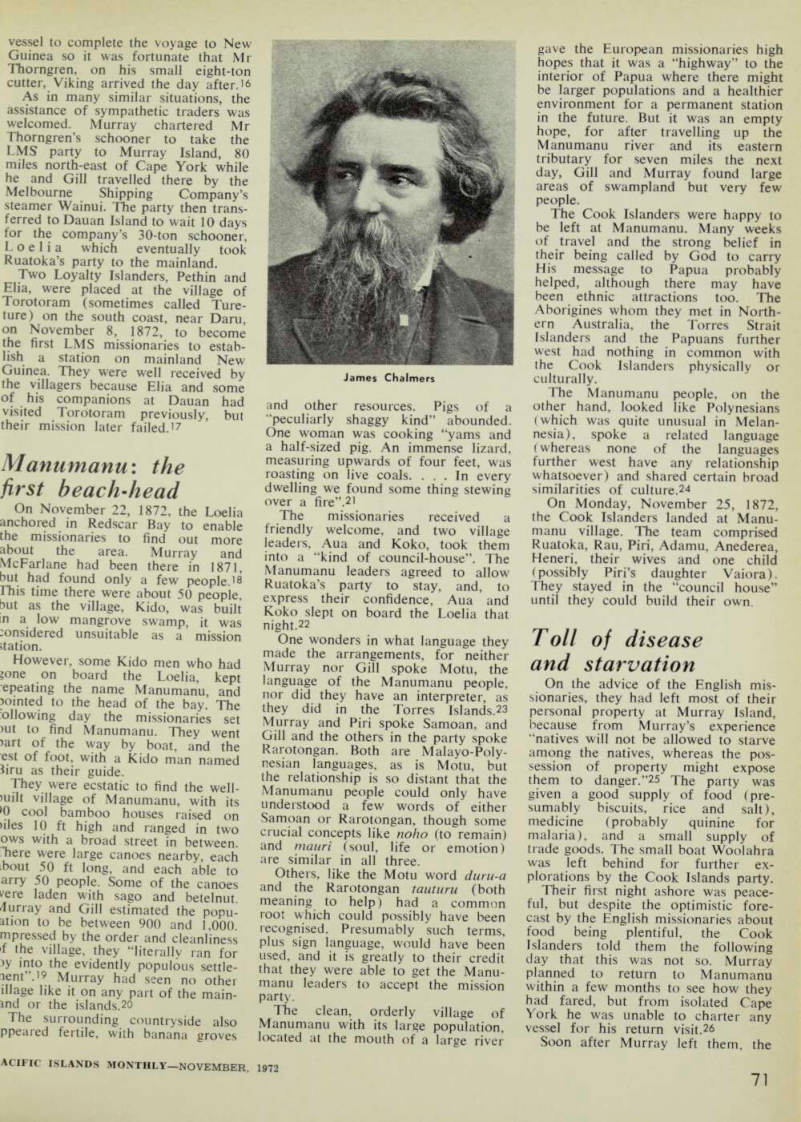
James Chalmers
First Contact With Port Moresby
Cook Islanders prepared timber to build their house. Adamu injured his foot and was unable to do any more work, and his wife died of malaria.
Adamu died soon after. The wives of Rau and Heneri both died in child birth, and all other members of the party became weak from malaria and starvation, Murray later said that this was because they were “improvident with reference to the supplies we had left them. Instead of carefully husband ing them, they had been serving them out among the natives.” 27 But despite the English mis sionaries’ impressions on the first day, food seemed to have been genuinely scarce. The Motu inhabited an infertile stretch of the Papuan coast line and have never been able to “live off the land”. Men of Manu manu and other Motu tribes were obliged until recently to sail on annual trading voyages (hiri) to the Gulf of Papua to trade clay pots for sago to supplement their diet during the north-west monsoon season.2B The missionaries had arrived at the worst possible time, when sup plies of the staple vegetable (yam) begin to rot, and food gets scarcer until the harvest in April or May Groves says bananas were always in short supply and famine was endemic”.
It would be difficult indeed for visitors who arrived unexpectedly and were at the mercy of their hosts, not to share their food and medical sup plies It is not surprising that the Look Islanders were starving when 1873 29 ren ViSit6d them early in The search for food by another Motu-speakmg clan from Hanuabada village (m the Port Moresby area ibout thirty miles from Manumanu) wrought them in contact with the r ook Islanders, thus laying the :oundation for the friendly reception ater given to Ruatoka and his party n Hanuabada. 3 <s GiU scribed h ow frightened some the Manumanu people were when m landed with a red shirt which hey thought was an outer skin, but ney do not mention any one person is leader of the party. Motu oral rad i t ions recorded by other esearchers and by me, however all efer to Ruatoka as the leader. > - an old woman from an village, near Port Moresby, lescnbed the contact this way: One day the elders of Kwaradubu tan of Poreporena [Hanuabada ] vent to Manumanu and Gorohu to *et building material and gather
edible mangrove. At that time the South Sea islanders brought the Gospel of Jesus the Lord. A man called Ruatoka of these good men was the leader, with his wife. Kwara dubu people saw them at Manumanu.
Kwaradubu elders asked the Manu manu people, “Where did that boat anchored there come from?” They said, “The people of God. Don’t answer them when they call you.
Don’t go near them.”
But the Kwaradubu elders, Lakani Toi, Vagi Tau and their brothers said, “Let’s try. Let’s go and have a look at them.” So they rowed their canoe towards Ruatoka and his people. By looking them over they concluded that these were real men. We were the same as they were.
But the Manumanu said again, “They are gods who have come down from Tauru, the spirit world.”
Rautoka and his party were show ing many signs of peace and friend
. . Where did that boat anchored there come from?" They said , “The people of God. Don't answer them when they call you . Don't go near them''
ship in case they were attacked. They displayed and gave cloth, axes, knives, beads and different good things to the Motu chiefs there.
From the receiving of these things they were known to be of good wi11.31 Another oral tradition collected by myself and Dr Ako Toua, refers to other contacts with the visitors at Manumanu, and the introduction of new foods to the Motu: While in Manumanu, Lakani and his clansmen and women were given watermelon and other foods to taste. Because these watermelons and other foods were strange, and they were given by strangers, Lakani and his friends were afraid that he might die from eating these strange foods, but Lakani warned them that if he died the rest of the party should then avoid eating the watermelon . 32 Because of their friendliness at
Manumanu, Ruatoka asked Lakani to tell him about his village. Lakani described with hand signals the direction and rough estimate of the distance there as indicated by the passage of a number of nights. . . .
Before Lakani left Manumanu he gave Ruatoka a piece of string with about 14 knots. Ruatoka was told how many landmarks he should pass before reaching Hanuabada. These landmarks are as follows: The first was Lagava (Redscar Point) and Varivara, a small un inhabited off-shore island. Then Iduata, a rocky landmark with Boera village to the east of the point. Next was H aid ana, an island off a sandy beach, which they were told to by pass, and proceed eastwards past a lagoon called Roku until they sighted two small islands, Gemo and Lolorua, at the mouth of a harbour. From these islands they would see the large village of Hanuabada. They were told to call for Lakani Toi on their arrival at Hanuabada.
On his return to Hanuabada, Lakani Toi told the other members of Kwaradubuna clan of his meeting with the strangers at Manumanu and that he expected a visit from them. 33 On January 25, 1873, Mr Thorn gren of the Viking, told Murray at Cape York that, while prospecting for gold on the Manumanu River, he had found the mission party weak from illness and starvation. Murray therefore wrote to ask Captain Moresby, who was about to make a voyage of exploration to New Guinea, to visit Manumanu and help them.
He also sent them quinine, and some trade goods for barter. Captain Moresby called at Manumanu and took two very sick missionaries and one of the women on board. He then continued his voyage and discovered the huge harbour now called Port Moresby on February 21, 1873. 34 On his way back to Cape York, Captain Moresby called again at Manumanu to pick up the wife of one of the two sick missionaries on board. He took them to Murray’s headquarters at Somerset to re cuperate. Three months later, on May 25, 1873, the three remaining mission families were picked up by a Mr Orkney of the Loelia and taken to Cape York. The Manumanu mission was abandoned. 3s After almost five months recupera tion at Somerset, Ruatoka and Anederea and their wives sailed with Rau, Heneri and Murray on Mr Thorngren’s new ship Retrieve, to set up a new station at Port Moresby.
They called at Manumanu, but found that their houses had been demolished by an inland tribe while the men of Manumanu were away on a hiri to
Ruatoka Missed
the Gulf of Papua. Tire last of their salt and fowls had been taken. 36
Murray explained to the people
why the missionaries had been re
newed and promised to bring others
is soon as he could. But it was a ong time before the LMS could nation a permanent missionary there )ecause of the small population and lazards to health. In August, 1880, he old chief Naime, who claimed hat he protected the Cook Islanders when others wanted to kill them for fusing sickness in the village, chided
Chalmers for continually leaving
danumanu “out in the cold”, while
ither Motu people already had
missionaries. Naime disregarded
Chalmers’ explanation about the
nhealthiness of Manumanu for
oreigners, explaining that Ruatoka’s
arty was there during an unusually ad period in a “year of great sick ess.” Everyone, the young, old and Treigners alike had been sick. 37
> Next month: Ruatoka takes
control.
Footnotes . Richard Lovett, James Chalmers; his auto biography and letters, (London, 1902), p.
Joseph King, W. G Lawes of Savage Island and New Guinea, (London, 1909), pp. 47-50 • Placed there by Murray and McFarlane on frnm m t b h er , 7 ' I! 72 '. .' V ‘ sit to New Guinea from the Loya!ty Islands', Papua reports aru c^' B C V 5, 1871, London Mission after S SSj e ) tyS S ° Uth Seas Journa,s (here ■ James Chalmers, Life and work in New Guinea, (London, 1895), 23-4. • Only Chalmers and Lieutenant Governor le Hunte of British New Guinea referred to Ch. a r S ., ™ ssl °naries', others called them teachers —Lovett, James Chalmers: . . . and king, W. G. Lawes, 279. But if a rT*? n r Y J /? ne who Peaches the Gospel to, and tries to make converts to Christianity (The Universal English Dic tionary, London 1961) the islands mission uthis definition and performed this task better than that of classroom teachers.
Unlike some of his contemporaries, Ruatoka did not write much. A translation ?; ® ne , of h| s letters is contained in James Chalmers . . . , 502.
W. Wyatt Gill, Life in the Southern Isles, (London, 1876), 87-110; Maretu, untitled vernacular manuscript of 516 pp. (Raro Turn M UII L . ibrar y' Wellington.
Ural tradition on Mangaia in 1970 records mm as the youngest of three sons of Taooa, (genealogical information supplied list ,lr arua school - Mangaia ' Lovett, James Chalmers . . . , 132-7 For his limited knowledge of English see Gill L| fe . .. , 104 Gill, Life . . . , 133.
The Rarotonga Institution (later named the in 1839 Theo,ogical C01, «9e) was opened Lovett, James Chalmers . . . , 77.
Cook Islanders then in Samoa were prob ebly mainly Rarotongan labourers on some ot the larger European cotton plantations.
R -,. i . P - Gilson, Samoa 1830-1900: the ft 0 * iu CS a multi-cultural community, (Melbourne, 1970), 225. 1
14. A. W. Murray, Forty years mission work in Polynesia and New Guinea (London, 1876) 450-63. 15. Gill, Life . . . , 199; A. W. Murray, 'Voyage from the Loyalty Islands', Sep tember-December, 1872, SSJ. 16. Murray, Ibid. 17. Ibid. 18. Murray and McFarlane, 'Visit to New Guinea from the Loyalty Islands', SSJ. 19. Gill, 247. 20. Murray, 472. 21. Gill, 256-9. 22. Murray, 'Voyage from the Loyalty Islands . . .' 23. Ibid. In the Torres Strait islands the inter preter was a Tongan, John Joseph Ive, who worked for Captain Banner's pearling station. He had been away from Tonga for thirty years, had served m the Crimean War and lived in London and Sydney. He had an extensive knowledge of the people of Torres Strait. 24. For Manumanu social organisation, includ ing certain similarities with Polynesian societies, see Murray Groves, 'Western Motu descent groups'. Ethnology, II (1963), 15-30. I am also aware of similarities of language and culture from my own ex perience. 25. Murray, 474. 26. Ibid, 480. 27. Ibid. 28. Murray Groves, 'Motu pottery'. Journal of the Polynesian Society, 69 (1960), 5.
Groves notes that their uniquely poor en vironment made the Motu worse off for vegetable food than all the surrounding peoples. 29. Lovett, James Chalmers . . . 130 30. Murray said part of the reason for the friendly welcome his party received in Port Moresby in 1873 was that some Hanua bada people recognised Rau, who was fluent in Motu, after seeing him at Manu manu. 31. Extract from Kori Taboro's story. Recorded by Peter Livingston and translated by Smaka Goava. G. A. V. Stanley collection.
University of Papua and New Guinea Library. Not dated. 32. This visit probably occurred either in March or April, the approximate time it would have taken for watermelons to mature.
It was the practice for missionaries to introduce new plants both for their own needs and to broaden the diet of their hosts. One species of sweet potato intro duced by these missionaries has retained the name Pin. In Delena, Chatterton records (Journal of the Papua and New Guinea Society 2, 1968, 53) that another species is called Waunaea, after one of the two first missionaries there. In the Milne Bay district, the variety of taro called tarua in Rarotonga, is known as taro Rarotonga.
In various villages I have visited on the south central coast of Papua, people have pointed out varieties of breadfruit, tubers, and other produce, as well as cultural items, including certain forms of song, dance, weaving and food preparation which they credited to Cook Islands missionaries.
On the other hand Cook Islands mission anes who returned home took plants with them. These became known as originating m Papua, e.g., nu Papua (Papuan coconut) and ora Papua (derris eliptica) a vine used tor fish poison. 33. 'The first missionary in Hanuabada', a Motu coconut on tape and typescript held by the author (copy at the University of Papua and New Guinea Library, Port Moresby). Narrated by Tau Lakani, Nao Lakani and others. Recorded in Hanuabada by Marione Crocombe, October, 1967, and translated by Dr. Ako Toua. 34. Captain John Moresby, Discoveries and surveys in New Guinea and the D'Entre -35. 48, ' (L ° ndon ' 1876) ' ' 39 ’ 41 - 36 ‘ M urra y/,'Voyage to Redscar Bay and Port Moresby, Nov. 13-Dec. 17, 1873, SSJ. 37. James Chalmers, Work and adventure in New Guinea, (London, n.d.) 145; Lovett, James Chalmers . . . , 78