Solomons Fish Troubled Waters
pp. 47-51 · Read in the full issue


Prom a Honiara correspondent
The Solomons Governing Council may have salvaged its future financial "independence” by its action during the August meeting to legislate for the control of commercial fishing. In the Solomons at present this means only one thing, the proposed joint venture by the government with the Taiyo Fishery Company. The two parties get down to negotiations in October after Taiyo finishes its 16 months survey of skipjack fishing and sampling baitfish catches.
It’s popularly accepted in Honiara, with some distaste by numerous ex patriates and outright dislike by more Solomon Islanders, that the joint venture would give the Solomons a far more reliable income than from present rural cash crops—mainly copra and timber. Both have suffered badly on world markets.
Serious doubts are being thrown on the future of copra as a planta tion crop in the long-term future, whatever the short-term prospects, and this will hardly encourage the backbone of the industry—the vil lagers who raise more than half the :opra grown in these islands. Village aeople have been spending much ime this year in planting, clearing, a rushing and so on to build up their ree numbers while it has been less vorthwhile to push production. Even o, production overall has been up :ompared with last year, as has }uality.
But income has been down so badly >ecause of prices that the High Com missioner, Sir Michael Gass, told jovco that revenue from duty on opra exported would be less than talf that budgeted for this year.
Taiyo’s survey has been controversial from the start. It was sprung on the population in mid-1971 after a trip to Japan by the Financial Secretary, Mr John Smith, and the chairman of the Natural Resources Committee in Govco, Mr. David Kausimae. The arrangement was a fait accompli before it was announced. 1 aiyo since has run the gauntlet of protests from worried village fishermen who believe the baitfishing close to shore (Taiyo isn’t allowed to
go closer than 500 yards under the agreement covering the survey) is reducing the fish population available to them. The cyclones this year affected fishing and encouraged the reaction.
Taiyo has made various agreements about encouraging local people to catch the baitfish for long-lining skipjack, and at times promised free transport for islanders and other con cessions to try to win favour. It is obliged anyway to turn over bait fishing as soon as it can to Solomon
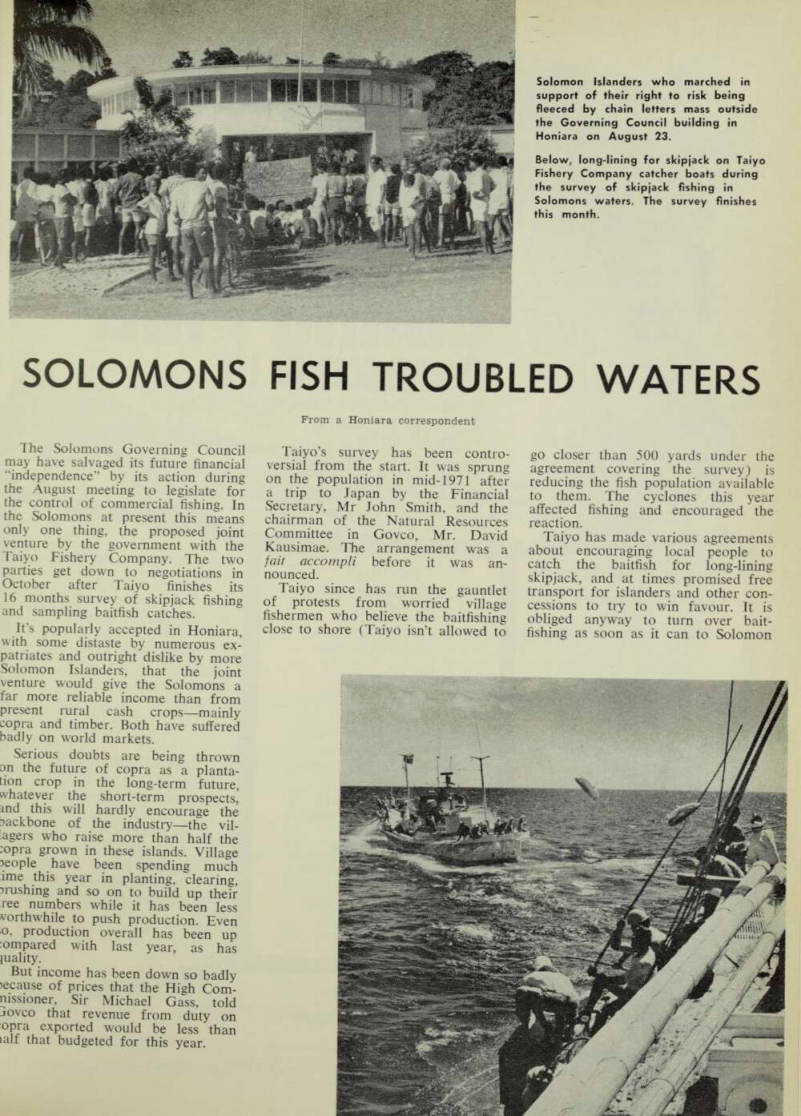
Solomon Islanders who marched in support of their right to risk being fleeced by chain letters mass outside the Governing Council building in Honiara on August 23.
Below, long-lining for skipjack on Taiyo Fishery Company catcher boats during the survey of skipjack fishing in Solomons waters. The survey finishes this month.
How's The 12-Mile Limit To Work?
Islanders if the joint project goes ahead, also it is required to “localise” its boats in place of the present Okinawan crews, which are spiced with about 180 locals at present.
Catcher boats are being levied S5OO a month each by government and this is expected to bring $78,000 by the end of this year. But Solomon Islanders who don’t want to give away their natural resources even in return for expertise, and others who haven’t forgotten World War 11, are con tinually stirring up opposition, if not enough to make any impression on Govco’s 17 elected members. They passed the enabling Fisheries Bill in August without a demurring speech or vote, with debate on the bill mainly taken up with concern over whether it would restrict Solomon Islanders from fishing with traditional methods even if the fish is for sale (it won’t), or how this poor country was to defend its extended waters from fish poachers.
The bill, by the way, changes the three-mile limit to a 12-mile limit.
It also provides for a fine of $5,000 for masters who poach, or goal; but the Financial Secretary squashed, for the present at least, any ideas of an infant navy or coastguard to enforce the new law, because of the enormous cost of running fast boats.
The difficulties of policing illegal fishing were pointed out by Mr Solomon Mamaloni, who described how only a few weeks before he had been on a government vessel which came across a foreign fishing vessel where it ought not be. A government officer in the bow aimed a stick so it looked like a rifle to warn the vessel off!
Even then, it was pointed out, even one first-class boat would be lucky to be in the right place at the right time. Members accepted that if Taiyo came, their presence would do as much as anything to ensure poachers kept out.
Taiyo is necessary because the Solomons’ financial future will look very sour if the group is to rely on its own sources of revenue for re current expenditure. At least that’s the story being put around by the govern ment, and its not hard to swallow.
Agriculture department plumps for diversification, and scattered acreages of chilli and turmeric have been planted. The first chillis were sold to New Zealand several months ago.
Cocoa is still being encouraged but because of past failures it has got nowhere with village people.
Cattle are only an import replace
ment, and the Guadalcanal Plains rice project still struggles against nature’s cyclonic blows to become a com plete import replacement alternative.
On top of all that, the vast Santa Ysabel Island timber reserves were chopped up badly by cyclone Ida this year so that an alternative is being sought, and again it’s the Japanese who have been visiting (in August through into September) to assess the prospects for a pulp wood industry which cyclones would not hurt nearly so much.
But what else did Govco do that meant a lot in the long term?
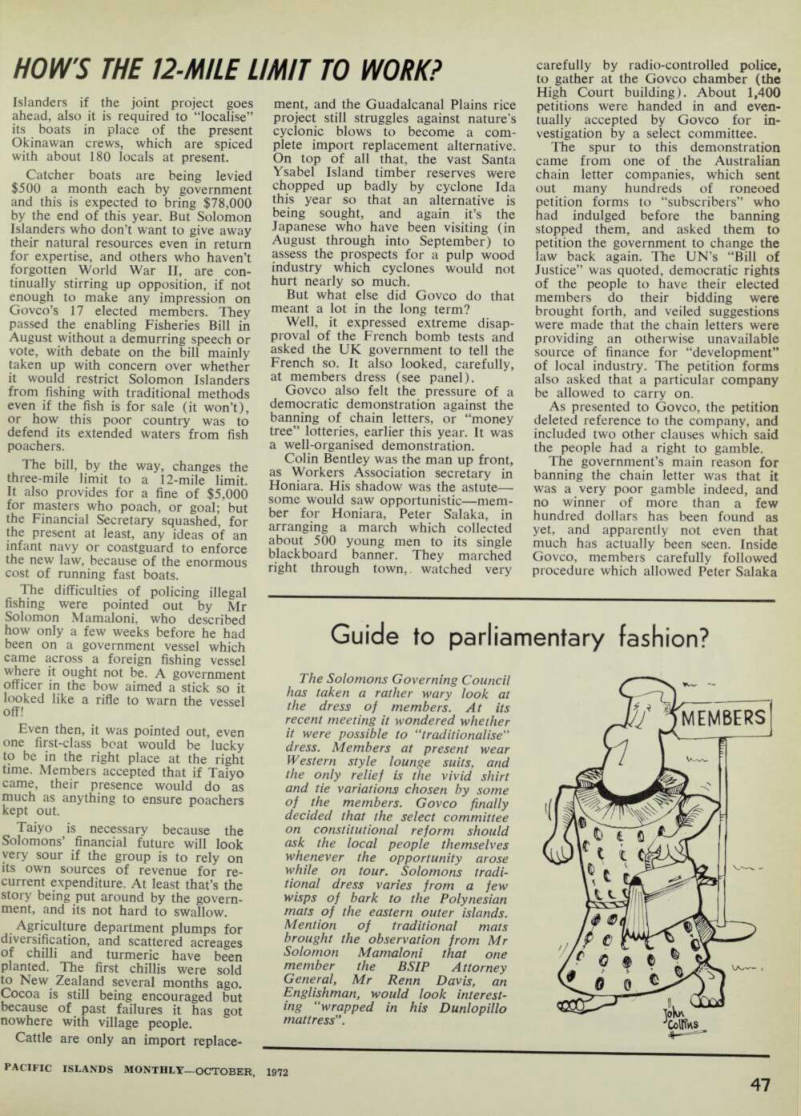
Well, it expressed extreme disap proval of the French bomb tests and asked the UK government to tell the French so. It also looked, carefully, at members dress (see panel).
Govco also felt the pressure of a democratic demonstration against the banning of chain letters, or “money tree” lotteries, earlier this year. It was a well-organised demonstration.
Colin Bentley was the man up front, as Workers Association secretary in Honiara. His shadow was the astute— some would saw opportunistic—mem ber for Honiara, Peter Salaka, in arranging a march which collected about 500 young men to its single blackboard banner. They marched right through town, watched very
to gather at the Govco chamber (the High Court building). About 1,400 petitions were handed in and even tually accepted by Govco for in vestigation by a select committee.
The spur to this demonstration came from one of the Australian chain letter companies, which sent out many hundreds of roneoed petition forms to “subscribers” who had indulged before the banning stopped them, and asked them to petition the government to change the law back again. The UN’s “Bill of Justice” was quoted, democratic rights of the people to have their elected members do their bidding were brought forth, and veiled suggestions were made that the chain letters were providing an otherwise unavailable source of finance for “development” of local industry. The petition forms also asked that a particular company be allowed to carry on.
As presented to Govco, the petition deleted reference to the company, and included two other clauses which said the people had a right to gamble.
The government’s main reason for banning the chain letter was that it was a very poor gamble indeed, and no winner of more than a few hundred dollars has been found as yet, and apparently not even that much has actuall y been seen - Inside Govco, members carefully followed procedure which allowed Peter Salaka
to present the petition “from all over the Solomons”, as he said. To be accepted, 14 of the 19 members in the chamber had to be in favour.
Fifteen were, including some who privately disparaged the particular gamble. Only one elected member, Gordon Siama (chairman of Com merce and Industry Committee) re mained seated with the three nominated civil servant members.
Cynics say that a number supported it because they fear the election early next year; there is no doubt a strong body of feeling is in favour of the chain letters.
Among the marchers were many Liu —a north Malaita word meaning roughly one who walks about doing nothing, a good description of Honiara’s body of school dropouts who are jobless. Absenteeism was said to be slight around town, although domestic servants’ absen teeism was difficult to assess.
And how are the leadership stakes, mentioned in these pages several months ago? Who could be the strong man in BSIP government? It’s a mighty man who can sit through all Govco sessions, so one can miss good performances, but of the Solomon Islanders one must look seriously at David Kausimae (chairman of Natural Resources Committee), who acquits himself well despite his obvious preference for wanting to use pidgin in place of the obligatory English; and the once flamboyant and now intense and thoughtful Solomon Mamaloni (member for Makira, Santa Cristoval). Others miss out for waffling, parochialism, lack of educa tion, extreme reticence, or op portunism, and perhaps old age.
But the next elected Govco will be the real proving ground, and the speed at which a leader can appear in a Pacific country under the pres sures of rapid localisation and progress to independence can be gauged by a look at Papua New Guinea next door, its chief minister, Michael Somare.
A woman at Ta’aru village on South Malaita, BSL, is growing jour new teeth. This would not normally be news, but Teresia Tarehoia is a 70year-old grandmother.
Many people from the surrounding area have visited the lady to inspect her new molars. Teresia can’t see what all the fuss is about. “It’s only a few teeth” she said.