Footnotes
pp. 44-45 · Read in the full issue
the recent round of talks, referred to in last month’s PIM, between Australian Minister for External Territories Andrew Peacock and Papua New Guinea’s National Coalition Government, two interesting announcements were made by Chief Minister Michael Somare.
The first was that District Administration, until now a division within the Department of the Administrator, will in future come under the control of the Office of the Chief Minister.
The second was that it is Mr Somare’s intention to maintain the “kiap system” intact.
“Kiap” is a Pidgin word which is applied to the hierarchy of officers of the district admini stration service from district commissioners down to patrol officers. Father Mihalic’s dictionary derives it from the English word “captain”; other derivations have been suggested. Wherever it came
from, it has long been a key word in the language of govern ment in New Guinea; and since World War II it has become widely known and used in Papua, sometimes with a slightly oppro brious connotation which per haps it doesn’t bear on its New Guinea homeland.
In both territories it has con noted an authoritarian system of government, which, to be fair to it, was necessary, and not un acceptable to the governed in the
past. In the present, though less necessary, it is still acceptable to the people in some areas, though less so in others.
What then, in essence, is the “kiap system”?
I suggest that basically it may be defined as the decentralised implementation of centrally made decisions. Formerly made by Konedobu and Canberra, these decisions are being made more and more by an elected central government. This is a step in the right direction, but it isn’t what I mean by decentralisation, and it isn’t what Dr John Guise, now Mr. Somare’s Minister for the Interior, used to mean, and I hope still means, by decentralisation.
What we have meant by decentralisation is
Time For A
Melanesian
Forum?
decentralisation of decision making—to local government councils and to intermediate bodies such as the proposed “area authorities” and Dr Guise’s envisaged “provincial assemblies”.
Failure to face up to the distinction between these two kinds of decentralisation has been re sponsible not only for much muddled think
ing but also for some tense situa tions. It has been the main cause of friction between local govern ment councils and their kiap ad visers; and in the past no one has more vehemently espoused the cause of the councils vis-a vis the kiaps than Dr Guise.
Does the declared intention of the Chief Minister to retain the kiap system mean that he wants centralised decision making, with decentralisation only of the de cision implementation? And if
so where does his deputy, Dr Guise, now stand?
But perhaps Mr. Somare doesn’t mean this.
In a recent address at the Administrative Col lege, he. stated that there was a great need for regional government in Papua New Guinea. Let us hope that he really means regional govern ment, that is, regional decision making, and not merely regional administration.
Recently a certain coolness sprang up between the ministry of not yet completely self-governing Papua New Guinea and that of now independent
With Percy Chatterton
in Port Moresby
Fiji on the question of Papua New Guinea’s admis sion to the South Pacific Forum.
The thinly veiled threats of some PNG ministers that if the South Pacific doesn’t want us we might look for friends elsewhere was probably no more than a passing pique. But they do point up a very real dilemma in which Papua New Guinea is likely to find itself as it moves into indepen dence. Which way should it orientate itself?
Should it look eastwards towards Polynesia for its friends, or west or north towards Indonesia and South-east Asia?
It is clear that Paguinean leaders currently take very seriously the need for maintaining good re lations with Indonesia, and in the future members of the Free Papua Movement fleeing West Irian and seeking political asylum in Papua New Guinea are likely to receive an even cooler welcome from a self-governing Papua New Guinea than they received in the past from the Australian colonial government.
But are the two alternatives I have referred to the only ones? I suggest that they are not, and that there is a third possibility, namely, the estab lishment of a Melanesian Forum.
In the past the idea of a Melanesian Federation has not taken root, perhaps because it was envi saged too much on western, and particularly on Australian lines.
Maybe the time is ripe for taking the idea out of moth balls and looking at it with fresh eyes. For, in the meantime, the new nations of East Africa have been experimenting with a dif ferent kind of federation, and it might be worth while for the emerging Melanesian nations to take a look at its possibilities. A Melanesian Forum might well be the foundation on which an East African style federation could be built.
It is clear that the egalitarian traditions of Melanesia are very different from, on the one hand, the chiefly traditions of Polynesia, and, on the other, the traditions of Indonesia and South east Asia with centuries-old civilizations behind them. It is still not too late to develop a Mela nesian bloc which, while maintaining friendly re lations with the peoples both to its east and to its west, would preserve its own identity.
Those of us who, during the past few years, have criticised Papua New Guinea’s income tax structure will regret that its re-structuring, fore shadowed in a white paper tabled last year in the second House of Assembly, has been post poned for yet another year. It is a re-structuring
long overdue.
The National Coalition Government can reason ably claim that it has not yet had much time to settle itself in the saddle. But is this, one wonders, the real reason for the deferment, or is there a reluctance to pick up what may prove to be a hot potato?
Our present income tax system is in fact two systems, one for high and one for low incomes; and at the point where they overlap and coalesce there has been some very bad joinery leading to serious inequities—inequities which would have been ironed out by the adoption of the system proposed in the white paper.
Let us hope that there will be no fumbling next year. An income tax system which allows to the rich the benefit of concessional deductions for dependents which it denies to the poor de serves to be listed as one of those things which the Chief Minister will not tolerate.
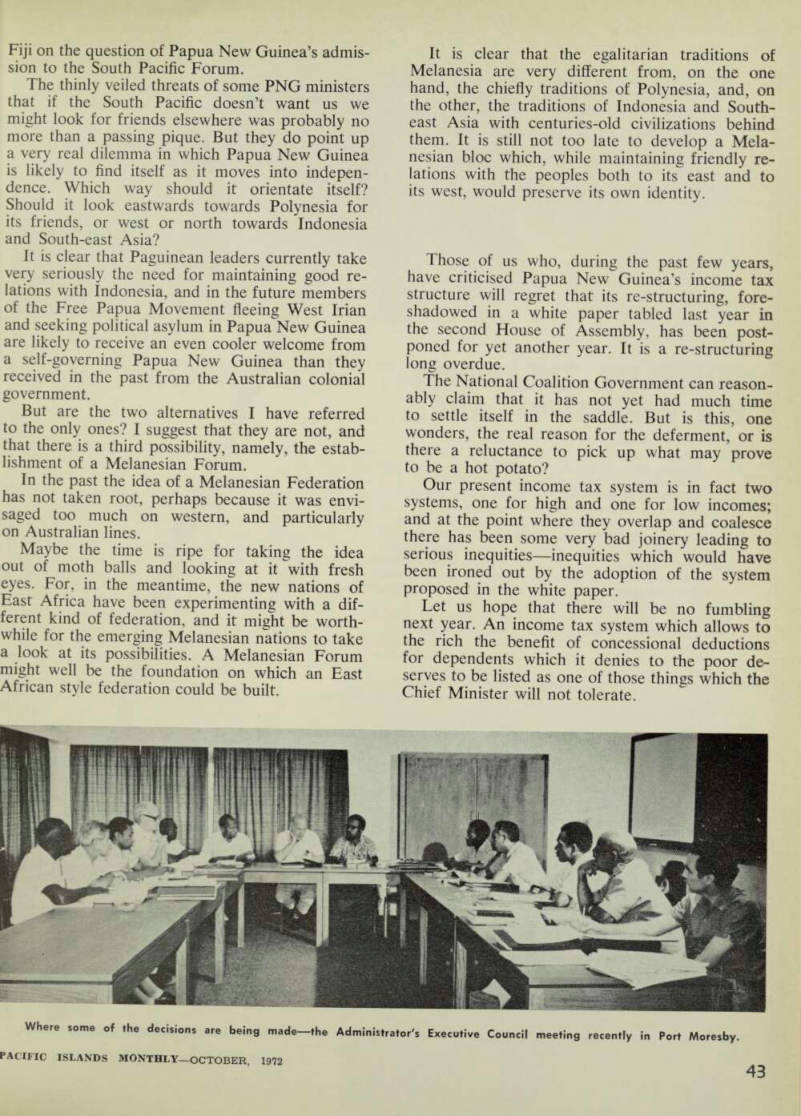
Where some of the decisions are being made—the Administrator's Executive Council meeting recently in Port Moresby.