of post-colonial relationships"
pp. 20-22 · Read in the full issue
They're building together "a new pattern of post-colonial relationships"
From JOHN CARTER , in Suva
The three days which the leaders of the five independent or self governing Island countries spent at the South Pacific Forum on the campus at the University of the South Pacific in Suva in September could be the most momentous in the history of the Islands.
In about 13 hours of discussion, the Forum, meeting for the third time, tabulated the Islands’ problems, suggested some solutions, created its first infant—the Bureau for Economic Co-operation—gave the infant some pointers on how to earn its keep and ensured the willing co-operation of the elder brethren, Australia and New Zealand.
It was only mildly political, ad ministering a rap to France over the nuclear tests. The rest of its labours were confined to the things which can make the Islands pros perous.
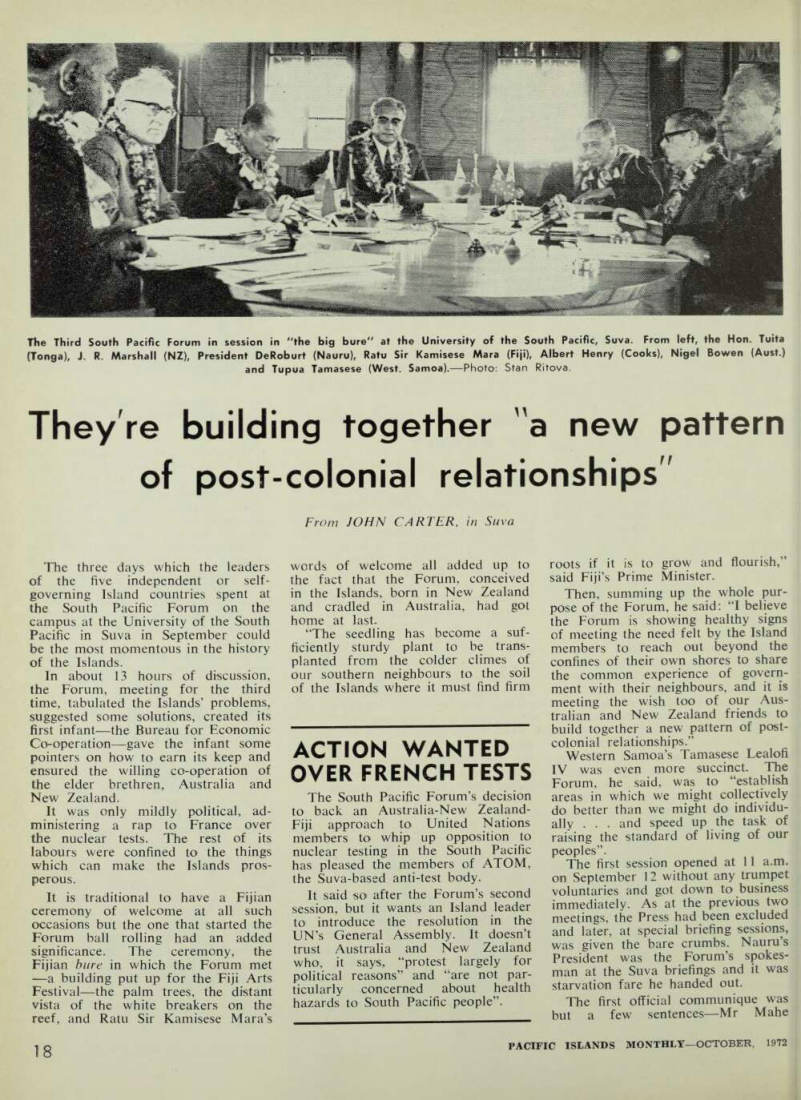
It is traditional to have a Fijian ceremony of welcome at all such occasions but the one that started the Forum ball rolling had an added significance. The ceremony, the Fijian bure in which the Forum met —a building put up for the Fiji Arts Festival—the palm trees, the distant vista of the white breakers on the reef, and Ratu Sir Kamisese Mara’s
words of welcome all added up to the fact that the Forum, conceived in the Islands, born in New Zealand and cradled in Australia, had got home at last.
“The seedling has become a suf ficiently sturdy plant to be trans planted from the colder climes of our southern neighbours to the soil of the Islands where it must find firm
roots if it is to grow and flourish,” said Fiji’s Prime Minister.
Then, summing up the whole pur pose of the Forum, he said: “I believe the Forum is showing healthy signs of meeting the need felt by the Island members to reach out beyond the confines of their own shores to share the common experience of govern ment with their neighbours, and it is meeting the wish too of our Aus tralian and New Zealand friends to build together a new pattern of post
colonial relationships.”
Western Samoa’s Tamasese Lealofi IV was even more succinct. The Forum, he said, was to “establish areas in which we might collectively do better than we might do individu ally . . . and speed up the task of raising the standard of living of our
peoples”.
The first session opened at 11 a.m. on September 12 without any trumpet voluntaries and got down to business immediately. As at the previous two meetings, the Press had been excluded and later, at special briefing sessions, was given the bare crumbs. Nauru s President was the Forum’s spokes man at the Suva briefings and it was starvation fare he handed out.
The first official communique was but a few sentences —Mr Mahe
The Third South Pacific Forum in session in "the big bure" at the University of the Sooth Pacific, Suva. From left, the Hon. Tuita (Tonga), J. R. Marshall (NZ), President DeRoburt (Nauru), Ratu Sir Kamisese Mara (Fiji), Albert Henry (Cooks), Nigel Bowen (Aust.) and Tupua Tamasese (West. Samoa). — Photo: Stan Ritova.
Islands Want Wider Trade Ties
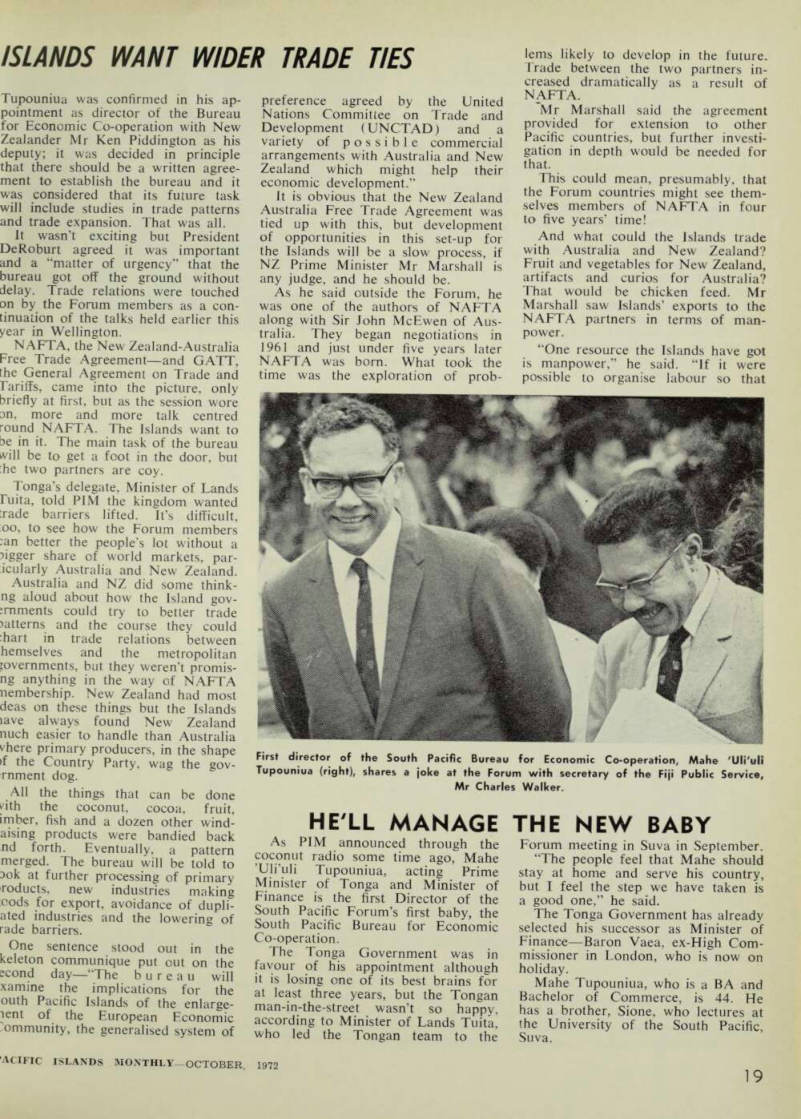
Tupouniua was confirmed in his ap pointment as director of the Bureau for Economic Co-operation with New Zealander Mr Ken Piddington as his deputy; it was decided in principle that there should be a written agree ment to establish the bureau and it was considered that its future task will include studies in trade patterns and trade expansion. That was all.
It wasn’t exciting but President Deßoburt agreed it was important and a “matter of urgency” that the bureau got off the ground without delay. Trade relations were touched on by the Forum members as a con tinuation of the talks held earlier this year in Wellington.
NAFTA, the New Zealand-Australia Free Trade Agreement—and GATT, the General Agreement on Trade and Lariffs, came into the picture, only briefly at first, but as the session wore an, more and more talk centred round NAFTA. The Islands want to be in it. The main task of the bureau will be to get a foot in the door, but :he two partners are coy.
Tonga’s delegate, Minister of Lands Luita, told PIM the kingdom wanted •fade barriers lifted. It’s difficult, 00, to see how the Forum members :an better the people’s lot without a digger share of world markets, par icularly Australia and New Zealand.
Australia and NZ did some think ng aloud about how the Island gov ernments could try to better trade )atterns and the course they could :hart in trade relations between hemselves and the metropolitan governments, but they weren’t promis ng anything in the way of NAFTA nembership. New Zealand had most deas on these things but the Islands lave always found New Zealand nuch easier to handle than Australia vhere primary producers, in the shape •f the Country Party, wag the gov rnment dog.
All the things that can be done idth the coconut, cocoa, fruit, imber, fish and a dozen other wind aising products were bandied back nd forth. Eventually, a pattern merged. The bureau will be told to 3ok at further processing of primary roducts, new industries making cods for export, avoidance of dupli ated industries and the lowering of rade barriers.
One sentence stood out in the keleton communique put out on the day—“The bureau will xamine the implications for the outh Pacific Islands of the enlarge ment of the European Economic immunity, the generalised system of
preference agreed by the United Nations Committee on Trade and Development (UNCTAD) and a variety of possible commercial arrangements with Australia and New Zealand which might help their economic development.”
It is obvious that the New Zealand Australia Free Trade Agreement was tied up with this, but development of opportunities in this set-up for the Islands will be a slow process, if NZ Prime Minister Mr Marshall is any judge, and he should be.
As he said outside the Forum, he was one of the authors of NAFTA along with Sir John McEwen of Aus tralia. They began negotiations in 1961 and just under five years later NAFTA was born. What took the time was the exploration of prob
lems likely to develop in the future.
Trade between the two partners in creased dramatically as a result of
Nafta.
Mr Marshall said the agreement provided for extension to other Pacific countries, but further investi gation in depth would be needed for that.
This could mean, presumably, that the Forum countries might see them selves members of NAFTA in four to five years’ time!
And what could the Islands trade with Australia and New Zealand?
Fruit and vegetables for New Zealand, artifacts and curios for Australia?
That would be chicken feed. Mr Marshall saw Islands’ exports to the NAFTA partners in terms of man power.
“One resource the Islands have got is manpower,” he said. “If it were possible to organise labour so that
First director of the South Pacific Bureau for Economic Co-operation, Mahe 'Uli'uli Tupouniua (right), shares a joke at the Forum with secretary of the Fiji Public Service, Mr Charles Walker.
the Islands could produce components and assemble more sophisticated pro ducts for which there is an export market that would be one answer.”
And that’s the sort of thing the bureau, which is already known as SPEC, will tackle.
Another subject which brought some verbiage and a resolution from the Forum was that of nuclear test ing—with France in mind, of course.
As the preliminary communique put it, “The Forum supported steps being taken by Australia, New Zealand and Fiji to mobilise inter national opinion to bring about the cessation of all nuclear weapon tests”.
Spokesman President DeRoburt said the Forum was generalising and didn’t single out France.
But it was obvious when the final communique was produced—and it took some time for the Forum to agree on its wording—that the Forum had meanwhile decided to point the finger at France. ‘‘Members were unanimous in ex pressing their deep concern that the French Government should have failed so signally to accord recog nition to the wishes of the peoples of the South Pacific area despite the views so clearly indicated by both governments and peoples,” said the communique.
Despite the ban on politics in the South Pacific Commission, it wouldn't be surprising if there’s a nuclear fall out at the Apia meeting in late Sep tember.
With so much water and so little land, the members concentrated a lot of thinking on the Law of the Sea Conference planned in Geneva. There are some knotty problems there— what constitutes territorial waters and international waters in the middle of an archipelago*, and control of fishery zones?
The Forum heard from Tonga about its Minerva Reef dispute with the self-styled Republic of Minerva.
There have been rumours sparked off by a United States newspaper report that the republic is recruiting an army of mercenaries to defend its rights to the reef.
“President” Davis was quoted as saying that they wouldn’t attack Tonga itself because Tonga had nothing they wanted. Judging by the Forum’s tone, the republic would have to take on the whole of the South Pacific.
The Forum’s view was that it “welcomed the Tongan Government’s continuing interest in the area and agreed that there could be no ques tion of recognising other claims, and specifically that of the Ocean Life Research Foundation to sovereignty over the reefs”.
Regional shipping was an impor
tant item but although the subject was given a thorough airing the Forum made little progress and will depend on the bureau to come up with some answers on how to create a viable shipping line and keep freight rates down.
There was no mention in the re lease of the Union Steam Ship Company’s offer of a 50 per cent, share in a new shipping project (see p. 83) but Ratu Mara revealed after the meeting that the members were less than lukewarm over the offer.
The Forum as a whole did not lean towards accepting the offer, he said.
The largest increase in freight rates had been in the New Zealand services.
There was probably another factor influencing the Forum—the impudent declaration by the NZ Seamen’s Union that it would “interfere” with services by ships of a South Pacific regionally-owned line if their mem bers’ jobs were threatened.
Mr Marshall, however, doesn’t favour an Islands’ regional shipping line. He said outside the Forum that he much preferred private enterprise to gov
ernment-owned shipping.
“We wouldn’t oppose the sug gestion of an Islands regional ship ping line but we would point out the problems, of the need for suitable ships, regularity of service and reasonable freight rates, he said.
This was one area where Australia must have felt it could do some par ticular good because Mr Bowen offered his country’s help in the study the bureau will make of shipping.
It was early in the agenda that the Forum showed wise statesmanship in dealing with a tricky problem posed by Papua New Guinea, which had asked for membership of the Forum.
From the beginning, membership has
been confined to independent or self
governing countries.
The Forum stuck to its guns but neatly cut a back door for PNG. It did it this way. PNG has now been invited to attend future meetings as an observer until such time as it meets the criterion for full member
ship.
Unless something unusual happens to bring the Forum together it won’t meet again till next September, and PNG may have met the criterion by then. It expects to be self-governing by the end of next year.
Meanwhile, the Forum decided that membership of the bureau could be opened to others if their applications were approved and it also decided to make the bureau’s services avail able to any territory in the region whether it contributed to the finances or not. That should earn the forum some goodwill.
There were other matters con sidered and pronounced upon — education, an approach to UNESCO for a conference along with the SPC
on population problems, urbanisation
and resettlement, tourism, university finances and the UNDP’s recom mendation of the establishment of a regional development bank.
Australia’s Foreign Minister, Mr Bowen, thought it had been a very satisfactory three days. He told PIM: "Discussions were very full and very frank and I think the topics dealt with have been very important to the region. I think the bureau which has been created will bring a concentra tion on trade and economic issues which will assist the Forum towards getting real solutions.”
To sum up, the Forum’s meeting was a great success. It has come of age in just over a year, and in three meetings.
• Full communique, p. 123.
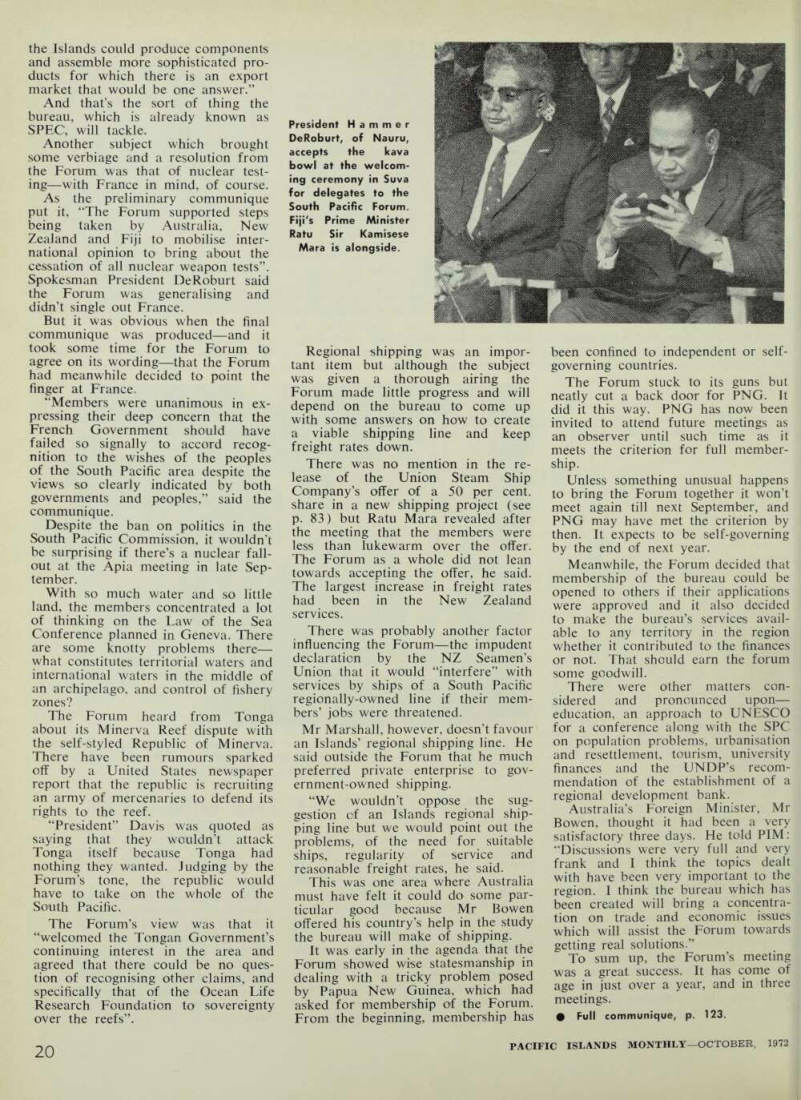
President Hammer DeRoburt, of Nauru, accepts the kava bowl at the welcom ing ceremony in Suva for delegates to the South Pacific Forum.
Fiji's Prime Minister Ratu Sir Kamisese Mara is alongside.