Tropicalities
pp. 17-19 · Read in the full issue
He’s grappling
(intelligently)
with edueation
Education is high on the list of Fiji’s “national problems” and if youthful new Minister for Education, ¥outh and Sport, Mr Jone Naisara, xrnld perform miracles, he would.
Since taking on the job four nonths ago, Mr Naisara’s task has ?een to sort out priorities, a thankless occupation even the most ardent critic of government policies might shirk.
He has on his desk a long and growing list of things his ministry vould like to achieve—and they all xost money.
Fiji this year spent $9.4m on edu cation—or 22i cents out of every lollar’s worth of revenue raised by he government. Just under S7m of his went on teachers’ salaries—which loesn’t leave much over for the nultitude of urgent projects jostling or priority.
Fiji has 12,000 children of primary chool age who’ve never attended chool, or who’ve had to leave be cause their parents can’t pay the fees, the money spent by the Fiji jovernment on educating one handi capped child, five of the non-handi capped children could be educated.
Vhich should come first?
Mr Naisara’s ministry is under in creasing pressure to assist financially n the introduction of a widespread ystem of pre-school education. Is it nore important than the provision of )rimary school facilities for those 2,000 non-attenders?
The government has already de cided to introduce fee-free primary education in the next five years, but t will be many years before a similar ystem can be adopted for secondary chool pupils. With secondary school tudents increasing by more than •’OOO a year, there’s a great need to ncrease government expenditure on he award of free or partly-free places, iut is it more urgent than providing •re-school facilities, for instance, or acilities for handicapped youngsters?
As a major cause of spiralling
building industry costs in Fiji is the growing shortage of competent trades men, part of the answer would be to establish up-grading courses for those already in jobs and initial training courses in the basic skills for the un employed. But should they have priority though over the increased allocation of teacher-training scholar ships, when last year more than 1,300 untrained teachers were employed in Fiji’s schools, 300 of them at second ary school level?
During Education Week in Fiji in September, Mr Naisara posed these and other questions, adding that his ministry certainly didn’t claim to know all the answers.
“We obviously cannot expect a big increase in our present share of 221 per cent, of government revenue,” he said.
“To decide what we should do first and what we should defer is not as easy a task as some of our critics seem to think. I am in no doubt that the priority list we are now preparing will be a sensible one. I am equally sure that it will not please everyone.”
That’s for sure—but at least Mr Naisara can’t be accused of talking pie in the sky. He doesn’t promise miracles.
Jimmy Stephens
about-turn
Has Jimmy Stephens, leader of the Na-Griamel movement in the New Hebrides, changed his tune?
British and French officials there think that Na-Griamel, which was a thorn in their side, has altered its policy of non-co-operation to a more positive, helpful one.
Their hopes were raised through speeches he made at the movement’s headquarters at Vanafo, Santo, in August.
Jimmy told more than 400 of his followers during five days of celebra tions to mark their anniversary that they must co-operate more with the French and British authorities. This, opinioned the British Newsletter, the British administration’s mouthpiece, appeared to mark a welcome change in Na-Griamel policy.
Tongan soc*4*er
gets a boost
Tonga’s keenest soccer fan, King Taufa’ahau Tupou IV, was away in England when the combined Fiji Southern Division and Labasa soccer side arrived in Nukualofa on Sep tember 1. But the king had given clear instructions before he left. “Look after them,” he told Tongan soccer officials.
Well, they did. The 17 Fiji players and two officials found everything throughout the 11-day tour free—the return voyage from Suva in the Tongan Government ship Aoniu, accommodation at Tongan Football Association president Hameti Mataele’s huge house, all meals and a lot of the New Zealand Steinlager beer at the ageing Tongan Club.
But while they may have over whelmed the Fiji side with hospitality
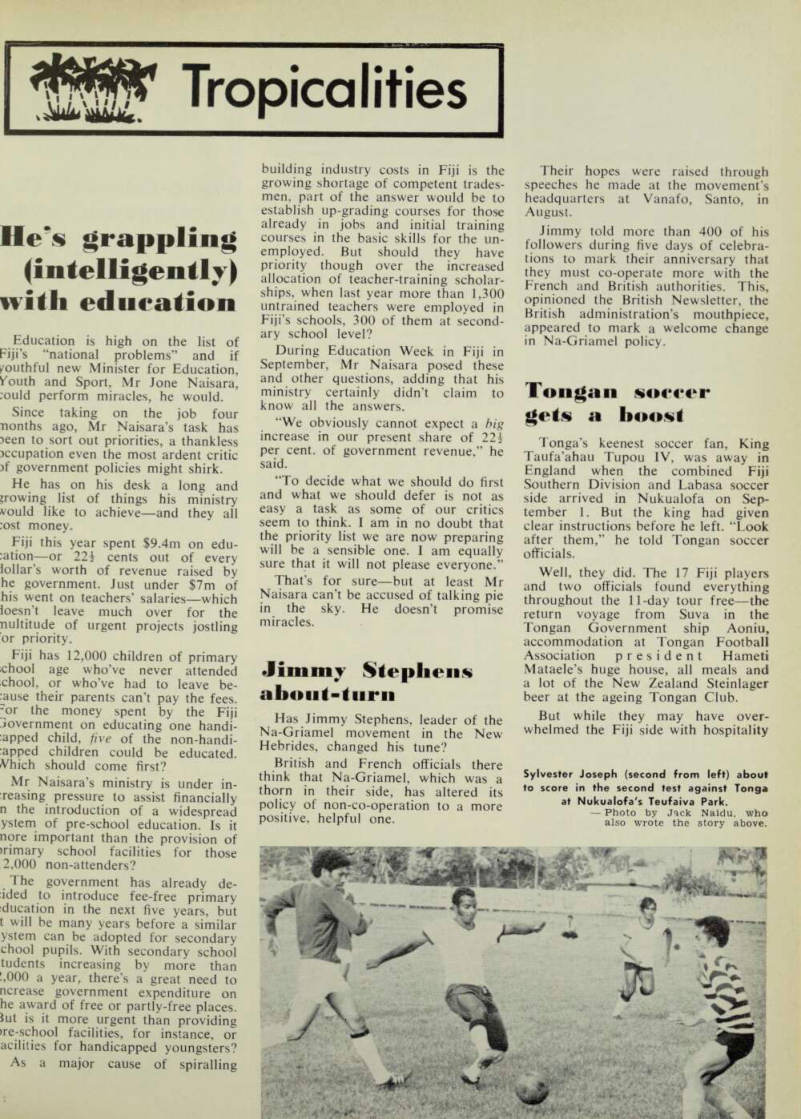
Sylvester Joseph (second from left) about to score in the second test against Tonga at Nukualofa's Teufaiva Park.
Photo by Jack Naidu, who also wrote the story above.
—they lagged on the field of play.
The first test, which was the first match of the tour, showed that Tongan soccer was a little behind the times. Fiji won 6-0.
But keenness and interest in the game were very much to the fore.
What is really needed is a good soccer coach to teach them the basics of the game. Perhaps the only person in Tonga who has some idea of the game is the secretary to the British High Commission in Nukualofa, John Carrol who hails from Liverpool, England.
As the visitors played the Tongans quickly caught on to some of the tactical and positional play. Fiji’s second last match against a combined Ngeleia and Uta side nearly ended in a draw, but Fiji just managed to score in the dying minutes of the game to win 2-1, On the tour the Fiji side scored 24 goals and conceded only three.
It could have done even better, but the team stormed trying to get goals and concentrated on demonstrating some finer points of the game. Dribb ling, ball control, long and short passes, running into the gaps and some hard shooting from outside the penalty box had the Tongans puzzled for a while.
The Tongans should take the in itiative and start its soccer in the primary schools.
“ The Tongan Football Association is virtually penniless and outside com petition is scarce,” said association president, Hameti Mataele. “But we hope that this step of inviting a com bined side here will improve our standard of the game and we hope in years to come that we may be able to send a good side to Fiji.”
Fiji’s manager, Mr Moti Musadilal has already invited a Tongan side to tour Fiji next year. But if a Tongan side should tour Fiji, it ought to play club sides and be given special coach ing sessions.
A remarkable part of the tour was
the Tongan friendliness and hospitality. Even their girls who outnumber the boys three to one were never so friendlv It the Fiji team did not find much to keep it occupied on the field, it surely found it when it came off!
All comrades
in the Cooks
It’s not recorded that anyone sang the Volga Boatmen but a Russian officer whirled around the stage in a Georgian dance at Rarotonga’s Maruaiai Danceland during a visit to the Cooks in August by the Russian meteorological ship Volna.
The islanders entertained their guests as only islanders can and the Russian were no less friendly.
Not to be outdone in hospitality, the Volna’s captain threw a party on board his ship for Cabinet Chairman Mr Geoffrey Henry and other
cabinet members and also presented films on the USSR to Tereora College.
The junket lasted four hours.
“The visit of the Russian Meteor ological Research team has certainly done something to create friendship between our two nations,” enthused the Cook Islands News.
Super-colossal TV
extravaganza soon
The hour-long colour film on the first South Pacific Arts Festival, which was held in Suva in May, is about to be released to the world television. The festival’s executive officer, Victor Carell, put the last of the film together in Sydney in Sep tember—including a narration taped by Raymond Burr and flown from Hollywood. Burr, surely one of TV’s “greats”, has extensive Fiji interests and has done the narration (written by Carell) for free as his contribution to the festival.
Pacific Hotels and Developments Ltd., the company behind the big Deuba development in Fiji, has put up the money to make it possible for every one of the 18 territories which took part in the festival to receive free copies of the 16 mm film. The South Pacific Commission gets two copies.
Said Carell in Sydney: “Every territory is represented on the film, and all aspects of the festival.
There were five cameras there. The TV impact can be nothing less than enormous.”
At last the Gilbert and Ellice Islands Colony's weekly newsletter has a name other than the prosaic "Colony Information Notes" which it has carried on the masthead for years.
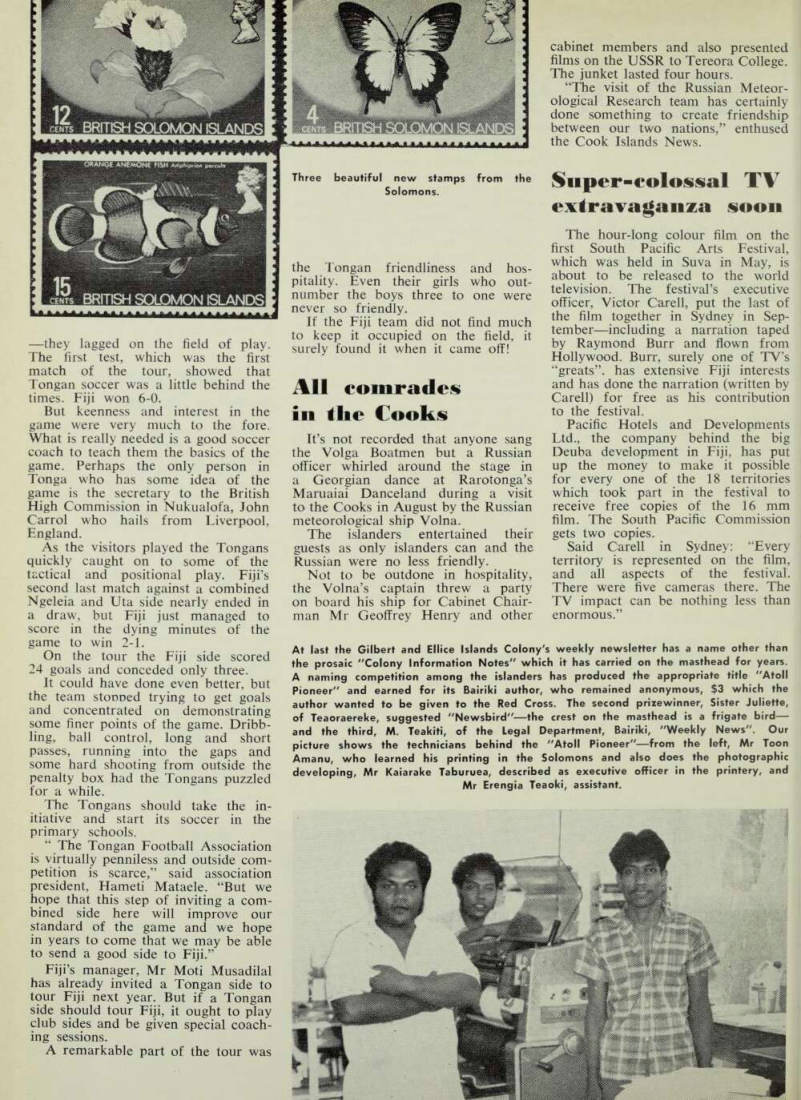
A naming competition among the islanders has produced the appropriate title "Atoll Pioneer" and earned for Its Bairiki author, who remained anonymous, $3 which the author wanted to be given to the Red Cross. The second prizewinner, Sister Juliette, of Teaoraereke, suggested "Newsbird" —the crest on the masthead is a frigate bird— and the third, M. Teakiti, of the Legal Department, Bairiki, "Weekly News". Our picture shows the technicians behind the "Atoll Pioneer" —from the left, Mr Toon Amanu, who learned his printing in the Solomons and also does the photographic developing, Mr Kaiarake Taburuea, described as executive officer in the printery, and
Mr Erengia Teaoki, assistant.
Three beautiful new stamps from the Solomons.
On fire for
National Dav
w Papua New Guinea’s National Day celebrations, held this year on Mon day, September 11, seem to be settling down into a discernible pat tern. This pattern includes plenty of fun and games, ranging from tradi tional singing and dancing through string band competitions to football matches and other sporting fixtures, laced with speeches by kiaps, parlia mentarians and other dignitaries on :he subject of national unity.
It will soon become as difficult to jay anything fresh in a National Day speech as it already is in an Anzac Day one. Nevertheless, this year some 'ery good speeches were made, and ve were encouraged to note that ome of the sentiments expressed sug gested that the speakers who voiced hem were regular readers of Percy :hatterton’s PIM “Footnotes”!
In Port Moresby, a soccer match >etween a PNG team and a visiting earn from the New Hebrides drew i capacity crowd of 15,000 to the »ir Hubert Murray Stadium to see he home side win 3-1. Later they leard speeches from the Adminis rator, the Lord Mayor of Port Moresby, Gala Gala Rarua, and the aernber for Central Regional, Miss • M. Abaijah, The last-named per ormed gracefully in a role for which lost people would never have dared 3 cast her.
All, or nearly all, was peace and oodwill. Even the lion and the lamb, by the Australian Broad asting Commission and the Adminis ■ation Radio Network, lay down to ether and concocted a joint National )ay programme. Everybody tried ery hard, yet listening one came to -alise how fatally easy it is for any ne with a microphone thrust in ont of him to waffle on without dually saying anything.
Probably not all was peace and lodwill. At Popondetta, in the orthern District, an angry crowd lased two men from the Gulf Dis ict through the town and stoned ic buildings in which they succes vely took refuge.
Two days after the nationwide chortations to bung wantaim, a mini ar, causing three deaths and much jstruction of property, broke out Jtween rival tribal groups in the
Astern Highlands.
Is National Day worth celebrating 9 r e believe it is. Well, it’s fun, in a orld in which there’s not nearly as uch fun as there should be. And it merates a lot of goodwill, even if me of it is rather evanescent.
But clearly National Day will not ilidate New Guinea’s national unity.
It will have to be the other way round.
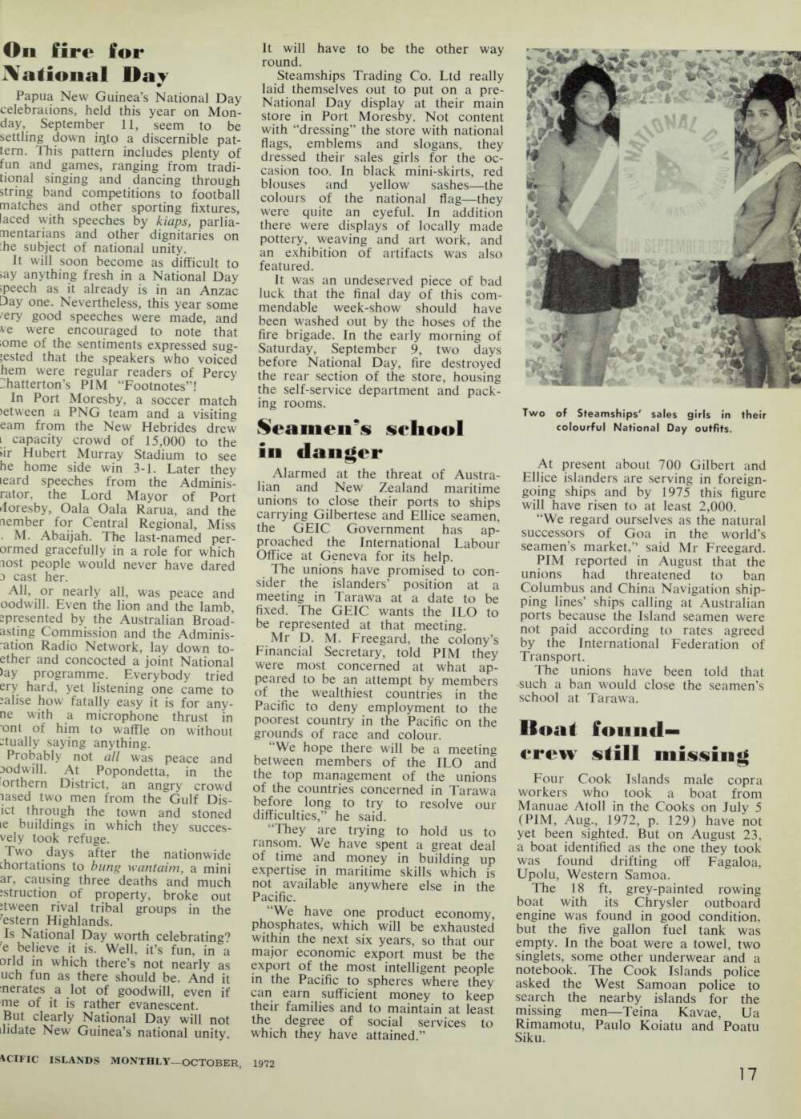
Steamships Trading Co. Ltd really laid themselves out to put on a pre- National Day display at their main store in Port Moresby. Not content with “dressing” the store with national flags, emblems and slogans, they dressed their sales girls for the oc casion too. In black mini-skirts, red blouses and yellow sashes—the colours of the national flag—they were quite an eyeful. In addition there were displays of locally made pottery, weaving and art work, and an exhibition of artifacts was also featured.
It was an undeserved piece of bad luck that the final day of this com mendable week-show should have been washed out by the hoses of the fire brigade. In the early morning of Saturday, September 9, two days before National Day, fire destroyed the rear section of the store, housing the self-service department and pack ing rooms.
Seamen’s school
in danger
Alarmed at the threat of Austra lian and New Zealand maritime unions to close their ports to ships carrying Gilbertese and Ellice seamen, the GEIC Government has ap proached the International Labour Office at Geneva for its help.
The unions have promised to con sider the islanders’ position at a meeting in Tarawa at a date to be fixed. The GEIC wants the ILO to be represented at that meeting.
Mr D. M. Freegard, the colony’s Financial Secretary, told PIM they were most concerned at what ap peared to be an attempt by members of the wealthiest countries in the Pacific to deny employment to the poorest country in the Pacific on the grounds of race and colour.
“We hope there will be a meeting between members of the ILO and the top management of the unions of the countries concerned in Tarawa before long to try to resolve our difficulties,” he said.
“They are trying to hold us to ransom. We have spent a great deal of time and money in building up expertise in maritime skills which is not available anywhere else in the Pacific.
“We have one product economy, phosphates, which will be exhausted within the next six years, so that our major economic export must be the export of the most intelligent people in the Pacific to spheres where they can earn sufficient money to keep their families and to maintain at least the degree of social services to which they have attained.”
At present about 700 Gilbert and Ellice islanders are serving in foreign going ships and by 1975 this figure will have risen to at least 2,000.
“We regard ourselves as the natural successors of Goa in the world’s seamen’s market,” said Mr Freegard.
PIM reported in August that the unions had threatened to ban Columbus and China Navigation ship ping lines’ ships calling at Australian ports because the Island seamen were not paid according to rates agreed by the International Federation of Transport.
The unions have been told that such a ban would close the seamen’s school at Tarawa.
Koat found—
crew still missing
Four Cook Islands male copra workers who took a boat from Manuae Atoll in the Cooks on July 5 (PIM, Aug., 1972, p. 129) have not yet been sighted. But on August 23, a boat identified as the one they took was found drifting off Fagaloa, Upolu, Western Samoa.
The 18 ft, grey-painted rowing boat with its Chrysler outboard engine was found in good condition, but the five gallon fuel tank was empty. In the boat were a towel, two singlets, some other underwear and a notebook. The Cook Islands police asked the West Samoan police to search the nearby islands for the missing men—Teina Kavae, Ua Rimamotu, Paulo Koiatu and Poatu Siku.
Two of Steamships' sales girls in their colourful National Day outfits.