Tragedy Of Eniwetok One Good
pp. 34-35 · Read in the full issue
Bombing Deserves Another
From a correspondent in Saipan
Ever since 1886, when the Germans occupied the Marshall Islands, Eniwetok has been under continuous alien control. Military utilisation of Eniwetok began in 1939 as the Japanese geared their forces for war.
After 1944, Eniwetok was held by the US as a military base. In 1946, the Eniwetokese were exiled from their native land; Eniwetok being the target of thermo-nuclear bomb test ing by the US Government. Although the Eniwetokese were told they had to vacate their atoll, they claim that at no time were they ever advised that their homeland was to be de vastated. Had they been so informed, they claim, they would have never allowed the military to remove them from Eniwetok.
From Eniwetok the Eniwetokese were moved to Ujelang atoll, where, for the next 12 years, their life was fraught with hardship resulting from an unfavourable environment and poor service by government supply ships. Until the nuclear test ban of 1958, Eniwetok was rocked by over 30 nuclear detonations. So severe were the explosions that three whole islands of the atoll disappeared without trace. Even today, the remain ing islands bear a resemblance to the surface of the moon.
For years the reiterated plea of the Eniwetokese to return to their homeland fell on deaf ears. Finally, in 1971, the displaced people of Eniwetok made a public proclama tion that they would return to Eniwetok, no matter what, within one year. Soon to take up the banner
of the Eniwetokese were lawyers employed by Micronesian Legal Services, Inc. of Majuro.
This April, the United States an nounced that the military would return Eniwetok to the Eniwetokese by the end of 1973. Shortly after, the Trust Territory Government arranged a visit to Eniwetok for the leaders of its people, their attorneys; and military officials and their attorneys.
The Eniwetokese were greeted by a scene that confirmed their worst fears and has left them gravely embittered. Where there were once islands, conspicuous gaps now spoil the shape of the atoll. The remaining islands on the atoll bear huge craters which are breeding grounds for the most plentiful form of life now on Eniwetok—swarms of mosquitoes.
But, what pains the Eniwetokese now, even more than the past destruc tion is the continued bombing of their atoll under the current Pacific Cratering Experiment (PACE). The PACE project is sponsored by the US Air Force and consists of further blasting what is left of Eniwetok through the use of quantities of TNT so enormous that they simulate the effects of nuclear explosion.
The lawyers who represent the Eniwetokese have insisted that any use of the atoll must be justified in terms of how the environment of Eniwetok will be affected. They have submitted that only human con siderations should govern future activities on Eniwetok.
For the present, at least, the Eniwetokese have not demanded a halt to the PACE bombing. They
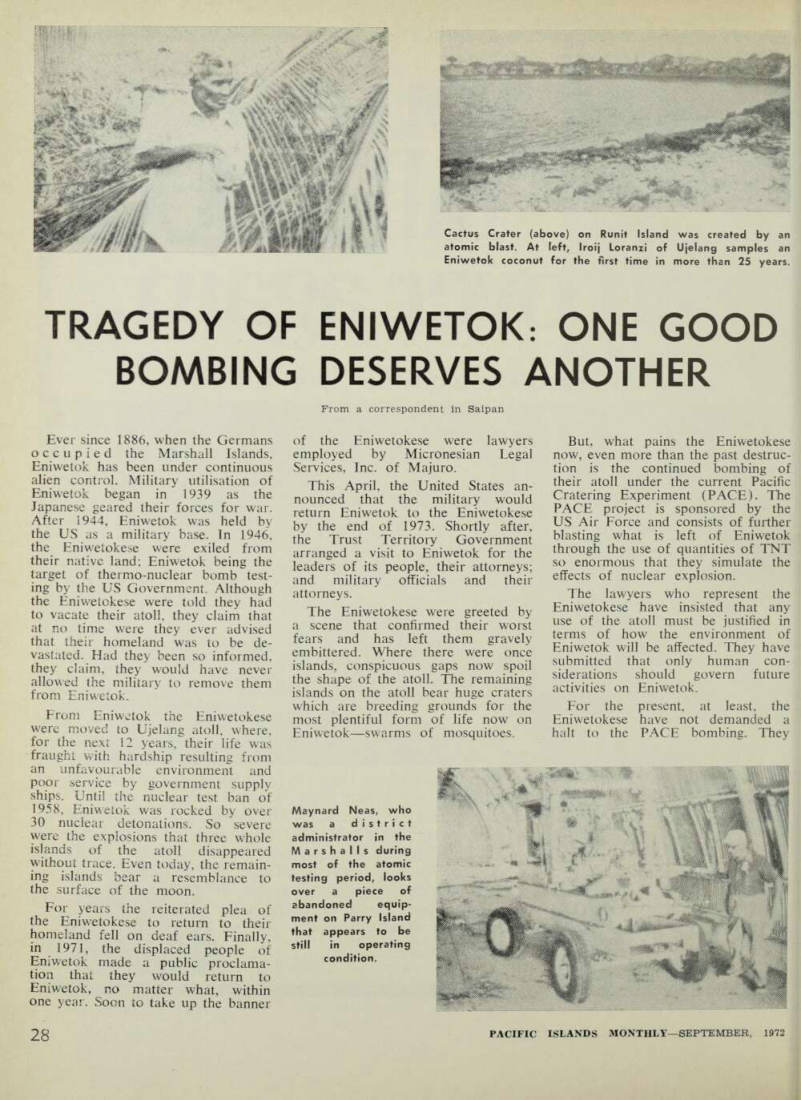
Cactus Crater (above) on Runit Island was created by an atomic blast. At left, Iroij Loranzi of Ujelang samples an Eniwetok coconut for the first time in more than 25 years.
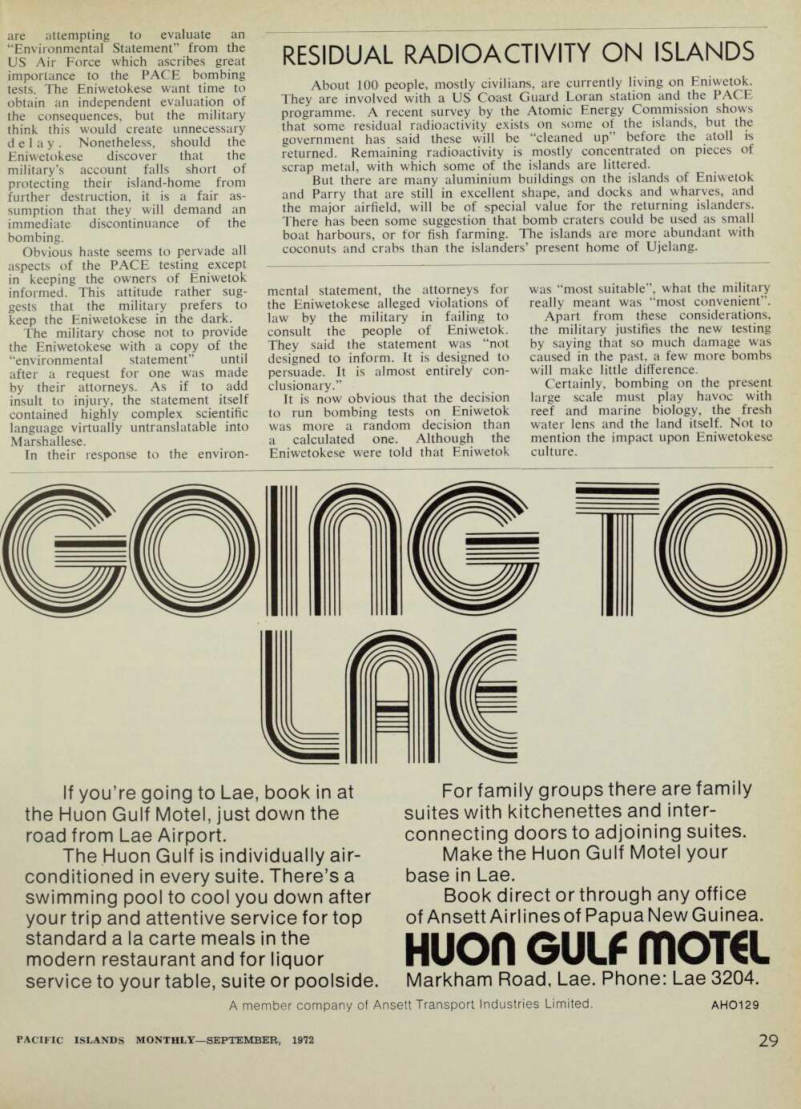
Maynard Neas, who was adistrict administrator in the Marshalls during most of the atomic testing period, looks over a piece of abandoned equip ment on Parry Island that appears to be still in operating condition.
are attempting to evaluate an “Environmental Statement” from the US Air Force which ascribes great importance to the PACE bombing tests. The Eniwetokese want time to obtain an independent evaluation of the consequences, but the military think this would create unnecessary delay. Nonetheless, should the Eniwetokese discover that the military’s account falls short of protecting their island-home from further destruction, it is a fair as sumption that they will demand an immediate discontinuance of the bombing.
Obvious haste seems to pervade all aspects of the PACE testing except in keeping the owners of Eniwetok informed. This attitude rather sug gests that the military prefers to keep the Eniwetokese in the dark.
The military chose not to provide the Eniwetokese with a copy of the “environmental statement” until after a request for one was made by their attorneys. As if to add insult to injury, the statement itself contained highly complex scientific language virtually untranslatable into Marshallese.
In their response to the environ
mental statement, the attorneys for the Eniwetokese alleged violations of law by the military in failing to consult the people of Eniwetok.
They said the statement was “not designed to inform. It is designed to persuade. It is almost entirely con clusionary.”
It is now obvious that the decision to run bombing tests on Eniwetok was more a random decision than a calculated one. Although the Eniwetokese were told that Eniwetok
was “most suitable”, what the military really meant was “most convenient”.
Apart from these considerations, the military justifies the new testing by saying that so much damage was caused in the past, a few more bombs will make little difference.
Certainly, bombing on the present large scale must play havoc with reef and marine biology, the fresh water lens and the land itself. Not to mention the impact upon Eniwetokese culture.