Tropicalities
pp. 28-32 · Read in the full issue

His Worship
streamlines
ropra drying
Ebon Atoll in the Marshalls has a new magistrate who will be remem bered, not for his judgments and sentences, but for his patent copra dryers.
The newcomer, James Milne, who has been around Micronesia for more than a decade, has managed to stream line and cheapen copra drying. Using his methods, the people of Ebon can now cut the drying process from a week to a day which will mean a big increase in production and bigger profits.
Milne had long observed the traditional methods of producing copra—sunshine or hot air ovens, but alternatively, not simultaneously.
Trays of drying copra would either dry in the sun with no heat from below, or in the oven, away from the natural sunshine. His new tech nique combines the two methods through the use of a horizontally severed 55 gallon drum which is placed on the ground beneath a 12 ft-square tray or platform of woven pandanus root and coconut rib. This happens to be fire-resistant, an im portant quality as the tray rests on legs about four feet above a smoulder ing fire contained in the open drum below.
Coconut shells rather than husks are used as fuel for the fire as they burn longer, and do not discolour the copra. Raw coconut meat is spread over the tray. During daylight, the combined effects of the sun’s rays and heat from the fire produce rapidly-dried copra. Whenever there is rainfall, and at night, a six-foot high, removable cone-shaped hood is fitted just above the platform. Con structed of pandanus leaves, the hood provides a light and fire-resistant shelter; trapping heat, but releasing smoke.
Though hardly a profound or dramatic process, this system enables
copra production for 24 hours a day.
Except for the drums, given by Kwajalein Missile Range, the use of indigenous materials eliminates virtually all production expense, and the coconut shell, after serving as fuel, turns into charcoal—a profitable by product.
In 1954, on the island of Kili, about 80 miles from Ebon, Milne first applied his method, and recalls that by 1955 Kili was exporting 120 tons of copra a year. Unfortunately, poor shipping prevented the con tinuation of Kili’s copra activity, and the project was abandoned. Ebon’s maximum yearly output is 600 tons.
Thanks to Milne’s low-cost method, soon each family will be operating one of the new copra units, and it is expected that, within a year, the peak production figure can be reached.
An iceberg cracks
anti money flows
Islanders could be excused for wondering what might be hidden under the large iceberg floating around our region SPIFDA, the South Pacific Islands Fisheries Development Agency.
It was known the SPIFDA fisheries projects, planned by the first director since 1969, seemed to be skating on thin ice. Credits had been frozen since the beginning of this year, while the United Nations Develop ment Programme investigated criticisms of the work planned. Since an islands fisheries meeting early August in Noumea, the air has cleared, the iceberg cracked and UNDP funds are flowing again.
Meanwhile, in islands where the administration has been keeping up counterpart contributions, certain projects are being realised. Among them is the marine culture station just installed in New Caledonia, adjacent to Georges Guerlain’s oyster farm on the St. Vincent Bay. The giant Caledonian experimental pond of 13,000 square metres, built here this year, is designed to allow con trolled cultivation of mussels, oysters, prawns and mullet. Both local and imported marine species are to be produced in the experimental pond, with some SUS7O,OOO of Caledonian
territorial funds already spent on the project.
Islanders now hope the United Nations will be able to allocate extra funds for SPIFDA to help it operate two years beyond the original budget limit of June 30, 1973.
These distant,
greener fields again
“It’s the world’s newest and safest tax haven, with 75 world banks moving in and 500 corporations in corporating! This is your only chance to invest in The Second Hawaii—the New Hebrides—one of the only places in the South Pacific where Americans can own land and get residency.
That’s why we are ALMOST SOLD OUT. Ninety per cent, of the little
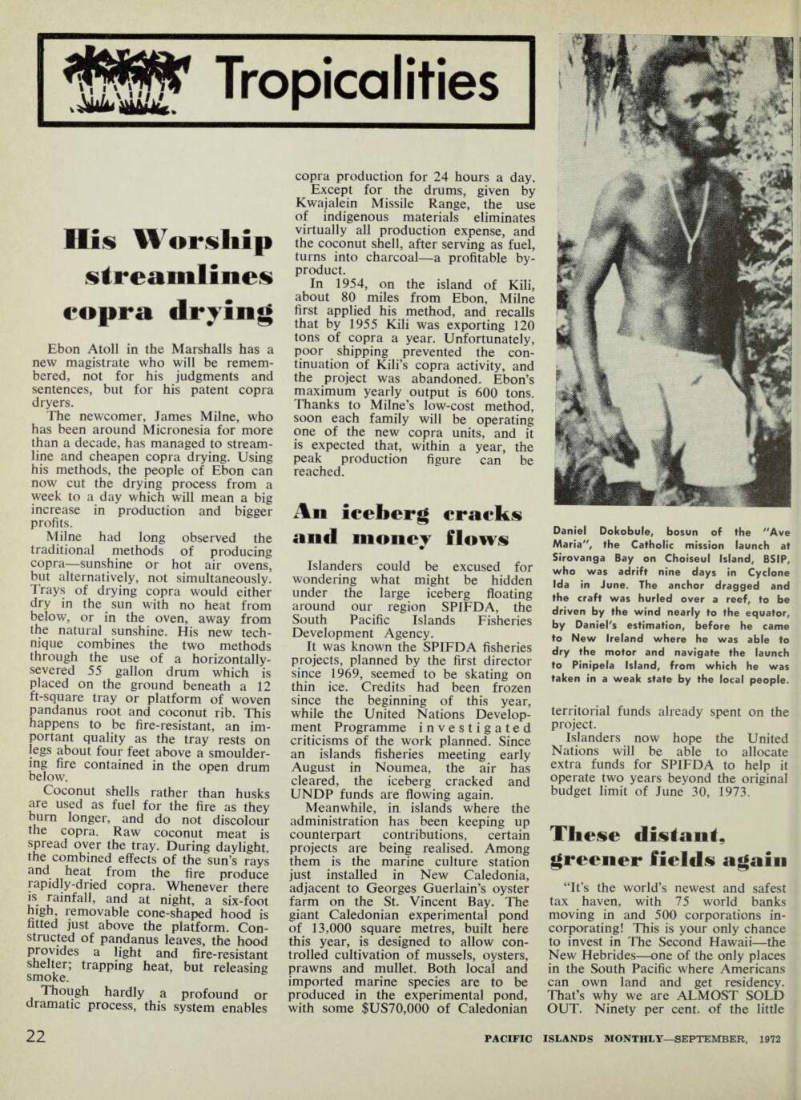
Daniel Dokobule, bosun of the "Ave Maria", the Catholic mission launch at Sirovanga Bay on Choiseul Island, BSIP, who was adrift nine days in Cyclone Ida in June. The anchor dragged and the craft was hurled over a reef, to be driven by the wind nearly to the equator, by Daniel's estimation, before he came to New Ireland where he was able to dry the motor and navigate the launch to Pinipela Island, from which he was taken in a weak state by the local people.
available land was sold in Hawaii.
Why? The lush beauty! Mild climate!
Low cost of living! And NO
Paxes!”
That lush advertisement, in English in a Taiwan newspaper, has raised »ome hackles in the New Hebrides, that land “of sugar-white beaches, [lowing palm trees and clear blue Dceans”, as the advert, also claims.
It’s inserted over the name of the General Investment Corporation, of Paipei.
Most astonishing news is that 75 vorld banks are moving in to the Mew Hebrides, If so, only eight have »o far set up their shingles! And 300 companies have been incorpo rated, not 500. But any American— ar anybody else—who thinks that the ownership of a block of land in the Mew Hebrides will give him residency is in for a shock. The Yanks in Paiwan (at whom the advertisement s directed) might like to ask some if that big body of Hawaiian buyers if New Hebrides land about it.
Canoe building
Piteairn-wise
Using a technique developed more ;han a century ago by Moses Young, grandson of Edward Young, one of he “Bounty” mutineers, the islanders if Pitcairn have just built three new Sshing canoes, using mango tree vood —and power saws.
Construction techniques have been landed on from father to son over he years. The expert today is named Elwyn—in such a small community ast names are hardly ever used.
The canoes are 18 ft long, have i 30-inch beam and an overall depth if a little more than 2 ft. Each canoe vas built in two halves running engthwise and the two logs forming he bottom were shaped with the lower saw, used for the first time.
Phe halves were laid side by side ind held in position with blocks iriven into the ground. The sides, iow and stern, made from pieces of vood three to four inches thick and "astened in place with wooden pegs ibout six inches long, were built up Torn the bottom logs. With this ob completed, the two halves were icrewed together with four-inch icrews. The last job before fitting he seats and other fittings was that if caulking and puttying the joins.
The canoes, the islanders report, landle well in the water.
Pitcairn’s population has been ncreased recently by four—men of he British Army’s Royal Engineers vho will be on the island for about i month tracking satellites. When
their work is finished, the Pitcairners hope, the four REs will help with development projects such as harbour facilities and reading.
The islanders also have a grumble.
There was no truth in the story ap pearing in many newspapers that they contemplated evacuating the island because of the French nuclear tests.
“Gross distortion,” they say.
The world’s
garbage ean
Despite increasing concern through out the world with the problems of environmental pollution, marked in June by the UN conference in Sweden, there is as yet little sign that the anxiety shown by the major powers for their own environment is being extended to the Pacific. The vast reaches of sea and tiny islands are still looked on as fair game for anyone with a few tons of nerve gas to get rid of, or a little strontium-90
to add to the world’s atmosphere.
France of course, with its con tinuance of Pacific nuclear tests in defiance of world opinion, is the most obvious example, but there are other more sinister figures lurking in the background. The US has already been caught trying to dump nerve gases, and who is to say that it was the first attempt? Will Russia and China, who at least had the good grace to carry out nuclear tests in their own countries, be quite so un selfish when it comes to disposing of the waste from nuclear power stations?
Some radio-active by-products of nuclear power have half-lives of half a million years. One proposal for their disposal puts them in steel con tainers cased in concrete and sinks them to the depths of the ocean.
But which ocean?
The tiny countries of the Pacific are in no position to argue when the superpowers come along to the gar bage shute. And, after all, if some thing leaks by accident, it is only a
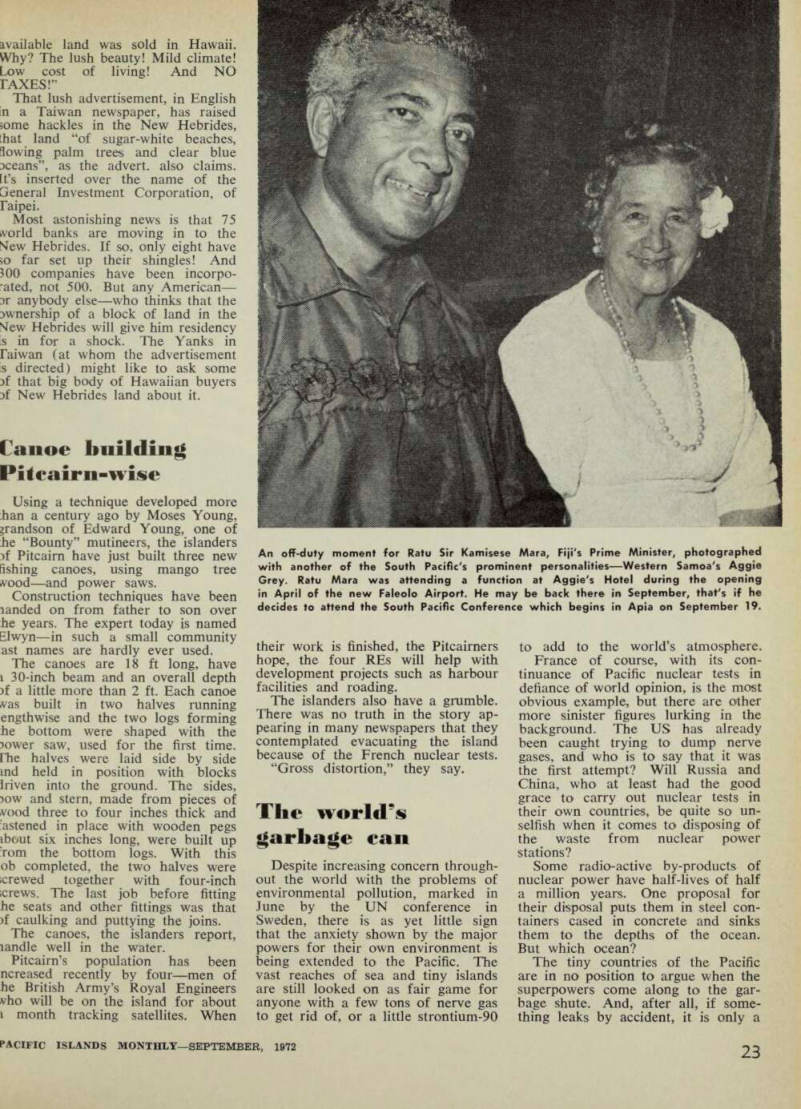
An off-duty moment for Ratu Sir Kamisese Mara, Fiji's Prime Minister, photographed with another of the South Pacific's prominent personalities—Western Samoa's Aggie Grey. Ratu Mara was attending a function at Aggie's Hotel during the opening in April of the new Faleolo Airport. He may be back there in September, that's if he decides to attend the South Pacific Conference which begins in Apia on September 19.
few thousand people on remote islands who are wiped out, not hundreds of thousands in Minneapolis, Kharkov, Marseilles or Chunking.
It is to be hoped that the growing conscience of the world as regards the damage being done to the planet by chemical, biological and physical pollution will expand to include con cern for Pacific Islanders.
Or perhaps it doesn’t matter. The pursuit of nuclear weaponry by countries with chips on their shoul ders seems to indicate that the human race need only worry about the next five years, not the next 500,000.
Sea tragedr
in the Solomons;
Danger is part of the pattern of life for island-hopping public servants, but some officers in the Solomons are wondering if more could not be done to reduce the risk sometimes en countered in the line of duty. This was sparked by the death of a soil scientist, Dr Ken Barnes, aged about 30, in a tricky landing from a small boat at Tinakula Island in June, and the subsequent inquest in July.
The coroner, Mr W. R. M, Low, said that it was not unusual in the
Solomons, for landings to be made from dinghies unequipped with life saving gear, because the gear itself is generally regarded as an en cumbrance. One civil servant, how ever, expressed his view privately, “I’d rather fall into the drink more often and live than be relying on my agility because I was lightly burdened.”
Dr Barnes had been one of a party visiting the normally uninhabited Tinakula, but where the volcanic soil is favoured for gardens, in the course of a complete soil survey of the Solomons. Dr David Wall, in charge of the party, described how their aluminium boat with a com plement of eight Islanders was swamped in the tricky, but only available approach to the shore.
Doctor Toiqi hit
below the belt
Hitler’s tongue talked him into the top job in Germany. Mark Anthony borrowed the Romans’ ears to revenge Julius Caesar’s assassina tion. But no orator has ever been recorded as having sickened his audience at least not until the Cook Islands’ Legislative Assembly debated
in July a bill to improve the Raro tonga water supply.
The orator was Dr Tom Davis (Tom Taote), Democratic Party opposition leader, who attacked Premier Albert Henry’s government over water supplies in the Cooks.
Maybe it was his smooth-tongued oratory or perhaps the fact that he was one of the foremost research physicians in the United States, which gave added weight to his words. He made a few stomachs heave when he alleged that the islanders were drinking dirty water.
The contamination, he said, was caused by human waste and he quoted a 1970 report of tests carried out on the water supplies in which was found repo tangata. Then, in scientific terms, he explained his point.
This “washing of the islands' dirty water” in public didn’t go down well.
Health Minister Inatio Akaruru ac cusing Tom Taote of creating fear among the people. He did more than that with the parliamentarians. Three members left the House and the manner of their leaving was diagnosed as “stomach sickness”.
There was another funny thing in the Cooks about that time. Agri cultural survey teams reported on the number of dogs and said they were an immediate and distressing factor
in the country as they killed poultry and goats. The survey leader said the real purpose of the exercise was to make an attempt to assess the dogs’ impact on food production.
Killing poultry and goats made an impact, no doubt, but there was another impact. “Dogs in the outer districts are more frequently well fed than dogs in town,” he said. “And roast dog baked in the umu remains a great favourite with many families.”
Lessons swap
h\ satellite
Launched little more than 12 months ago, PEACESAT is spread ing so fast that the time must come soon when governments face up to its implications. Will it compete against commercial communications?
PEACESAT means Pan Pacific Education and Communication Ex periments by Satellite. It began its development with a pilot system at the University of Hawaii in April last year, and this year it “went international”.
It is a system of low-cost ground stations which send and receive messages by bouncing their signals off a NASA satellite, ATS-1, above the Pacific. ATS-1 is normally used for weather reporting, but it has some spare time available which is being put to use in this new way.
It’s still in the experimental stage and it’s strictly for use by non-profit organisations only. There are three ground stations in Hawaii (all on university or college campuses), and others at the Wellington Polytechnic Institute, NZ, the University of the South Pacific, Suva, at Nukualofa (operated by the Tonga Government), and the Lae (PNG) Institute of Technology. Testing is now going on for a station in Pago Pago, and by the end of the year there should be stations on Saipan and Truk, in Micronesia.
One of the advantages of PEACESAT is that stations can be built that will hook into the system for as little as SUS 1,500—0 r SUS6,OOO to $7,000 for large stations.
Stations can both send and receive voice messages, facsimiles, still TV pictures and teletype, and can connect with any one or all stations on the network. There can be general dis cussions involving people in Lae, Wellington, Suva and Honolulu, for instance.
The system has so far been used to transmit library materials, and for instructional exchanges on all kinds of university subjects. Doctors in Suva sought information from
doctors in Honolulu about a dengue fever outbreak in Fiji; research information on the starfish plague has been passed on.
The University of Hawaii, which administers the system, is planning to use the system for a student news paper exchange, a non-commercial radio news service and for inter national debates on subjects such as tourism.
More ground stations will obviously join, and in fact the director of the project, Dr John Bystrom, of the University of Hawaii’s Department of Speech Communication, is inviting institutions to join the experiment.
He says, “If an effective system of sharing by long distance telecom munication transmission is developed between the universities, educational institutions and professional services of the nations of the Pacific, it will benefit not only the people living there but will serve as an example to the world.” The demonstration will have implications for India, South America and Africa.
It ’s a re-mateh
For the first time in Papua New Guinea an election result has been challenged in the Court of Disputed Returns, and as a con sequence the election of well-known and highly respected Yule Island businessman Ron Slaughter has been disallowed and a new election ordered.
At the general elections earlier this year Mr Slaughter won the Kairuku- Hiri seat in the House of Assembly with a majority of 60 votes from Mr Charles Maino Auki of Mekeo, Unfortunately, in the course of pol ling, four ballot boxes had been tipped into a fast flowing river. Only two of them were recovered, and the contents of these were undecipherable.
Under these circumstances, it is not surprising that the result of the poll should be challenged.
Oddly enough, both Mr Slaughter and Mr Auki had been runners up in the 1968 elections, though in different electorates. Ron Slaughter lost to Oala Oala Rarua in the Central Regional poll, while Charles Maino Auki lost to Toua Kapena in what was then called the Hiri, now re named Kairuku-Hiri electorate.
The court’s decision leaves Kairuku-Hiri without representation at the September meeting of the House, but Chief Electoral Officer Simon Kaumi hopes to be able to organise a by-election in time for the new member to take his seat at the November meeting.