Pacific Islands Monthly
pp. 13-14 · Read in the full issue
[?]Icronesians Come Out Fighting
In Fifth Round Of Status Talks
'he Micronesian Congress Joint nmittee on Future Status and ted States Government represen ts entered the fifth round in shington in mid-July of their top- I talks to decide the political ire of the Trust Territory.
Jl discussions were behind closed rs and details were not available he time of writing but PIM under ds that, once again, there was a dy struggle over the United es’ reluctance to acknowledge full jreignty of a future government Micronesia. he Micronesian leaders want to be r own masters, both in matters of I government and in deciding ign policy and relations with ign countries. Both sides are ;ed on a self-governing Micro a “in free association with the ted States” but the definition of e” is an important bone of con ion. he financing of Micronesia, in ling compensation for Micronesia’s ;eing to deny use of its land and ers to the military forces of any on other than the US, payment the continuing right to use land waters for US military bases and ;als, are among the details now to thrashed out. he fourth round of talks, at Palau \nril, saw agreement on the prin e of free association which should in the form of a revocable com t, terminable unilaterally by either , but there was no agreement on initial period during which ter ation could occur only by mutual sent. he Micronesians wanted a five r period, the United States a 15r period. This argument has ned large in the Washington talks. :re is no doubt that the Micro ians, even before they entered the s, had achieved major success in r drive for self-determination, but le of the details will be sticky (see 1 June, p. 9). .eading the United States team was bassador Franklyn Haydn Wil is, chairman of the US delegation,
specially appointed by President Nixon. His opposite number was Senator Lazarus E. Salii.
The Marianas representatives, Her man Q. Guerrero and Senator Edward Pangelinan, remained some what aloof from the talks. They were there only to observe and, if neces sary, to protect the interests of the Marianas. The people of the Marianas’ district have already decided that they want a closer association with the United States and their decision has, in principle, been recognised by the Carolines and the Marshalls.
Before the talks opened, Pan gelinan said he expected their Micro nesian colleagues would express con cern over the Marianas issue but, “whatever the concern may be, it won’t seriously affect our position with the US relative to the desire to negotiate a close and permanent re lationship with the United States.
“We want to make it clear that our attendance is not to negotiate any status for the Marianas.”
They will conduct their own separate negotiations with the Ameri cans, and this is annoying some mem bers of the joint committee, despite the fact that at the Palau talks the status committee gave the Marianas permission to have separate talks aimed at getting a close political re lationship with the US.
The United States leaders are anxious that the talks should end in agreement, with America retaining enough of its position consistent with its self-appointed task of ensuring “United States Pacific Ocean and world security”, and military control of the strategically-placed Micronesia.
The US also wants to end the talks with decisions favourable to both sides to stifle criticism from the United Nations where it was con siderably embarrassed earlier this year by Senator Andon Amaraich of the Congress of Micronesia, one of Micronesia’s negotiators. The senator’s views are not fully representative of Micronesian opinion, but they help to underline the divergence of opinion on the independence question. Micro nesians are not united.
He said at the UN hearing of the report on the United States trustee ship, “There are many troublesome areas which may hamper the reach ing of an agreement between Micro nesia and the United States on Micro nesia’s political future. In addition, many of us wonder why we should have to negotiate at all. We find it very difficult, as one of the world’s smallest and least powerful countries, to negotiate with one of the world’s largest and most powerful.
“The difficulty is compounded by the fact that legally the United States and Micronesia occupy a relationship of trustee and ward. This implies certain duties on the part of the trustee to the ward. We are sure that those duties do not include attempt ing to bargain with it as an equal.
It does seem to suggest that the United States should be a lot more willing to allow Micronesia what it wants rather than requiring it to bar gain for it.”
Complaining of America’s insis tence in retaining control of Micro nesia’s external affairs and defence, Senator Amaraich said the two sides were talking on different levels which might prove a hindrance to the rapid conclusion of an agreement.
It was obvious from the fourth
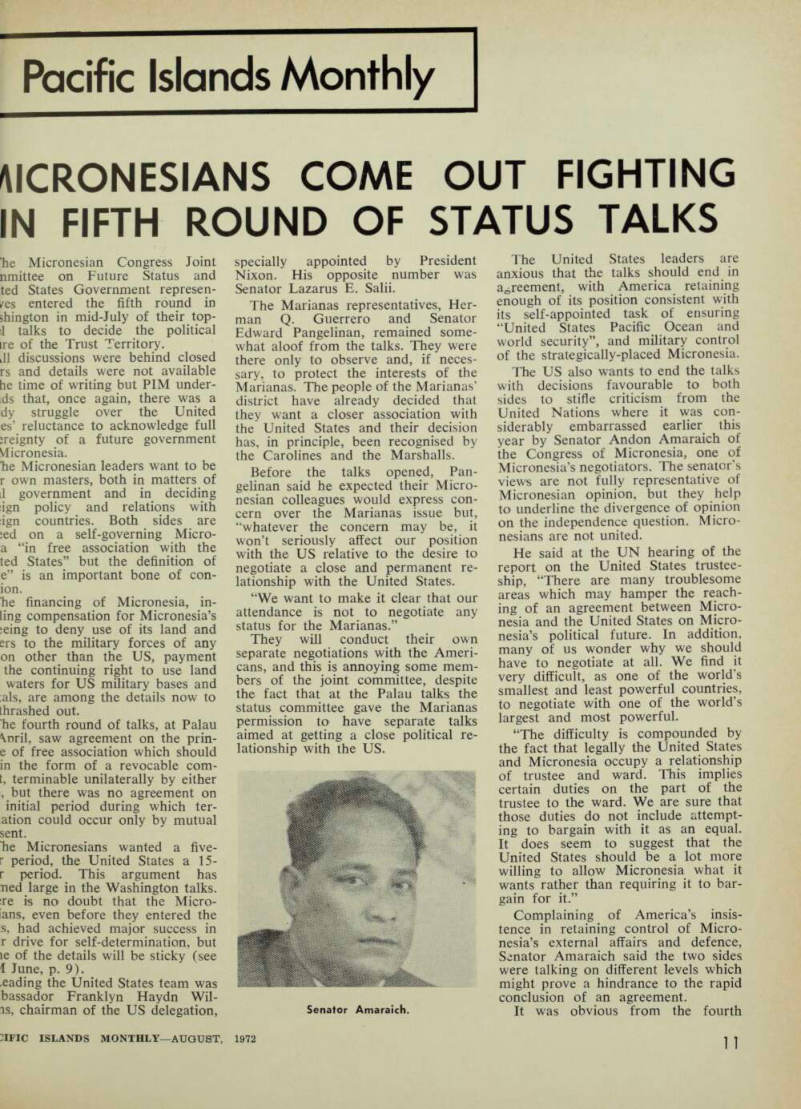
Senator Amaraich.
Ocean of peace in world of strife
round of the talks at Palau, said the senator, “how much a role United States defence interests play in its foreign policy, and, therefore, how much they are being made to affect Micronesia’s political future.
“The vast majority of the people of Micronesia does not want and has no use for the United States military.
Yet the United States has disregarded the wishes of the people in proposing its demands for military lands in Micronesia after the end of the Trusteeship.
“That the people of Micronesia hold this attitude should not come as a surprise. We are and have always been a peaceful people. Within memory, our islands have been devastated by the horrors of war, our people dislocated, our islands turned into radioactive infernos, blown up completely or altered by the awe some force of the hydrogen bomb so that they are unrecognisable if they are still there at all. Only recently, the United States announced its in tention of conducting a series of tests at Eniwetok Atoll in the Marshall Islands for the purpose of seeing how big a hole in the ground its bomb can make.
“At the fourth round the United States made it very clear that the future support of Micronesia would be closely linked to the control the United States would have in our country. I would think it much more appropriate that our people, who have paid with their lands, their homes, their health and their lives, deserve compensation without the imposition of any additional hardship. I do not think it is right, either legally or morally, that the United States should have to put us in the position of sell ing our souls for a few pieces of silver.
“Because of its sad experience with the military not only under the United States Administration but also under our past rulers—our only hope is that we be left alone in peace. We hope that we do not have any enemies, and we do not want them —ours or anyone else’s.
“It is therefore our hope that Micronesia and eventually the entire Pacific Ocean can be neutralised, closed to the warmakers of all nations —truly an ocean of peace in a world of strife and conflict. Is it beyond the capability o¥ the United States and the other great nations of the world to do that? Or will Micronesia again be used as a battleground, again suffer the horrors of war and destruction?
If we could honestly believe that all nations truly wanted peace in the Pacific we should be unable to believe that they could not accomplish it.
“Nor has the United States recognised the fundamental right of the people of Micronesia to control its own destiny. It has not completely recognised its sovereignty. Very simply, it has refused to honour its obligations under the United Nations Charter, the Trusteeship Agreement and the Declaration on the Granting of Independence to Colonial Countries and Peoples by refusing even to discuss the proposition of indepen dence for Micronesia.
“The United States has stated its willingness to recognise the complete responsibility of the Government of Micronesia to control its constitution
and laws. It has recognised ownership of land in Micronesia i with the Micronesian people. It even recognised, conditionally u agreement to its present position) questing complete authority in fields of foreign affairs and defe: that an association between the Uni States and Micronesia, to be trull free association, requires that eili party be able to terminate the ai ciation unilaterally at any time, it appears our difficulty in reacH agreement—that is, conceding to United States position—on fore affairs and defence may prevent from ever arriving at a final, ft agreement. I am today unable express much optimism that we reach an agreement that will be f : protective of Micronesian interest Senator Amaraich also protesteo the threatened severance of Marianas from the rest of Microne
All Quiet In The New Hebrides
Feeling in Vila in July was that it was unlikely that Britain would m react strongly to the speech of Mr Pierre Messmer in which he proposed tl virtually the status quo be retained in the New Hebrides Condominium (P c July, p. 11). Britain does not want to upset France during the Comm Market entry formalities, and in any case Mr Messmer’s speech was regaro" as a breach of political etiquette, best not commented upon. But there is < doubt that Mr Messmer’s statement underlined the divergence of opinion tween Britain and France on the future of the New Hebrides, and it is lild to be a watershed in the condominium’s political history.
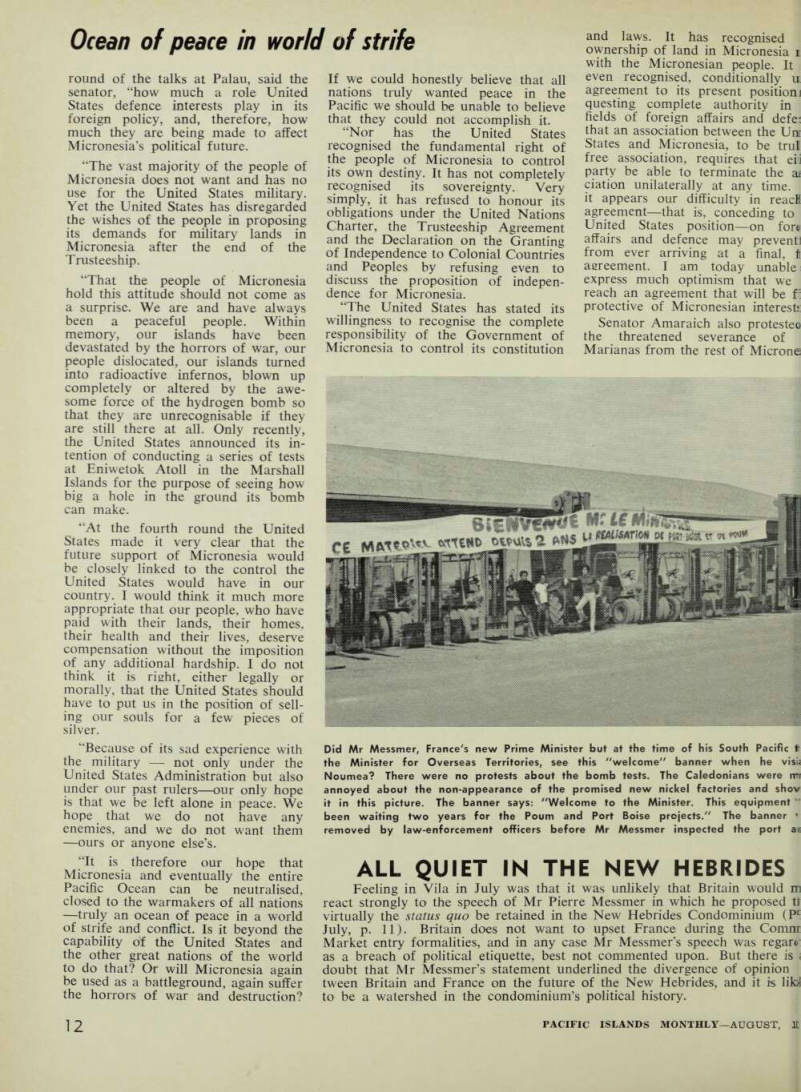
Did Mr Messmer, France's new Prime Minister but at the time of his South Pacific t[?] the Minister for Overseas Territories, see this "welcome" banner when he visi[?] Noumea? There were no protests about the bomb tests. The Caledonians were m[?] annoyed about the non-appearance of the promised new nickel factories and shov[?] it in this picture. The banner says: "Welcome to the Minister. This equipment [?] been waiting two years for the Poum and Port Boise projects." The banner [?] removed by law-enforcement officers before Mr Messmer inspected the port a[?]