The Editor's Mailbag
Bikini Bombs
ou will note from the above •ess (Grafton Nursing Home, :h Grafton, NSW) that I am a epit old man of almost 88 years, rom this home I can look down the bow of the old BP steamer luna” which was interned by the mans in Jaluit, Marshall Islands 914 and released by the Japanese y. be object of this letter is to draw ition to a statement said to have i made by the French Govem t that “no protest was made n the Americans said they were g to let off bombs at Bikini in wrote a letter to the “Sydney ning Herald” protesting strongly it the unfairness to the Marshall id natives. The “Herald” pub id the letter, omitting one im ant paragraph. Mr Robson of ' said, if I permitted him, he Id publish the full letter, which lid. here were no demonstrations it Americans letting off bombs the Marshall Islands in 1946 use only Marshall Island natives 5 going to be affected. Had any Dpean race been likely to be :ted, I venture to think there Id have been plenty of protests, have regularly read the PIM ; it was first published and am a subscriber.
Neville Chateield.
fton Nursing Home, ;h Grafton, NSW.
Rim's Charm
am so busy these days I cannot >w all the interests I have acquired ng my life. Therefore I often go : periods of time without checking what’s happening in the South fic. hen, unexpectedly, I come upon issue of your magazine, and pre ipied though I may be with other ters, I find myself reading the led thing from cover to cover, i the advertisements, he most recent copy I came upon the March, 1972, issue and every d of it enchanted me. I especially d your long article on copper in gainville, about which I had wn nothing, and that wonderfully :ise letter from Tahiti on the ;ic problem.
But equally rewarding were the articles on the ships that have been lost, the elections in Fiji, and especially the short report on the Little Nambas appearing in public for the first time. It has been more than a quarter of a century since I hiked through their territory, and the thought of them dancing in public seems quite bizarre. They should stir things up.
Your magazine looks healthier than ever. The colour on the cover is effective, but it is the homely news of places and of people that I once knew which accounts for the in definable charm.
A world of good luck,
Jim Michener.
Pipersville, Pennsylvania. • To avoid the traumatic shock of “unexpectedly coming across an issue” of PIM, James, you could subscribe to the damn thing. We're posting a subscription blank.
By The Lord Hari !
I have wanted for some time to write to tell you how much I enjoy reading PIM from cover to cover each month. There is so much of what is covered that I have seen first hand and so much that I some day hope to see that a few hours each month is the next best thing to going back. I know that when I am able to travel that way again, it will be much more pleasant, for my first trip was on a troopship with 5,000 others, and my first day on land was spent in a foxhole scared, needless to say, half out of my wits because
there was so much unpleasantness going on about that particular island.
Some subliminal pedantic instincts were aroused recently when I re read Sue Wendt’s article on Niue in the September issue. The place has always fascinated me for some reason. After re-reading it, I began to feel that there was something just a hair out of focus, and finally ran it to ground. “There’ll be no hari kari on this little isle,” Sue says (or writes). The emphasis is mine. I thought, “My God, of course not, Harry Carey, the famous American Western star is long dead. Not only that, but she doesn’t even know how to spell his name. She must be Japanese. Japanese, hmmmm, there’s a clue. Maybe Sue meant hara kiri, a very graphic Japanese phrase mean ing ‘cut the stomach’. Of course, hara kiri, or seppuku. Well, I should hope there would be none. No Harry Carey, either, for the grizzled old veteran’s ghost would be enough to put frost on the cricket pitch.
Not to put Sue down, though, be cause I enjoy the fact that she usually carries her dudgeon at high port and writes it the way she sees it. All of you do, and thanks.
W. K. Higgins,
Ltc, Usar (Ret.).
Library of Congress, Washington, DC.
P.S.: You must excuse the typing.
My secretary went out for a martini at some joint near the library last month, and they must have fed her a double because she’s not back yet.
Queen Emma's Land
The comments by your corres pondent about the tourist facilities around Rabaul and places of historic interest (July PIM) remind me that only last week I had a job trying to find Ralum, the site of Queen Emma’s home—although I had been there before, two years ago.
This is a most interesting spot commanding a wonderful view over the bay towards the Duke of York Islands. Queen Emma’s steps are still in evidence down which she used to walk to her waiting carriage. There is no sign post to this location, nor is there one indicating the whereabouts of the family cemetery, which is also of great interest —particularly to those who have read the book “Queen Emma” by R. W. Robson.
Such spots are of great interest to tourists and should be preserved; but whether this advice will be heeded is another matter.
V. T. Sanders.
P.O. Box 324, Port Moresby.
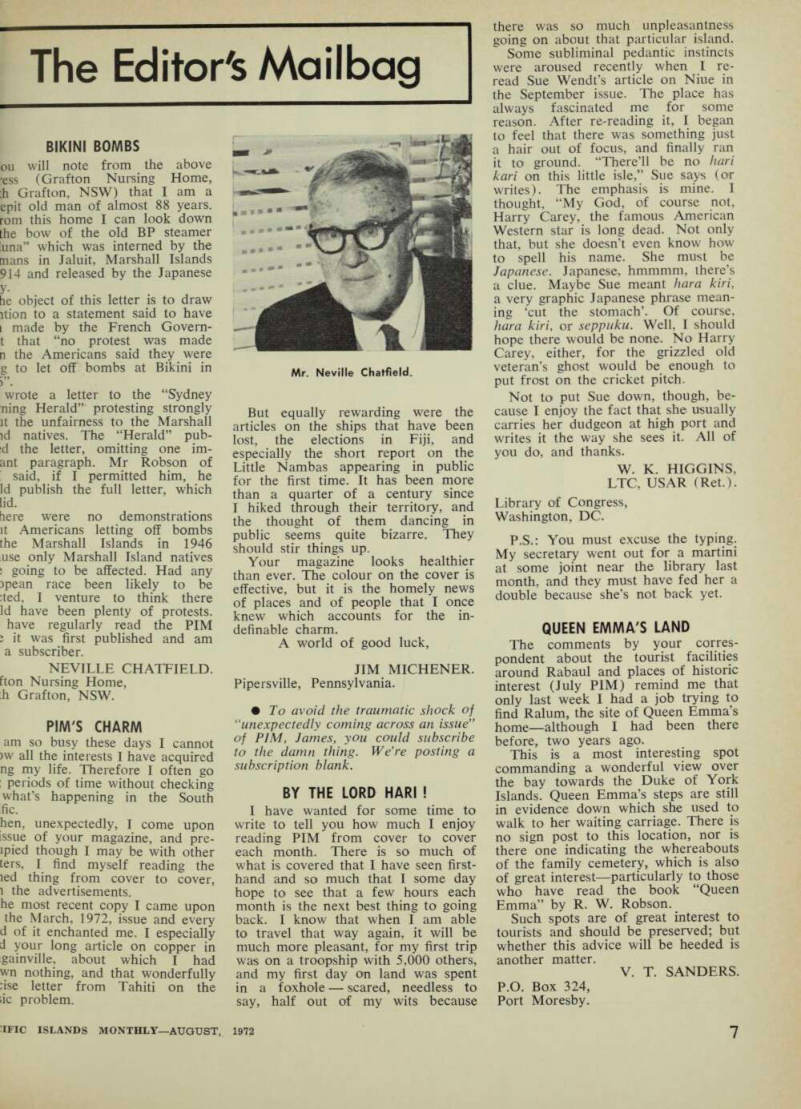
Mr. Neville Chatfield.