Pacific Shipping
pp. 85-87 · Read in the full issue
Two Charter Ships As Pioneers
Of Islands Container Service
By William Olson
A container shipping service employing two unusual vessels could be operating from New Zealand to the Pacific Islands by the end of the year.
A decision on whether to go ahead with the service is expected from the Union SS Co. by mid-August.
Indications are that transport ex perts examining the plan for Union and its parent, Thomas Nationwide Transport of Sydney, will strongly recommend the plan to the Union board in New Zealand.
But there are problems, particularly in port facilities, to be overcome.
In Sydney the deputy chairman and managing director of TNT, Sir Peter Abeles, told PIM that plans were to run two chartered stern-loaders.
“If we can resolve several prob which include labour and port facilities, then we feel we could give a much better service with these vessels,” Sir Peter said.
The scheduled run has not been spelt out, but the obvious service would be the one now served by con ventional vessels running out of Auck land to Fiji, Tonga, Western and American Samoa.
Three ships now service these ports with two others running to Norfolk and Noumea, Papeete and Western Samoa.
The container ships being looked at for charter are of the Scandinavian Tarros class.
Small by container ship standards (1,600 tons) they nevertheless can carry 120 standard 20 ft containers and have good sea speeds. Loading is through a stern ramp with containers being lifted off trucks by an overhead crane carried in the ship.
It is understood the Union board will consider chartering two ships of the class, the first to be in service by Christmas, the second by next March.
Chartering of these ships would enable Union to assess their per formance over two to three years before ordering its own vessels.
Such an operation would provide
valuable experience to balance against investigations of ship types for a permanent service.
TNT has already said it is looking at new shipping systems for its Island services and these include contamerships of the cellular type, vehicle-deckers, open hatch unitloaders and hybrids which combine the best features of all these types.
All can carry the standard container, with the vehicle-deckers providing more versatility by loading flats, unitised cargo, vehicles and standard containers.
There is still considerable debate in the shipping world as to the efficiency of the various ship types servicing the new systems of through transport which provide the shipper with door-to-door transport.
A trade such as that servicing the Pacific Islands poses special problems because of unsophisticated port
facilities. However, the benefits to be realised from a container service are such that a thorough investigation is well worth while.
Hovercraft (air-cushion vehicles) have been suggested in some quarters as sea carriers.
But these craft still have bugs to be ironed out for open-sea routes, and their economics have yet to be proved in circumstances which could involve maintenance problems.
The economics of the displacement hull allied with the savings of un manned engine-rooms and low deck manning scales is a combination which the “skimmers” (air-cushion and hydrofoils) have not yet been able to challenge in open-sea freight.
At the moment the New Guinea and Islands runs are serviced by ships which employ side-loading.
Continued on p. 85
open-hatches and conventional cargo handling methods. In the environment they have to deal with they are efficient and economical.
But there is little doubt that in the near future new types will replace them.
One mentioned as being suitable for the Islands is the LASH ship (Lighter Aboard SHip).
These vessels are already operating in the ocean-trades where they exceed 20,000 dwt in size.
LASH ships carry barges which are dropped off and picked up at ports-of-call. These are, in effect, large floating containers.
The advantages are obvious where unsophisticated ports are concerned.
Groups of barges can be left to be unloaded and loaded while the main carrier spends maximum time at sea.
Expensive and highly technical shore based equipment is not required.
However, LASH ships are at present very large and expensive to build.
The West Australian Government investigated LASH recently for its north-west of Australia coastal run.
It had to reject the system on the grounds of cost and turn to second hand unit load ships.
But the rate of technical advance is so great in the shipping industry that a small, hybrid LASH ship could quickly evolve and be ideal for the Pacific Islands trade.
In the meantime it will be interest ing to see what Union decides to do with its services.
If it should decide to go ahead and charter the Tarros class container ships it can be certain that other companies will be closely watching the results achieved.
Cooks Take Over Charter Ship
pie Cook Islands Shipping Co., which has been operating the freighter Lorena under charter from her Norwegian owners, has bought her and registered her as a New Zealand ship. The decision to buy was made because she had been so successful while under charter.
Her new owners intend to use her on a 21-day service between the Cooks and New Zealand and, according to managing director Mr. H. L. H.
Julian, the service is likely to be the fastest ever operated on that run.
Fiji Will "Go Slow"
On Regional Shipping
. phi wasn’t interested in “rushing into’’ a regional shipping line for the South Pacific ... it wanted to go about it “slowly and gradually”, Fiji’s Prime Minister, Ratu Sir Kamisese Mara, told a national television audience in Sydney in June.
Ratu Mara said he supported a regional line, and had supported it right trom the beginning, and it was untrue to suggest that Fiji had gone cold on the move to operate the regional line.
Was asked by the interv »ewer: Why must you go about it slowly?
W R a niii are M the P ™ bl fi mS r * Kalu Mara; Well, because from my information not very many shipping companies pay. Our very close neighbour, Nauru.
You do “’‘ think shipping line?® B °° W " h 3 Ratu Mara: No, I don’t think that they are makine great nmfitc rmt mey are making great profits out
More Engine Troiirifc
K.nrn P n °eu LES .
Nauru Pacific Shipping Lines y, 3 36-ton Enna G developed engine trouble m June en route from Sydney c° X 1 d 01 ? c the fil^ st of . lts re B ular South Pacific tourist cruises (PIM, June, p. 83) and returned to Sydney tor repairs. The cruise programme was put back a fortnight as a result
of the trouble, which involved a fire in the scavenger trunking of the diesel. Enna G has had a recent history of engine trouble and the owners were hopeful that the latest incident would enable engineers to identify the problem once and for all Enna G was carrying 26 passengers, who had no complaints to make about the extra holiday they got at the line’s expense. The ship has all first-class accommodation,
Stranger In The Lagoon!
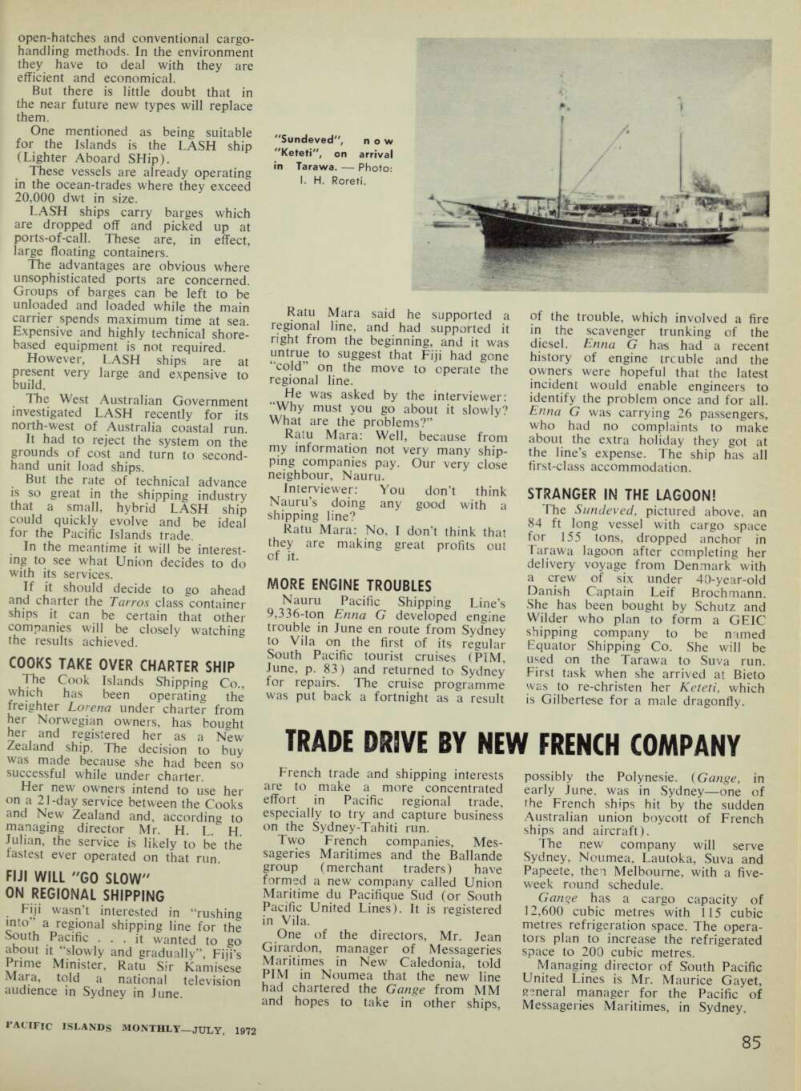
„ Tj? e pictured above, an it ~? ng . vesse ! Wlth . car 8° u s P a 9 e tons, dropped anchor in Tarawa lagoon after completing her delivery voyage from Denmark with a c . rew of six under 40-year-old Danish Captain Leif Brochmann.
She has been bought by Schutz and Wilder who plan to form a GEIC shipping company to be named Equator Shipping Co. She will be used on the Tarawa to Suva run.
First task when she arrived at Bieto was to re-christen her Keteti, which is Gilbertese for a male dragonfly.
"Sundeved", now "Keteti", on arrival in Tarawa. Photo: I. H. Roreti.