Nostalgic recollections
pp. 81-83 · Read in the full issue
of The Kempsey Lad
Growing up produces similar natural phenomena, no matter who is doing it. Or when. This seems to be the verdict after I tried out Gavin Souter’s The Idle Hill of Summer on people of three different generations.
All could identify with this account of Australian childhood and adolescence to some extent, and to laugh at the same funny bits.
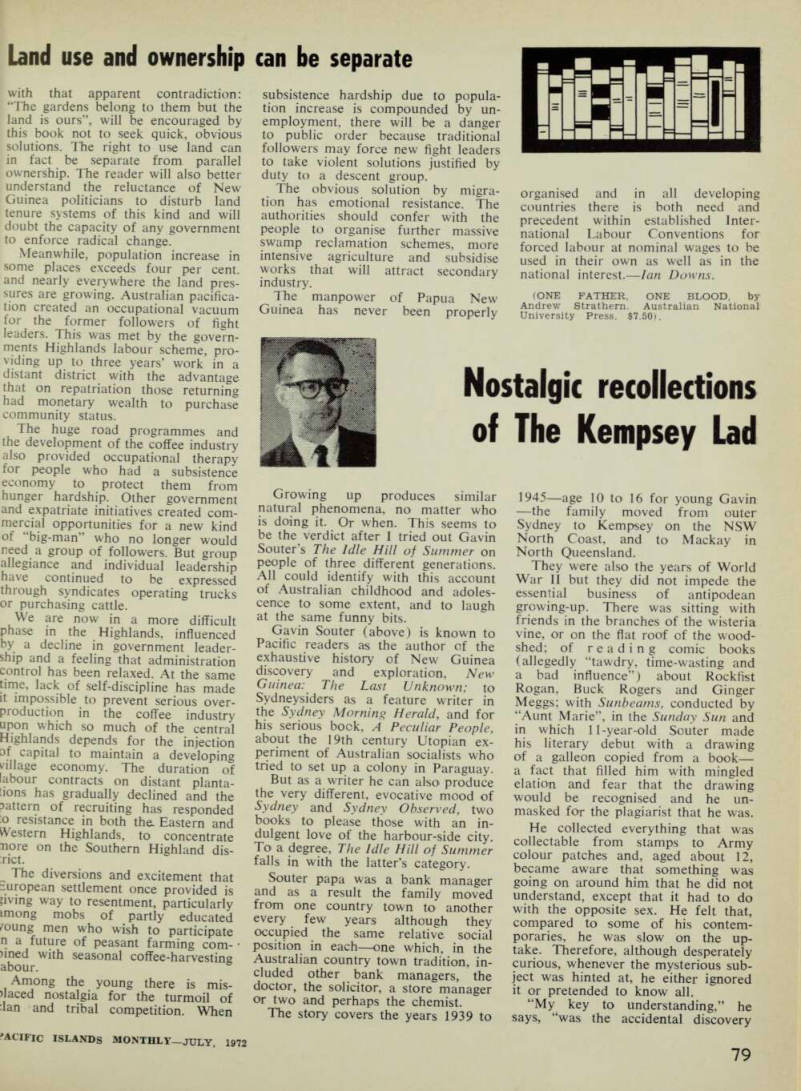
Gavin Souter (above) is known to Pacific readers as the author of the exhaustive history of New Guinea discovery and exploration, New guinea: The Last Unknown; to oydneysiders as a feature writer in the Sydney Morning Herald, and for his serious bock, A Peculiar People, about the 19th century Utopian expenment of Australian socialists who tned to set up a colony in Paraguay.
But as a writer he can also produce the very different, evocative mood of byaney and Sydney Observed, two the latter’s ca/e*o~ pouter papa was a bank manager and as a result the family moved trom one country town to another every few years although they occupied the same relative social position in each—one which, in the Australian country town tradition, included other bank managers, the doctor, the solicitor, a store manager or two and perhaps the chemist.
The story covers the years 1939 to
1945—age 10 to 16 for young Gavin —the family moved from outer Sydney to Kempsey on the NSW North Coast, and to Mackay in North Queensland, They were also the years of World War II but they did not impede the essential business of antipodean growing-up. There was sitting with friends in the branches of the wisteria vine, or on the flat roof of the wood shed; of reading comic books (allegedly “tawdry, time-wasting and a bad influence”) about Rockfist Rogan, Buck Rogers and Ginger Meggs; with Sunbeams, conducted by “Aunt Marie”, in the Sunday Sun and in which 11-year-old Souter made his literary debut with a drawing of a galleon copied from a book— a fact that filled him with mingled elation and fear that the drawing would be recognised and he un masked for the plagiarist that he was. w£ going on around him that he did not understand, except that it had to do with the opposite sex. He felt that, compared to some of his contem poraries, he was slow on the up take. Therefore, although desperately curious, whenever the mysterious sub ject was hinted at, he either ignored it or pretended to know all “My key to understanding,” he says, “was the accidental discovery
of Wyckham Terrace, a medical columnist in Woman, who seemed to specialise in the very subject about which I wanted more information . . . Every week ... I looked dis creetly to see what new words Dr.
Terrace had for my vocabulary.
Intercourse, genitals, contraceptive, pregnancy, womb, foetus: piece after piece they fitted into a picture, which, although far from complete, was at least now visible in broad outline.
The words were seldom explained and so I had recourse to the big Funk and Wagnall dictionary in the
library at school . . .
“One of the first words I looked up was womb, which I mentally pro nounced to rhyme with bomb ... Of all the new words this was the oddest in appearance and as 1 read the definition I wondered guiltily whether anyone looking over my shoulder would be able to guess which of the words from wolfram to woodchuck I was taking such an interest in.
Quick, which one? In momentary panic I scanned the page for a suit able alibi and decided that if anyone accosted me 1 would lay claim to wombat, of which marsupial animal there was a small line drawing !n the margin.”
If the war had no great influence on the mental processes of young Souter, it was there in the back ground. When the family moved to Mackay in 1943 they found the town a rest centre for American airmen of the Fifth Air Force, on duty in New Guinea, and for sailors from US Navy vessels.
He became a member of the Volunteer Air Observers’ Corps, an amateur spotter and collected sight ings in his log book of Lightnings, DC3’s, Cats, Mitchells or Thunder bolts as in other days he had col lected coloured cards out of Nestles penny chocolate bars.
In 1944 he was packed off to Scotts College in Warwick, southern
Queensland, partly because his
parents believed that this would give him polish and partly because they distrusted the Queensland public education system. ■ He was there when the war ended and reflects that the war had done him no harm at all . . . “In fact it had been a pleasure. I had seen the Lightnings and Thunderbolts from a safe distance. Many of those who were in the centre of the storm had been struck dead: the slave workers at Soltau, the Old Boys who were missing on air operations oyer Europe, the Australians who had died in Japanese prison camps. 1 knew all this; but to a distant observer like myself the war had been a spectacle rather than an ordeal. It
had been a long and exciting serial like ‘First Light Fraser’ on 2GB and to be perfectly honest I was sorry it had to end.”
The Idle Hill of Summer takes its title from A. E. Housman’s The Shropshire Lad: On the idle hill of summer, Sleepy with the flow of streams, Far I hear the steady drummer Drumming like a noise in dreams.
This is no story of mis-spent youth; of wicked parades of schoolmasters whose psychological ineptness pro duces trauma in the tender young.
There is absolutely nothing in it about genera ion gaps, revolt against moral values or the Establishment.
The author actually appears to have had a happy childhood and youth, with normal, satisfactory parents, and to have survived the formative years without waning to demolish existing society. It is a nostalgic piece, like a warmly recollected sunny, summer afternoon, cicadas in the gum trees, surf on the beach.
It is deceptively simple, covering considerable insight and was prob ably the hardest of the Sourer books to write. He accomnlishes the inh
splendidly.
Judy Tudor.
(The Idle Hill Of Summer.
$3 y 95? aVin Souter ’ Aun & us & Robertson.
I>AN Paperbacks has come out with * a varied collection of cookery books for everyone, from the beginner to the highly adventurous and ex perienced. Learning to Cook ($1.10) is the most comprehensive —an encyclopaedia for inexperienced would-be cooks. It even includes a small section on what to do if things go wrong. Is author, Marguerite Patten, has also wriLen World Cookery ($1.25) covering dishes from all over the world. Then there’s Mrs. Beeton’s All About Cookery ($1.25), an up-to-date version of this old-time favourite, particularly help ful for those on a budget. But of special interest to Islands’ people is Deep Freeze Cookery ($1.40) with many practical bin's. I would have been glad of it myself when I lived in New Guinea. It is written by Marika Hanbury Tenison. For the specialist, Pan has provided The Cordon Bleu Book of Jams, Pre serves and Pickles by R. Hume and M. Downes (95c). —Marie Shannon.
Book notes and news
|TERE are three books reporting Papua New Guinea research, under the general head of anthro pology: Fighting with Food, by Michael W.
Young (Cambridge University Press, UK price £5,80), is a perceptive and detailed study of the coercive gift giving among the Massim society of Goodenough Island which operates to subdue violence by the organised forms of competitive food exchange and ceremonial festivals. It has an important political message. Those not in the mainstream of European inspired development can go on suc cessfully being themselves by retain ing the dynamic quality of their own Melanesian society.
Place and People, by William C.
Clarke (Australian National Uni versity Press, 57.95), uses a remote minor group on the headwaters of the Simbai River on the northern fall of the Bismarck Range to carry out a very valuable ecological study of how isolated pre-literates managed to cope with their environment and how habitat both proscribes and de velops behaviour. Th s microstudy, undertaken before the clash with white man’s culture has had time to obscure its own initial impact, allows the reader to join the author in considering the consequences.
Some may feel that the shocking health deficiencies, now being made good, are enough to justify our alien interference.
Business and Cargo, by E. Ogan, New Guinea Research Bulletin No. 44 (ANU Press, $1.50), is another valuable contribution to our under standing of people, on this occasion the Nasioi groups living near Kieta, on Bougainville Island, who are con siderably involved in copying and adapting themselves to the European material culture thrust upon them.
The area is of special interest because much of the study was undertaken before the Bougainville Copper com pany decided to operate. At this stage, all conclusions are premature.
Like many investigations, the author’s work suffers because of understand able compassion for the people in
volved.
lan Downs.
A LTHOUGH it all happened long f*- ago, there is a growing interest in World War I aviation, and new and old material finds an avid market. Men and Machines of the Australian Flying Corps 1914-19, by Charles Schaedel, is the most recent
of the new publications, and an ex cellent outline it is of Australia’s infant air force. It is aviation history presented in its best form—accurately, and with few frills.
Chapter one covers the formation of the AFC and the little known Mesopotamian Half-Flight. Very brief mention is made of the AFC’s un eventful expedition as a support unit in New Guinea.
Other chapters cover the activities of Squadrons 1,2, 3 and 4 from the time of their formation.
Illustrations in the book are first class; 10 colour pages and 125 black and white pho os, many coming from private collections and never before published—something that is very re freshing to those of us who hear publishers make this claim with every new book released, and find it is not always justified.
My only real criticism is on the lack of an index. And I would like to have seen more details on Training Squadrons 5,6, 7 and 8. Our copy is from the publishers, Kookaburra Technical Pub. Pty. Ltd., Victoria.
Price $4.95.-
Bill Toohey.
Kangaroo Island, South Aus
tralia, has had a history of ship wrecks—if you include fishing cutters among the big stuff—such as the 5,865ton Portland Maru, wrecked there in 1935, and the 2,284-ton Montebello, wrecked in 1906. Now an amateur historian Gifford Chapman, has col lected the histories (with photographs where possible) of 51 wrecks around that coast since 1847, and published them in the Roebuck series of Australian history, at $4.50, called Kangaroo Island Shipwrecks.
Roebuck’s publisher is Dr. I. S.
Cumpston, 24 Holmes Cres., Camp bell, Canberra, whose aim is to give an outlet to books of merit on Aus tralian historical subjects not other wise published.
PAUL MATANE, a Tolai who holds a senior Papua New Guinea Government post, is the latest New Guinean to get his story into book form. Oxford University Press is shortly publishing Matane’s My Child hood in Papua, about his develop ment from early childhood to maturity. It’s part of an Oxford series for secondary schoolchildren.
As well as aspects of his life it covers more general matters concerned with the rapidly changing context of New Guinea politics and social develop ment.