of flying
pp. 73-75 · Read in the full issue
Fifty years of flying in PNG
By a special writer
The issue of four new stamps to commemorate the 50th anniversary of aviation in Papua New Guinea is a timely reminder of the place that the aeroplane has filled in the short history of opening up the Highlands, and indeed in the national develop ment generally.
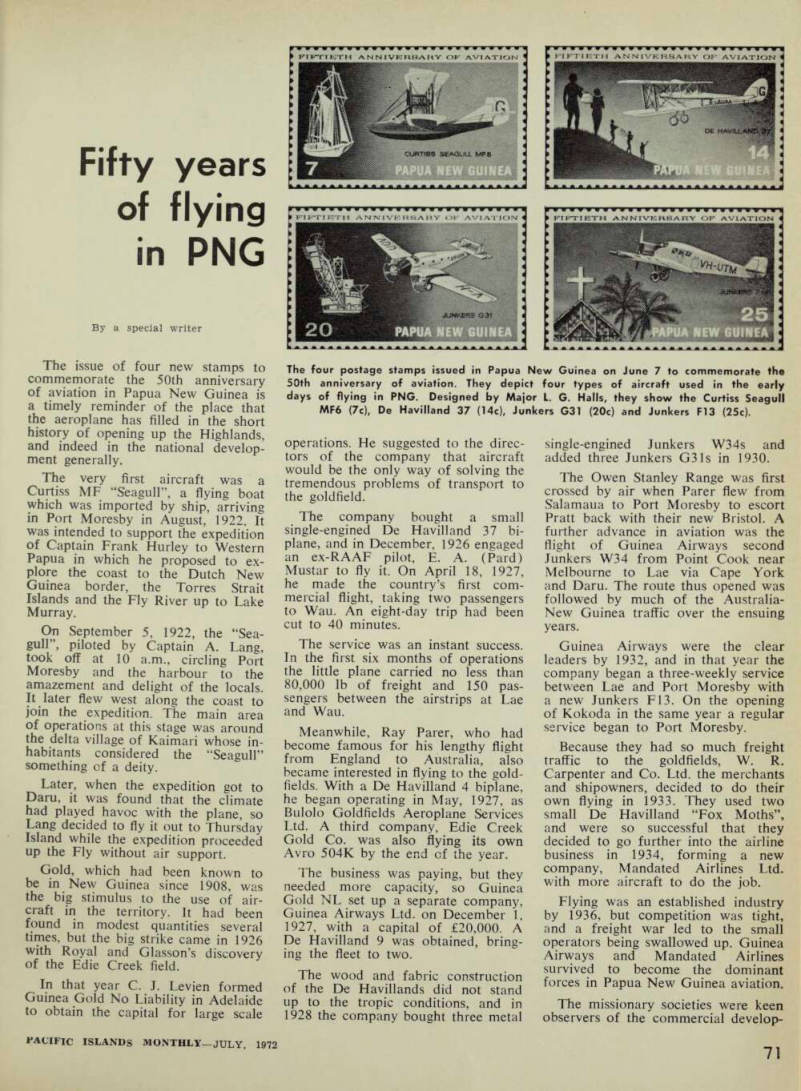
The very first aircraft was a Curtiss ME “Seagull”, a flying boat which was imported by ship, arriving in Port Moresby in August, 1922. It was intended to support the expedition of Captain Frank Hurley to Western Papua in which he proposed to ex plore the coast to the Dutch New Guinea border, the Torres Strait Islands and the Fly River up to Lake Murray, On September 5, 1922, the “Sea gull”, piloted by Captain A, Lang, took off at 10 a.m., circling Port Moresby and the harbour to the amazement and delight of the locals.
It later flew west along the coast to join the expedition. The main area of operations at this stage was around the delta village of Kaimari whose in habitants considered the “Seagull” something of a deity.
Later, when the expedition got to Daru, it was found that the climate had played havoc with the plane, so Lang decided to fly it out to Thursday Island while the expedition proceeded up the Fly without air support.
Gold, which had been known to be in New Guinea since 1908, was the big stimulus to the use of air craft in the territory. It had been found in modest quantities several times, but the big strike came in 1926 with Royal and Glasson’s discovery of the Edie Creek field.
In that year C. J. Levien formed Guinea Gold No Liability in Adelaide to obtain the capital for large scale
operations. He suggested to the direc tors of the company that aircraft would be the only way of solving the tremendous problems of transport to the goldfield.
The company bought a small single-engined De Havilland 37 bi plane, and in December, 1926 engaged an ex-RAAF pilot, E. A. (Pard) Mustar to fly it. On April 18, 1927, he made the country’s first com mercial flight, taking two passengers to Wau. An eight-day trip had been cut to 40 minutes.
The service was an instant success.
In the first six months of operations the little plane carried no less than 80,000 lb of freight and 150 pas sengers between the airstrips at Lae and Wau.
Meanwhile, Ray Parer, who had become famous for his lengthy flight from England to Australia, also became interested in flying to the gold fields. With a De Havilland 4 biplane, he began operating in May, 1927, as Bulolo Goldfields Aeroplane Services Ltd. A third company, Edie Creek Gold Co. was also flying its own Avro 504 K by the end of the year.
The business was paying, but they needed more capacity, so Guinea Gold NL set up a separate company, Guinea Airways Ltd. on December 1, 1927, with a capital of £20,000. A De Havilland 9 was obtained, bring ing the fleet to two.
The wood and fabric construction of the De Havillands did not stand up to the tropic conditions, and in 1928 the company bought three metal
single-engined Junkers W34s and added three Junkers G3ls in 1930.
The Owen Stanley Range was first crossed by air when Parer flew from Salamaua to Port Moresby to escort Pratt back with their new Bristol. A further advance in aviation was the flight of Guinea Airways second Junkers W 34 from Point Cook near Melbourne to Lae via Cape York and Daru. The route thus opened was followed by much of the Australia- New Guinea traffic over the ensuing years.
Guinea Airways were the clear leaders by 1932, and in that year the company began a three-weekly service between Lae and Port Moresby with a new Junkers FI3. On the opening of Kokoda in the same year a regular service began to Port Moresby.
Because they had so much freight traffic to the goldfields, W. R.
Carpenter and Co. Ltd. the merchants and shipowners, decided to do their own flying in 1933. They used two small De Havilland “Fox Moths”, and were so successful that they decided to go further into the airline business in 1934, forming a new company, Mandated Airlines Ltd. with more aircraft to do the job.
Flying was an established industry by 1936, but competition was tight, and a freight war led to the small operators being swallowed up. Guinea Airways and Mandated Airlines survived to become the dominant forces in Papua New Guinea aviation.
The missionary societies were keen observers of the commercial develop
The four postage stamps issued in Papua New Guinea on June 7 to commemorate the 50th anniversary of aviation. They depict four types of aircraft used in the early days of flying in PNG. Designed by Major L. G. Halls, they show the Curtiss Seagull MF6 (7c), De Havilland 37 (14c), Junkers G3l (20c) and Junkers Fl3 (25c).
ment of aircraft. The Lutherans felt that an aeroplane could make it much easier to supply their outstations in remote localities like the Markham Valley, Gavinazung and Kaiapit.
When further stations were opened at Kambaidam and Mount Hagen, air support became indispensable.
The Neuendettelsau Mission Society, at home in Germany, raised the money to buy a second-hand Junkers FI3. It arrived in Lae on February 19, 1935 and nine days later the pilot, Captain Loose, made the first flight to Kaiapit.
The Catholic Eastern New Guinea Mission, controlled by the German based Society of the Divine Word, followed the Lutheran lead and had two planes in service by the end of 1935. By 1939 they had a fleet of two Klemm monoplanes, a Fokker FVII (which crashed on August 6, 1939, killing three priests) and one Junkers with which they serviced 17 central stations and 181 outstations.
On the outbreak of the Pacific war all this activity ceased abruptly.
A number of aircraft were destroyed by enemy action. The remainder were used in evacuating civilians, and many of the surviving aircraft were impressed by the RAAF for the duration.