Magazine Section
pp. 71-72 · Read in the full issue
The man in the white flying suit
• Pioneer New Guinea aviator lan Grabowsky has recently died in Melbourne (PIM, June) and in this article J. P. Sinclair recalls some of Grabowsky's exploits in the territory's early days of flying.
Jim Sinclair is the author of a number of books on New Guinea, including "Sepik Pilot", the bio graphy of Bobby Gibbes, and has just completed a detailed history of PNG aviation, using much raw material collected by "Grab" in the last years of his life. Jim Sinclair is government District Commissioner for the Eastern Highlands of PNG.
Whenever the old pioneer fliers of New Guinea meet and gas of the good old, and risky days, “Grab” is sure to figure largely in the tell ing of the tales of feats which helped to open up a vast and wild territory.
lan Grabowsky was known affec tionately to all his friends and acquaintances as “Grab”. He was born around the beginning of the century, and the latter half of his life was clouded by crippling disease. His right leg was amputated in 1934 and later he lost the other. A man of supreme courage, Grab never complained and kept up his personal fight to the very end.
It is fitting that a tribute should be paid to the memory of this man in the pages of PIM, for Grab was a greatly respected pioneer of aviation in New Guinea and his name was often on the pages of the magazine in the thirties.
Born in Terioki, Finland, Grab had a Scottish father and his mother was bom of Irish parents, even though his name was Polish! He served as a pilot in World War I and survived three crashes. In 1920 he migrated from England to Australia and by 1930 he was sales manager and chief instructor for the De Havilland Aircraft Company, then based at Mascot Aerodrome, Sydney.
His New Guinea career commenced in July, 1931, when he was offered a position as pilot with Guinea Air ways Ltd. on a salary of £750 per year plus messing allowance—con siderable money in those depression dominated years. He sailed for Lae on the old Macdhui, arriving there on August 3, his wife and child remaining for the time being in Aus tralia.
The accommodation that GAL offered their pilots in 1931 was spartan in the extreme. Grab was assigned a single room, fully equip ped with a bed, horsehair mattress, one blanket, one sheet and a pillow.
Food served at the GAL Mess was mainly out of tins. Amenities were non-existent.
Yet for a flying man, Lae was the place to be in 1931, world freight records being regularly shattered by the GAL pilots in their single-engined Junkers W/34 and tri-motored G/31 aeroplanes. All this was not achieved without cost; Grab was engaged to fill the vacancy created by the death
of Les Trist, who crashed into a mountainside near the Wampit Gap in his W/34 on May 22, 1931.
The search for Les Trist and his machine went on for many weeks; it was grimly ironical that it was to Grabowsky that the native people who finally located the wreckage of the W/34 came with the news—and with Les Trist’s skull, in a net bag.
Initially, Grab flew as co-pilot in the G/31 freighters, most generally with H. D. L. McGilvrey. New Guinea flying was different to anything Grab had previously tackled, but he was a clever, experienced pilot and was soon flying the little De Havilland Moth biplanes also operated by GAL into the tiny airstrips that dotted the rugged Morobe goldfields.
The prospectors and miners who worked the outlying claims were completely dependent upon the little Moths and the other biplane types operated by GAL and their com petitors, who included at this time Ray Parer’s Pacific Aerial Transport Co., Lionel Shoppee’s Papuan Air-
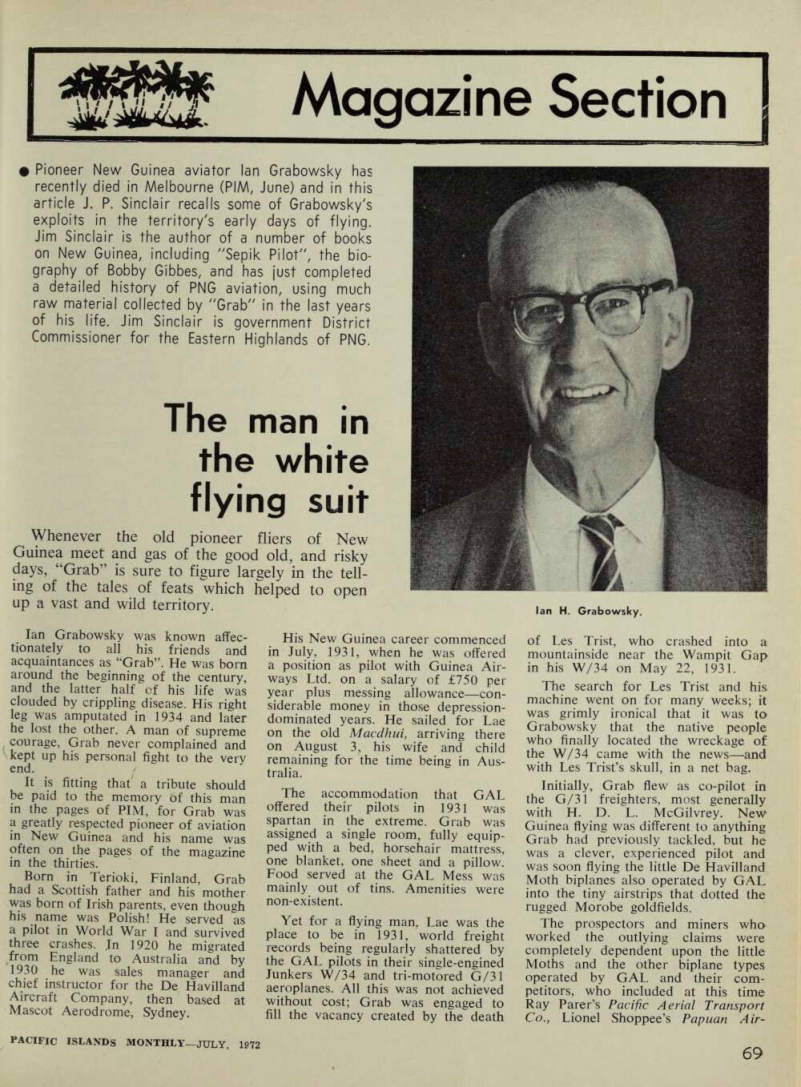
lan H. Grabowsky.
Air link with expedition
ways and Les Holden’s Holdens Air Transport Service.
Grab soon proved his worth, both as a pilot and as an administrator.
By June, 1933, he was acting manager of GAL’s New Guinea operations and soon afterwards he became general manager.
He was always a staunch, dogged supporter of aerial transport, never wavering in his opposition to the many road proposals that were constantly and fiercely argued in the late twenties and throughout the thirties. Many companies and in dividuals on the Morobe goldfields felt that a road link to the coast was essential if the field was to survive.
It was easy to accuse the air transport operators of excessive profit making (and Grab on many occasions called his own company greedy and pig-headed because, all too often, it failed to take the initiative in freight reductions) and just as easy to over look the enormous benefits that aerial transport brought to the goldfields.
Grab had no doubts at all. Aerial transport had thoroughly proved itself and should have received the undivided support of the administra tion and all on the field.
Indeed, Grab devised a scheme designed to persuade the Common wealth Government to grant GAL a complete monopoly of air operations on the goldfields, to end the “freight wars” between the rival operators common throughout the thirties. The proposals were very seriously enter tained by the Commonwealth but in the event individual operators con tinued on the field until the out break of the Pacific War.
As a pilot, Grab did his share of record-breaking, flying G/31s between Lae and Bulolo, but perhaps
his most celebrated feats were con nected with the famous 1933 ex ploratory journey of the Leahy- Taylor expedition, which penetrated for the first time the great Wahgi Valley of New Guinea’s Central Highlands and proved the existence of a half-million colourful people previously unknown.
Grab did not have the honour of being the first pilot to fly over part of the Highlands—Frank Drayton, who was killed in a Moth taking off from Wau ’drome in December, 1932, was the first, in November, 1929.
Nor was he the first to land an aeroplane on a Highlands airstrip— Bob Gurney landed a Moth on the first Highlands strip, Lapumpa, in September, 1932. But Grab was the pilot on that historic Bth day of March, 1933, when the Leahy Brothers and Major Harrison, general manager of New Guinea Goldfields Ltd., made the first flight through the great valley of the Wahgi.
And as the Leahy-Taylor ex pedition walked up the great valley and on to Mount Hagen it was Grab who kept in touch with them from the air and landed for the first time on the tiny strips that the expedition constructed during their epic walk, with the vital supplies that kept the explorers in the field. It was Gra bowsky, too, who pioneered the Mount Hagen airstrip, on April 27, 1933.
Leahy has recorded the immense impression that the coming of the aeroplane made on these people of the Wahgi, and of the awe of the people at the sight of the 6 ft H in.
Grabowsky, clad from head to toe in a long white cotton flying-suit, helmet and goggles, climbing out of his Moth.
This was dangerous flying, of course. There were no maps of this new country, no emergency landing grounds, no information about the mountain passes and the weather patterns. From the time he headed off into the west, looking for the explorers, to the time he thankfully landed his machine at Bena Bena, Lapumpa or Lae, Grab was on his own. He would have had scant chance of survival in the event of a forced landing.
Failing health drove Grab from New Guinea. In Australia he later joined Australian National Airways as planning and development manager, and was finally special project manager for TAA. But he never forgot New Guinea. Several years before his death, Grab commenced researching the pre-war history of Civil Aviation in New Guinea on behalf of the Department of Civil Aviation. He spent several years at this task, amassing a total of 1,700 foolscap pages of incredibly detailed material.
He completed basic research to the year 1935 before his physical condition compelled him to lay down his task. In December, 1969, he wrote to me, asking me to consider com pleting the work and offering me the fruits of his years of research. With some misgivings, I decided to attempt to complete the research that Grab began and to produce a book on those wonderful aviation years in Papua New Guinea. I spoke to him several times on the telephone and exchanged many letters with him, although as the end drew near writing became increasingly difficult for him. “I live in a sea of pain,” he wrote in 1971. He died peacefully, and mercifully without pain.
“Old hands” still living will know better than the rest of us the debt that modern Papua New Guinea owes to pioneers such as “Grab”
Grabowsky.
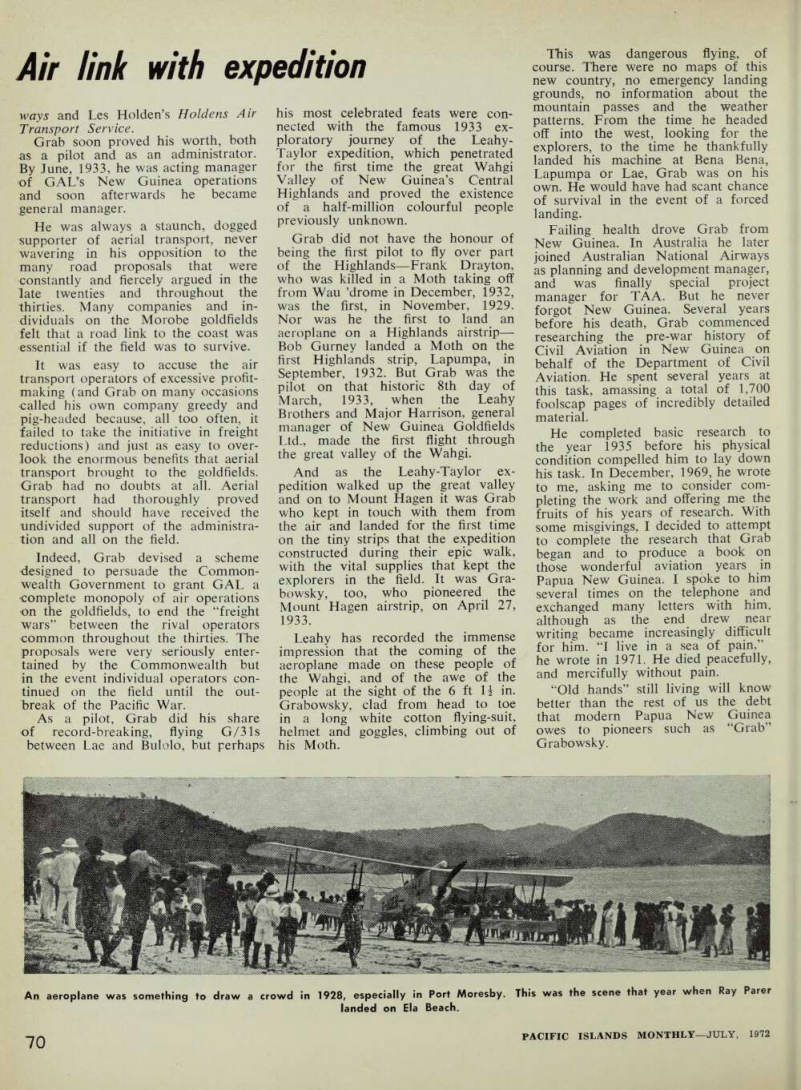
An aeroplane was something to draw a crowd in 1928, especially in Port Moresby. This was the scene that year when Ray Parer landed on Ela Beach.