drop that
pp. 44-45 · Read in the full issue
We didn't drop that bomb!
June began with a bombshell in Noumea Australian and New Zealand unionists were threatening to cut off supplies to New Cale donia, and this while the island was still reverberating from the effects of a Paris minister’s visit and reports of anti-French demon strations at the Arts Festival in Suva.
News of overseas unions’ boy cott of French ships and planes serving Noumea came as quite a shock to the Caledonians, especi ally as the action came from among the Caledonians’ most popular neighbours. The locals were surprised that the Aussies and Kiwis didn’t understand that the Caldoches already have their own load of squabbles with Paris, without being victimised by their neighbours for France’s policy in the Pacific.
Noumea housewives rushed local stores in fear of likely food shortages expected from the boy cott. Packets of rice, sugar, flour, butter, etc., fast disappeared from the shelves, together with biscuits —-in case of a flour shortage stop ping the baking of bread.
The French director of the Trade Department in Noumea, Mr. Jacques de Agostini, made a personal appeal over radio and TV, urging the Caledonians to be reasonable, to avoid panic buying. He said the French Ad ministration had matters well in hand, that the situation was not serious and that if the locals were to go short of Australian biscuits for a few days, that was not really “dramatique” . He admitted, how ever, that stores could run out of fresh milk, fruit, vegetables and butter. The French official claimed
that the matter was really more embarrassing for the New Zea landers and Australians, since they were “privileged suppliers, with a good market here”. The two countries sold about SA4O million worth of goods to New Caledonia in 1971, i.e. almost one-fifth of the territory’s total imports, and more than half of some individual food items.
One Noumea newsman sug gested the boycott could give a much-needed stimulus to promote Caledonian agriculture over im ported food. Admittedly the snails produced on the Isle of Pines are far larger (I can’t vouch for taste) than the tinned imports from over seas. But can one live on snails alone?
The local press also quoted the French administration as suggest ing the importation of extra food by special cargo flights from France, if necessary. But no-one specified how much this would cost the Caledonian housewife.
The visiting French Minister for Overseas Territories, Mr.
Pierre Messmer, had a quick answer to the first boycott reports, coming from New Zealand. The Caledonians were told that they could always look elsewhere for their supplies if New Zealand did not want to handle French ships and planes.
Two Noumea newspapers, both strong supporters of the adminis tration of Governor Louis Verger, quoted the minister as saying that “New Zealand went down on bended knee” to beg France to allow her continued exports to Great Britain for a period of five vears upon Britain’s entry to the Common Market. The minister
New Caledonia Diary
with
Helen Rousseau
was widely quoted as threatening that France could always consider a reduction of this period . . .
In the meantime, the Cale donian autonomists made a state ment deploring the fact that the Caledonians and other inhabitants of French colonies should be the victims of protests against the Paris test decisions. Spokesman Maurice Lenormand said the auto nomists condemned all nuclear tests.
By this time Cyclone Ida had added to the confusion, hitting Noumea with strong winds and over eight inches of rain in one day. Noumea streets which had flooded up to two feet deep in low-lying areas were left littered with galvanised roofing and other debris. Still, some housewives had braved the storm to shop for sup plies while the French ships were being turned out of Australian and New Zealand ports, without their cargoes . . .
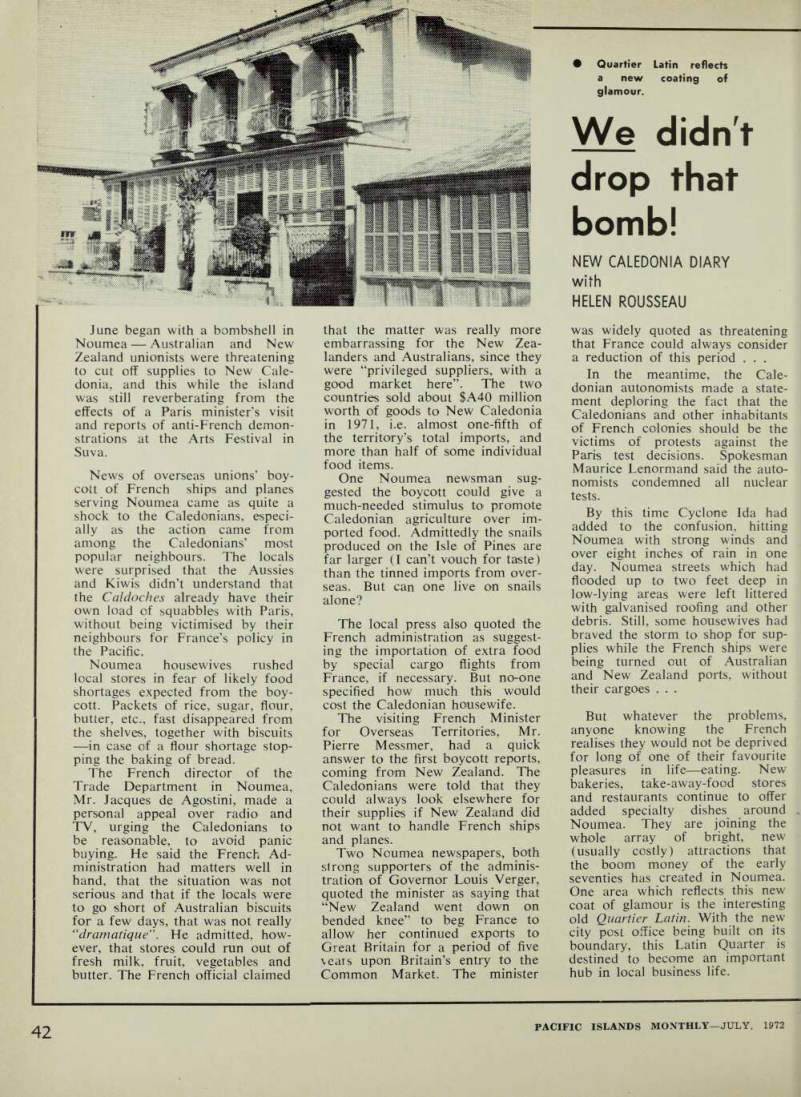
But whatever the problems, anyone knowing the French realises they would not be deprived for long of one of their favourite pleasures in life—eating. New bakeries, take-away-food stores and restaurants continue to offer added specialty dishes around Noumea. They are joining the whole array of bright, new (usually costly) attractions that the boom money of the early seventies has created in Noumea, One area which reflects this new coat of glamour is the interesting old Quartier Latin. With the new city post office being built on its boundary, this Latin Quarter is destined to become an important hub in local business life.
• Quartier Latin reflects a new coating of glamour.
The present Quartier Latin was long ago reclaimed from the sea.
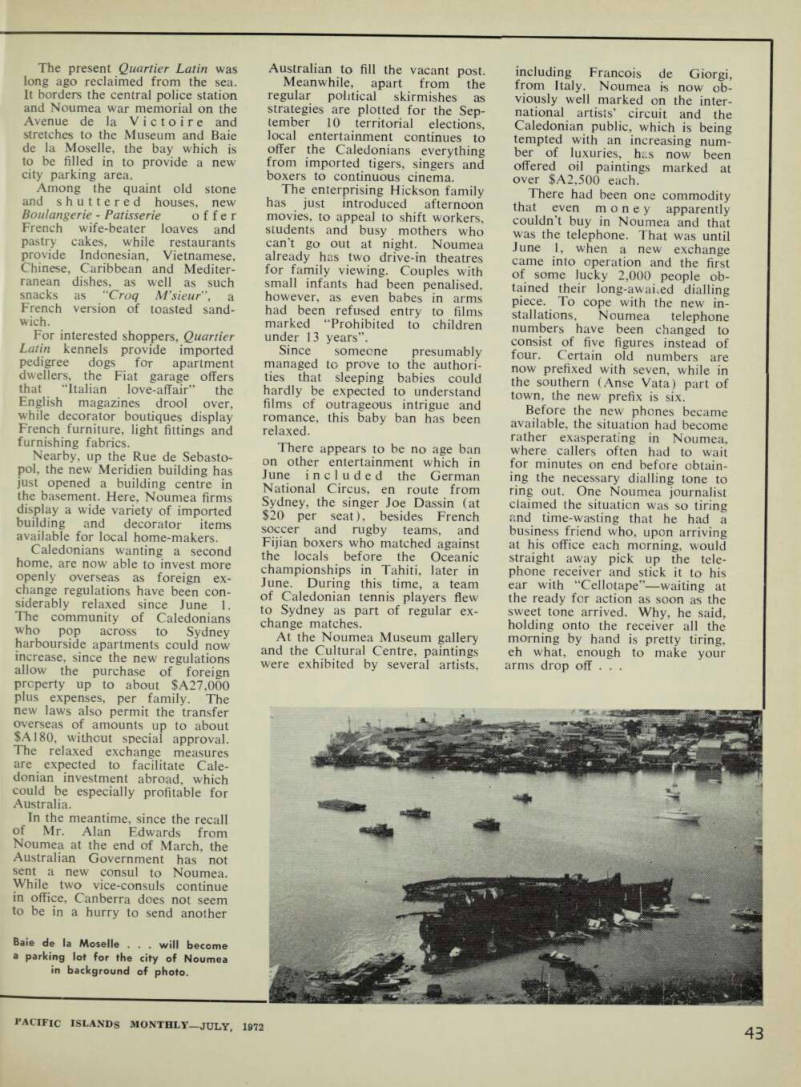
It borders the central police station and Noumea war memorial on the Avenue de la Vict o i r e and stretches to the Museum and Baie de la Moselle, the bay which is to be filled in to provide a new city parking area.
Among the quaint old stone and shuttered houses, new Boulangerie - Patisserie offer French wife-beater loaves and pastry cakes, while restaurants provide Indonesian, Vietnamese, Chinese, Caribbean and Mediter ranean dishes, as well as such snacks as “Croq M’sieur”, a French version of toasted sand wich.
For interested shoppers, Quartier Latin kennels provide imported pedigree dogs for apartment dwellers, the Fiat garage offers that “Italian love-affair” the English magazines drool over, while decorator boutiques display French furniture, light fittings and furnishing fabrics.
Nearby, up the Rue de Sebasto pol, the new Meridien building has just opened a building centre in the basement. Here, Noumea firms display a wide variety of imported building and decorator items available for local home-makers.
Caledonians wanting a second home, are now able to invest more openly overseas as foreign ex change regulations have been con siderably relaxed since June 1.
The community of Caledonians who pop across to Sydney harbourside apartments could now increase, since the new regulations allow the purchase of foreign property up to about $A27,000 plus expenses, per family. The new laws also permit the transfer overseas of amounts up to about SAIBO, without special approval.
The relaxed exchange measures are expected to facilitate Cale donian investment abroad, which could be especially profitable for Australia.
In the meantime, since the recall of Mr. Alan Edwards from Noumea at the end of March, the Australian Government has not sent a new consul to Noumea.
While two vice-consuls continue in office, Canberra does not seem to be in a hurry to send another
Australian to fill the vacant post.
Meanwhile, apart from the regular political skirmishes as strategies are plotted for the Sep tember 10 territorial elections, local entertainment continues to offer the Caledonians everything from imported tigers, singers and boxers to continuous cinema.
The enterprising Hickson family has just introduced afternoon movies, to appeal to shift workers, students and busy mothers who can’t go out at night. Noumea already has two drive-in theatres for family viewing. Couples with small infants had been penalised, however, as even babes in arms had been refused entry to films marked “Prohibited to children under 13 years”.
Since someone presumably managed to prove to the authori ties that sleeping babies could hardly be expected to understand films of outrageous intrigue and romance, this baby ban has been relaxed.
There appears to be no age ban on other entertainment which in June included the German National Circus, en route from Sydney, the singer Joe Dassin (at $2O per seat), besides French soccer and rugby teams, and Fijian boxers who matched against the locals before the Oceanic championships in Tahiti, later in June. During this time, a team of Caledonian tennis players flew to Sydney as part of regular ex change matches.
At the Noumea Museum gallery and the Cultural Centre, paintings were exhibited by several artists,
including Francois de Giorgi, from Italy. Noumea is now ob viously well marked on the inter national artists’ circuit and the Caledonian public, which is being tempted with an increasing num ber of luxuries, has now been offered oil paintings marked at over $A2,500 each.
There had been one commodity that even money apparently couldn’t buy in Noumea and that was the telephone. That was until June 1, when a new exchange came into operation and the first of some lucky 2,000 people ob tained their long-awaked dialling piece. To cope with the new in stallations, Noumea telephone numbers have been changed to consist of five figures instead of four. Certain old numbers are now prefixed with seven, while in the southern (Anse Vata) part of town, the new prefix is six.
Before the new phones became available, the situation had become rather exasperating in Noumea, where callers often had to wait for minutes on end before obtain ing the necessary dialling tone to ring out. One Noumea journalist claimed the situation was so tiring and time-wasting that he had a business friend who, upon arriving at his office each morning, would straight away pick up the tele phone receiver and stick it to his ear with “Cellotape”—waiting at the ready for action as soon as the sweet tone arrived. Why, he said, holding onto the receiver all the morning by hand is pretty tiring, eh what, enough to make your arms drop off . . .
Bale de la Moselle . . . will become a parking lot for the city of Noumea in background of photo.