Signposts
pp. 39-43 · Read in the full issue



For Tourism
In Fiji
By Rory Scott
Informed opinion about Fiji’s tourist industry is divided between those who believe that it has “arrived” on the world scene, and those who wonder which way it is going to go.
In fact neither view is necessarily ex clusive of the other.
The foundations for the present tourist boom were laid as long as 15 years ago. They included the choice of Nadi in 1957 as the prin cipal jet refuelling point between Sydney and Honolulu, and the conse quent up-grading of the airport; the introduction of duty-free shopping in 1962; and the passage of incentive legislation to attract hotel builders in 1963.
To these three elements should be added a fourth, undoubtedly the most important, yet one that is all too easily overlooked. This was the conscious decision of the government, in 1961, to develop a modern tourist industry in Fiji.
Once that decision had been taken all that was needed was the wit and the money to implement it, plus the determination not to let it be re versed. From this point on, pro posals for hotels aid, duty-free shop ping, expanding Air Pacific (formerly Fiji Airways), allowing in new air carriers, expanding the Visitors Bureau overseas, and a host of re lated matters—all could be tested against the basic intention to develop a modern tourist industry, and accepted or rejected in the light of whether or not they contributed to the atlamment of that goal.
The goal of a modem tourist in dustry has now been reached, and Fiji has unmistakably “arrived” on the world tourist scene. The question now is, which way to go next?
Any answer to this question de pends on recognising some of the deep-seated changes which have taken
place in the industry over the past decade, beneath the surface of the very obvious changes visible to the casual observer.
The first of these concerns the homogeneity of the industry, and its ability when necessary to speak with one voice, usually that of the Visitors Bureau. In sharp contrast to many other developed or developing tourist countries, Fiji has shown a com mendable ability to work har moniously as an industry, for the good of the industry as a whole, in stead of indulging in the internecine squabbling that so weakens its rivals in other lands.
Secondly, the image of Fiji in the early 19605, as a sort of bargain hunters’ bazaar on the doorsteps of Auckland and Sydney, has been con verted in + o one of a total holiday resort area, with beaches, good accommodation, much improved food and delightfully friendly people; and with duty-free shopping still in
evidence, but relegated to a position more calculated to increase the visitors’ length of stay.
Arising from this change of image has come another profound change in the attitudes of potential visitors. Ten years ago few people who had never been to Fiji would have chosen the country as one of the Pacific’s most desirable places to visit. Today the opposite is the case, largely due to the marketing efforts of the air and sea carriers serving the new dominion.
All this leads to an assessment of what Fiji means in mid-1972 to Mr. and Mrs. (or Ms.?) Tourist. Since roughly 30 per cent, come from Aus tralia, 30 per cent, from North America, 20 per cent, from New Zealand and 20 per cent, from other parts of the world, the answer is necessarily to some extent “all things to all men”. Luxury cruises, exotic hotels and custom-tailored services are available for the more affluent and elderly Americans who dominate that market, side by side with beach cottages, beachcomber islands and buses, which appeal more to the younger and less well-heeled Aus tralians and New Zealanders.
Common to both groups is the sense of timelessness when in Fiji, which allows a man to shake off the pressures of big city life. It would be unjust to claim that such inter national problems as The Bomb and crime in the streets do not also occupy the attention of Fiji’s citizens: only that they do not occupy it to the exclusion of more pressing domestic problems. But to the casual
Rory Scott has directed the Fiji Visitors Bureau since 1966. He has just left the post to be come general mana ger of Tapa Tours Ltd., of Suva. He sums up his views on the future of the Fiji tourist industry in this article specially commissioned by PIM.
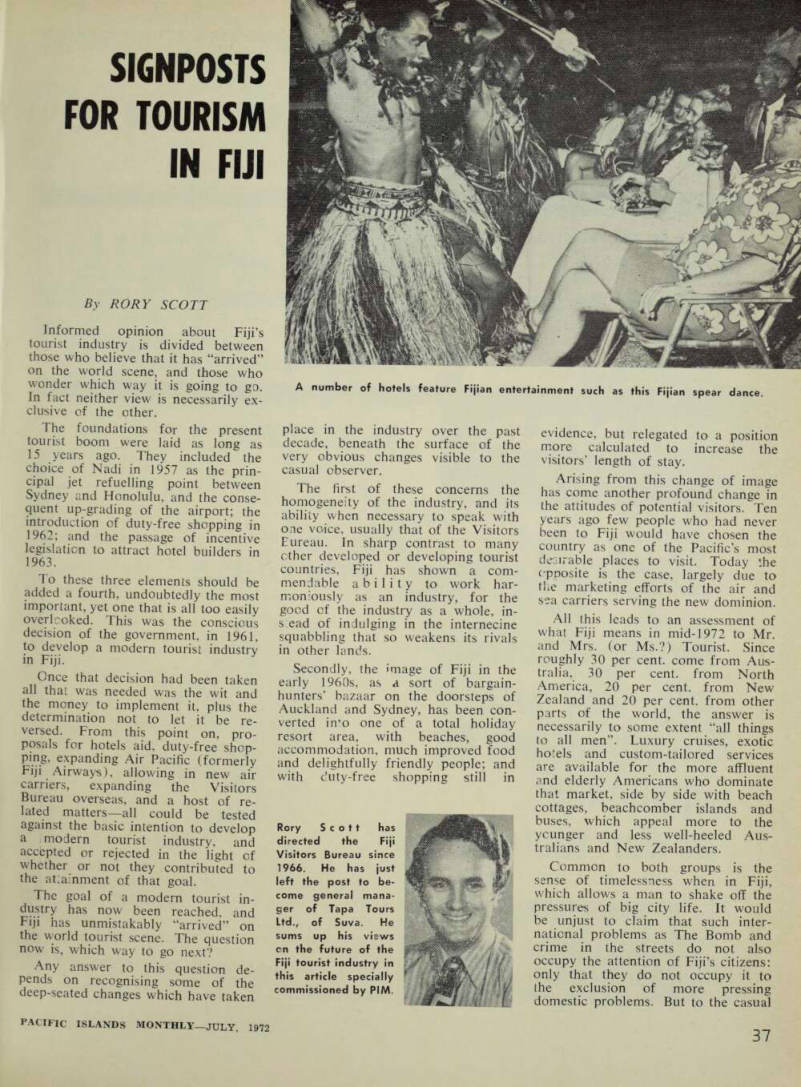
A number of hotels feature Fijian entertainment such as this Fijian spear dance
How many, how fast, how free?
observer they appear to be matters of no moment, and so the jaded city-dweller on holiday in Fiji is charmed.
So, whither Fiji tourism now?
There are all sorts of possible answers. It could become another Waikiki, catering to numberless, face less hordes only marginally more welcome than the soldiers of an army of occupation. Or another Bermuda, with stringent limitations on num bers, full house signs everywhere, and the certainty that the fat cats of the industry will get ever fatter.
Or a second Singapore, with liberal ised air landing rights and the tourists concentrated where the duty-free shops are, to the joy of the Japanese manufacturers.
It seems to me that the first step must be another conscious decision by the government, such as the one made in 1961. What does the govern ment want the tourism industry, now that it has “arrived”, to do for the social and economic life of Fiji?
TTie best opportunity to make this decision will come about February, 1973, when the report of the con sultants engaged by the World Bank to prepare a master plan for the de velopment of Fiji tourism will be delivered to the cabinet. The fact that this document is being prepared m close consultation with the Ministry for Communications, Works and Tourism—a senior official of the ministry has been seconded to work with the consultants—suggests that its final conclusions and recom mendations are likely to reflect the attitudes of the ministry to the future of the industry, and that it may well towar<^s answering the question Whither Fiji tourism now?’
Even before the report is published it is possible to predict a few of the directions that tourism is most likely to take. The first concerns the future role of Fiji citizens and Fiji capital.
In recent months the feeling has grown among Fiji’s civic, political and religious leaders, that the industry is getting to the stage where it is in danger of becoming the master, nither than the servant, of the people.
Central to this concern is the belief that Fiji, if it ever had full control of its tourism destiny i n the first place, is in danger of losing it now, it indeed it has not already done so. ♦u * , seer P s to me that the airlines, the hotels, the tour operators and the car rental companies must now recognise that the people of Fiji are demanding, and indeed are entitled to, a greater say than hitherto in the
control of the future of tourism.
Already the Native Lands Trust Board has given a lead in meeting this demand, through its new policy of bringing landowners increasingly into the ownership and managerial side of the business. This is being done by leasing Fijian land in con sideration of equity participation by, and a share of the annual income for, the landowners; as well as em ployment opportunities, training in higher skills, and similar fringe bene fits.
Following the NLTB lead, one cruise operator has instituted a profit
sharing scheme for his employees and others may follow suit. If the idea catches on I believe that it may go a long way towards meeting the natural aspirations of the citizens of Fiji for a greater share in the control and direction of tourism development, as well as having the benefit of reducing the chance of labour troubles in the future, and avoiding the bitterness that threatens to submerge the Caribbean tourist industry today.
A third new direction concerns the quality of the tourism product. If Fiji is to be attractive to a million visitors in 1980 as it was to 110,000 in 1971 then something has got to be done to remove the barriers that effectively prevent visitors from
mixing with, and getting to know, the citizens of the country.
At present, almost the only ones they meet are engaged in selling or providing goods or services to the visitors. They rarely, if ever, meet the farmers, teachers and villagers who contribute most of the image of “friendly Fiji”. This situation, if allowed to continue unchecked, must lead to increasing resentments and frustrations instead of to the mutual understanding and goodwill that ought to be the social goal of any tourist industry.
The chances of Fiji avoiding the pitfalls into which other countries have allowed their tourist industries to slide seem to me most promising.
Fiji has a great deal going for her.
To start with, the government is fully aware of the problems inherent in allowing unchecked growth, and the Tourism portfolio is now held by a minister, Ratu Penaia Ganilau, who is very much in touch with the think ing of ordinary people throughout the dominion. Secondly, the industry leaders are a homogenous group, and they include several imaginative men with a deep affection for the country of their birth or adoption.
Perhaps most important of all, there is tremendous goodwill through out the international tourist world for Fiji, and a desire on the part of air line, hotel, shipping and other com pany presidents to ensure that Fiji retains the attractions that have made it “the success story of post war Pacific tourism”, as PlM’s Judy Tudor puts it. When taken together with the local determination that these attractions shall never be thoughtlessly exploited, though it may not be possible to say exactly whither Fiji tourism is going next, at least the future can be faced with confidence.
Fiji's Minister for Tourism, Ratu Penaia Ganilau.