Sneak cyclone
p. 23 · Read in the full issue
savages the Solomons
From a Honiara correspondent The general weather situation early Wednesday, May 31 was deteriorat ing. It had been cloudy and heavy during the first half of the week, but anyone who suggested a cyclone was m the offing would have risked being laughed out of the Guadalcanal Club bar.
It was a bit like predicting a white Christmas in Sydney. Admittedly the south-east trades were a little late in arriving. But after all it was very nearly June. And June for the resi dents of northern Guadalcanal usually means switching on the irrigation pumps on the “Plains” and unblock ing garden hoses ready for the dry season.
By lunchtime messages were coming in from the western district and the Marine Department knew something unpleasant was brewing east of Bougainville. By 3.30 p.m. there were reports of 40-knot winds around Choiseul Island, Two hours later Melbourne confirmed a satellite re port that a storm centre had formed and was moving SE down the Solo mons. It looked like intensifying.
Storm warnings had already been issued for the west, and by 6 p.m. warning signals were up in the central district. Till then shipping had been on normal schedule runs.
Back in Honiara, cutter vessels which had confidently taken up their trade-wind positions on the west-side of Point Cruz, scuttled for the sheltered east-side and battened down. Residents in sea-front houses east and west of the capital—redolent with memories of Cyclone Carlotta —prepared to waterproof and other wise protect their possessions as best they could.
And incredibly, overnight, cyclone Ida swept down the central Solomons slot” bringing death, destruction, and havoc to north-western Choiseul, south-eastern Ysabel and the Russells. rirst reports in the morning placed Ida south-east of the Russell Islands, but this was soon changed to north of the Russells after more compre hensive wind reports were received.
Up till then three vessels were re ported missing, including the newly launched passenger vessel “Marata” with 13 passengers and crew aboard.
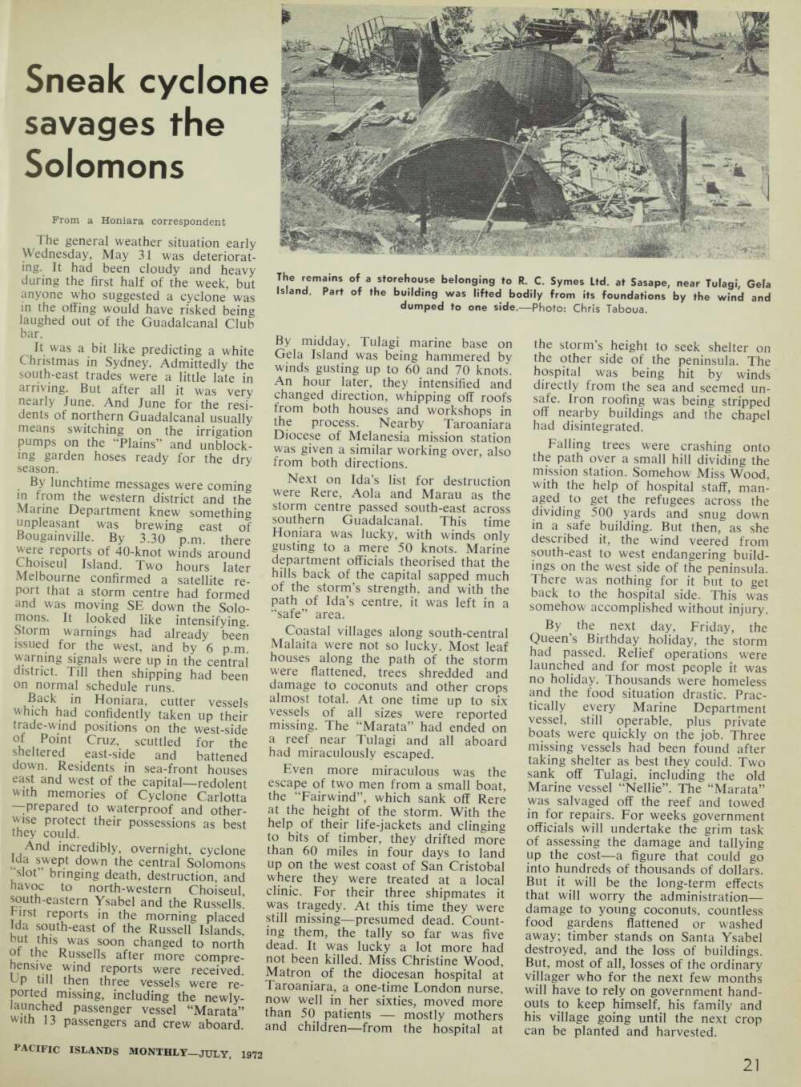
By midday, Tulagi marine base on Gela Island was being hammered by winds gusting up to 60 and 70 knots.
An hour later, they intensified and changed direction, whipping off roofs from both houses and workshops in the process. Nearby Taroaniara Diocese of Melanesia mission station was given a similar working over, also from both directions.
Next on Ida’s list for destruction were Rere, Aola and Marau as the storm centre passed south-east across southern Guadalcanal. This time Honiara was lucky, with winds only gusting to a mere 50 knots. Marine department officials theorised that the hills back of the capital sapped much of the storm’s strength, and with the path of Ida’s centre, it was left in a “safe” area.
Coastal villages along south-central Malaita were not so lucky. Most leaf houses along the path of the storm were flattened, trees shredded and damage to coconuts and other crops almost total. At one time up to six vessels of all sizes were reported missing. The “Marata” had ended on a reef near Tulagi and all aboard had miraculously escaped.
Even more miraculous was the escape of two men from a small boat, the “Fairwind”, which sank off Rere at the height of the storm. With the help of their life-jackets and clinging to bits of timber, they drifted more than 60 miles in four days to land up on the west coast of San Cristobal where they were treated at a local clinic. For their three shipmates it was tragedy. At this time they were still missing—presumed dead. Count ing them, the tally so far was five dead. It was lucky a lot more had not been killed. Miss Christine Wood, Matron of the diocesan hospital at Taroaniara, a one-time London nurse, now well in her sixties, moved more than 50 patients mostly mothers and children—from the hospital at
the storm’s height to seek shelter on the other side of the peninsula. The hospital was being hit by winds directly from the sea and seemed un safe. Iron roofing was being stripped off nearby buildings and the chapel had disintegrated.
Falling trees were crashing onto the path over a small hill dividing the mission station. Somehow Miss Wood, with the help of hospital staff, man aged to get the refugees across the dividing 500 yards and snug down in a safe building. But then, as she described it, the wind veered from south-east to west endangering build ings on the west side of the peninsula.
There was nothing for it but to get back to the hospital side. This was somehow accomplished without injury.
By the next day, Friday, the Queen’s Birthday holiday, the storm had passed. Relief operations were launched and for most people it was no holiday. Thousands were homeless and the food situation drastic. Prac tically every Marine Department vessel, still operable, plus private boats were quickly on the job. Three missing vessels had been found after taking shelter as best they could. Two sank off Tulagi, including the old Marine vessel “Nellie”. The “Marata” was salvaged off the reef and towed in for repairs. For weeks government officials will undertake the grim task of assessing the damage and tallying up the cost—a figure that could go into hundreds of thousands of dollars.
But it will be the long-term effects that will worry the administration— damage to young coconuts, countless food gardens flattened or washed away; timber stands on Santa Ysabel destroyed, and the loss of buildings.
But, most of all, losses of the ordinary villager who for the next few months will have to rely on government hand outs to keep himself, his family and his village going until the next crop can be planted and harvested.
The remaims of a storehouse belonging to R. C. Symes Ltd. at Sasape, near Tulagi, Gela Island. Part of the building was lifted bodily from its foundations by the wind and dumped to one side. Photo: Chris Taboua.