Tropicalities
pp. 19-22 · Read in the full issue
On being
just to
the justices
From FELISE VA’A, in Apia What is happening to the judiciary of Western Samoa? The question will perhaps never be fully answered, in volving as it does a number of persons, from clerks to ministers. And with government red tape, plus the non co-operative attitude by the present government towards the press it is unlikely that the public will ever come to know the reasons behind mass resignations on the part of officials of the judiciary.
Still, it is possible to get nearer to the real reasons for the mass exodus of judges. The rumblings which were audible became a roar when the Puisne Judge, Mr. G. J. Donne, resigned in 1970. Informed sources said Mr. Donne’s resignation was the result of internal politics in the Justice Department. They hinted that Mr. Donne, an ex-New Zealand stipendiary magistrate was probably fed up with interference and con flicting orders from his superiors.
Then, several months ago, the news leaked out that Cabinet has decided not to extend the term of the Chief Justice, Mr. Barrie Spring. Mr.
Spring’s term had already been ex tended for six months three times, and Mr. Spring was worried at this state of affairs.
He wrote to Cabinet saying that he wanted a ten year term as well as provision for a pension. But Cabinet would not accept these conditions.
Mr. Spring, therefore, will finish his present term about the middle of June.
A later event was another resigna tion, this time of the magistrate, Mr.
Raymond Patrick McAleer. This will be effective, also about the middle of June. Reasons for his resignation were compassionate, Secretary of Justice Su’a Leituposa Thomsen said A member of Mr. McAleer’s family was seriously ill in New Zealand.
With two judiciary officials due to leave soon, there was still no word or replacements at the time of going
to press, and the only judge certain to be in Western Samoa will be the Puisne Judge, Mr. Eric Francis Rothwell. But even he is not a per manent appointment.
Mr. Rothwell, an ex-stipendiary magistrate in New Zealand and relieving judge both in New Zealand and other Pacific territories, has been appointed for a three month term, after which he will return to his post as a member of a tribunal in New Zealand.
What is the story behind this state of affairs? Where are the replace ments going to come from? Reliable sources said the New Zealand authorities are already disgusted because Western Samoan authorities had turned down a person recom mended for the local Supreme Court, and this after the local authorities had already committed themselves to the recommendation. The person recom mended had already sold his house for an appointment that never came.
Stability and length of tenure are important elements in a free judiciary, and it would appear that they are being neglected in Western Samoa.
A Triple Bill in
Port Moresby
Papua New Guinea’s brand new city, Port Moresby, turned on a triple bill for the Queen’s Birthday weekend.
There was the Papuan Agricultural Society’s annual show. There was its younger sister, the Hiri Festival. And finally there was the investiture of the Port Moresby City Council. Percy Chatterton reports:— The show has a distinguished his tory behind it, but the Hiri Festival was celebrating its first birthday, having been inaugurated just twelve months ago.
“Hiri” is the Motu word for the great trading expeditions which the people of the Motu villages of the central Papuan coast used to mount every year, and in the course of which they sailed westward across the Gulf of Papua to trade their earthen ware pots for sago and canoe logs.
The custom in its traditional form died out in the 19305, but the name has become a kind of rallying cry for Motu cultural traditions, and the Hiri Festival aims at keeping these traditions alive and arousing the
interest of others, including tourists, in them.
This year’s festival began with a display of traditional dancing by pupils of a number of primary schools in and around Port Moresby. Under a hot sun beating down on the play ground of the Hagara (Hanuabada) Primary School, youngsters ranging in age from six to 16 displayed their finery and went through their paces with gusto, urged on by enthusiastic parents. It is an endearing charac teristic of coastal Papuans that on occasions such as this parents often put more energy into, and take more pride in, their children’s performances than their own.
In the evening, students from the Sogeri Senior High School, which caters for the fifth and sixth years of secondary schooling, put on a similar exhibition at Port Moresby’s Cultural Centre, which adjoins the Sir Hubert Murray Stadium at Konedobu, on the shores of Port Moresby harbour. This display was accompanied by an amudo, a Papuan style feast with food cooked on hot stones in an earth oven. In passing, I was glad to note that on this Papuan occasion the Motu word for this style of cooking was used instead of the more com monly heard Pidgin word mumu.
Perhaps the most remarkable feature of this display consisted in the fact that it took place at all. A few years ago young Papuans at this level of education were contemptuous of the ways of their forebears and aspired to become brown Australians.
It was good to see these “letting their hair down” (actually in most cases frizzing it up), and taking pride in the old ways.
It was also satisfying to note that these young people, brought together from many parts of Papua New Guinea, had been learning one
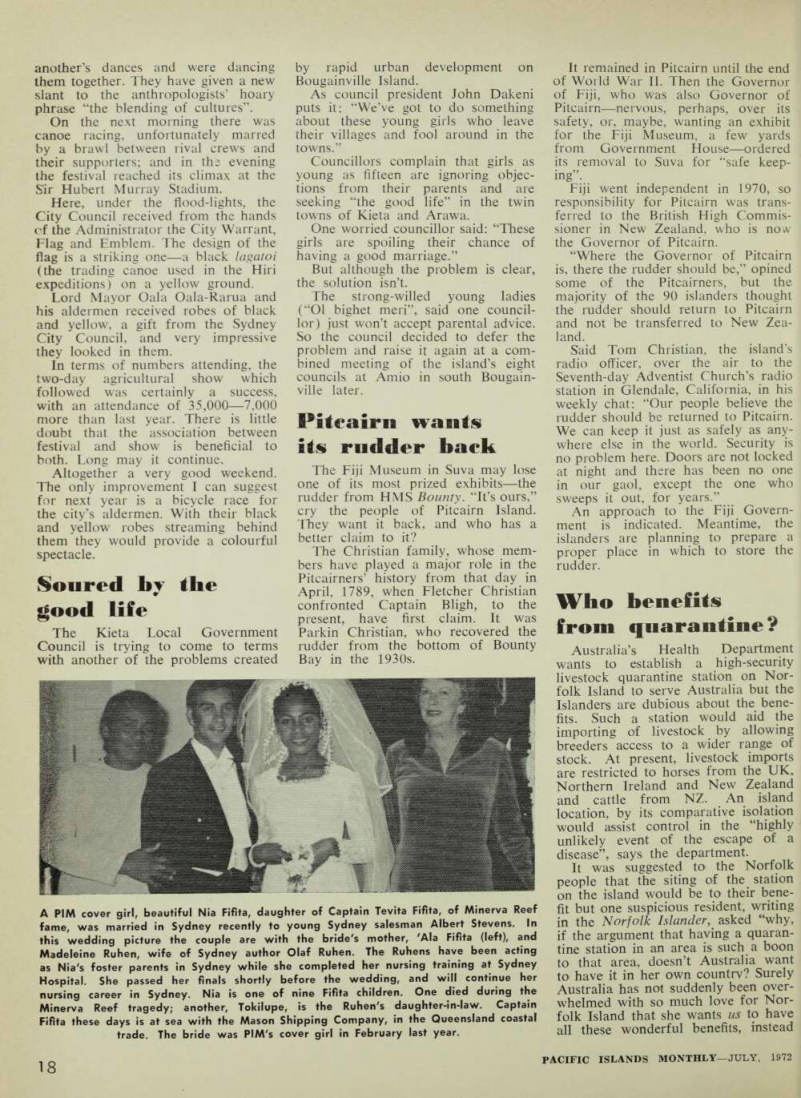
The flag of the new city of Port Moresby, received in June by Lord Mayor Oala Oala-Rarua.
another’s dances and were dancing them together. They have given a new slant to the anthropologists’ hoary phrase “the blending of cultures”.
On the next morning there was canoe racing, unfortunately marred by a brawl between rival crews and their supporters; and in the evening the festival reached its climax at the Sir Hubert Murray Stadium.
Here, under the flood-lights, the City Council received from the hands cf the Administrator the City Warrant, Flag and Emblem. The design of the flag is a striking one—a black lagatoi (the trading canoe used in the Hiri expeditions) on a yellow ground.
Lord Mayor Oala Oala-Rarua and his aldermen received robes of black and yellow, a gift from the Sydney City Council, and very impressive they looked in them.
In terms of numbers attending, the two-day agricultural show which followed was certainly a success, with an attendance of 35,000—7.000 more than last year. There is little doubt that the association between festival and show is beneficial to both. Long may it continue.
Altogether a very good weekend.
The only improvement I can suggest for next year is a bicycle race for the city’s aldermen. With their black and yellow robes streaming behind them they would provide a colourful spectacle.
Kw tflwi IfT ij nnfl ] Ilf** r- The Kieta Local Government Council is trying to come to terms with another of the problems created
by rapid urban development on Bougainville Island, As council president John Dakeni puts it: “We’ve got to do something about these young girls who leave their villages and fool around in the towns.”
Councillors complain that girls as young as fifteen are ignoring objec tions from their parents and are seeking “the good life” in the twin towns of Kieta and Arawa.
One worried councillor said: “These girls are spoiling their chance of having a good marriage.”
But although the problem is clear, the solution isn’t.
The strong-willed young ladies (“Ol bighet meri”, said one council lor) just won’t accept parental advice.
So the council decided to defer the problem and raise it again at a com bined meeting of the island’s eight councils at Amio in south Bougain ville later,
WclllflS
I*ll(Bd(*I* IliK'k
The Fiji Museum in Suva may lose one °f i ts rnost prized exhibits—the rudder from HMS Bounty. ‘ It s ours, cry the people of Pitcairn Island, They want it back, and who has a better claim to it?
The Christian family, whose mem bers have played a major role in the Pitcairners’ history from that day in April, 1789, when Fletcher Christian confronted Captain Bligh, to the present, have first claim. It was Parkin Christian, who recovered the rudder from the bottom of Bounty Bay in the 19305.
It remained in Pitcairn until the end of World War 11. Then the Governor of Fiji, who was also Governor of Pitcairn—nervous, perhaps, over its safety, or, maybe, wanting an exhibit for the Fiji Museum, a few yards from Government House—ordered its removal to Suva for “safe keep ing”.
Fiji went independent in 1970, so responsibility for Pitcairn was trans ferred to the British High Commis sioner in New Zealand, who is now the Governor of Pitcairn.
“Where the Governor of Pitcairn is, there the rudder should be,” opined some of the Pitcairners, but the majority of the 90 islanders thought the rudder should return to Pitcairn and not be transferred to New Zea land.
Said Tom Christian, the island’s radio officer, over the air to the Seventh-day Adventist Church’s radio station in Glendale, California, in his weekly chat: “Our people believe the rudder should be returned to Pitcairn.
We can keep it just as safely as any where else in the world. Security is no problem here. Doors are not locked at night and there has been no one in our gaol, except the one who sweeps it out, for years.”
An approach to the Fiji Govern ment is indicated. Meantime, the islanders are planning to prepare a proper place in which to store the rudder.
Who benefits
from quarantine?
Australia’s Health Department wants to establish a high-security livestock quarantine station on Nor folk Island to serve Australia but the Islanders are dubious about the bene fits. Such a station would aid the importing of livestock by allowing breeders access to a wider range of stock. At present, livestock imports are restricted to horses from the UK, Northern Ireland and New Zealand and cattle from NZ. An island location, by its comparative isolation would assist control in the “highly unlikely event of the escape of a disease”, says the department.
It was suggested to the Norfolk people that the siting of the station on the island would be to their bene fit but one suspicious resident, writing in the Norfolk Islander, asked “why, if the argument that having a quaran tine station in an area is such a boon to that area, doesn’t Australia want to have it in her own country? Surely Australia has not suddenly been over whelmed with so much love for Nor folk Island that she wants us to have all these wonderful benefits, instead
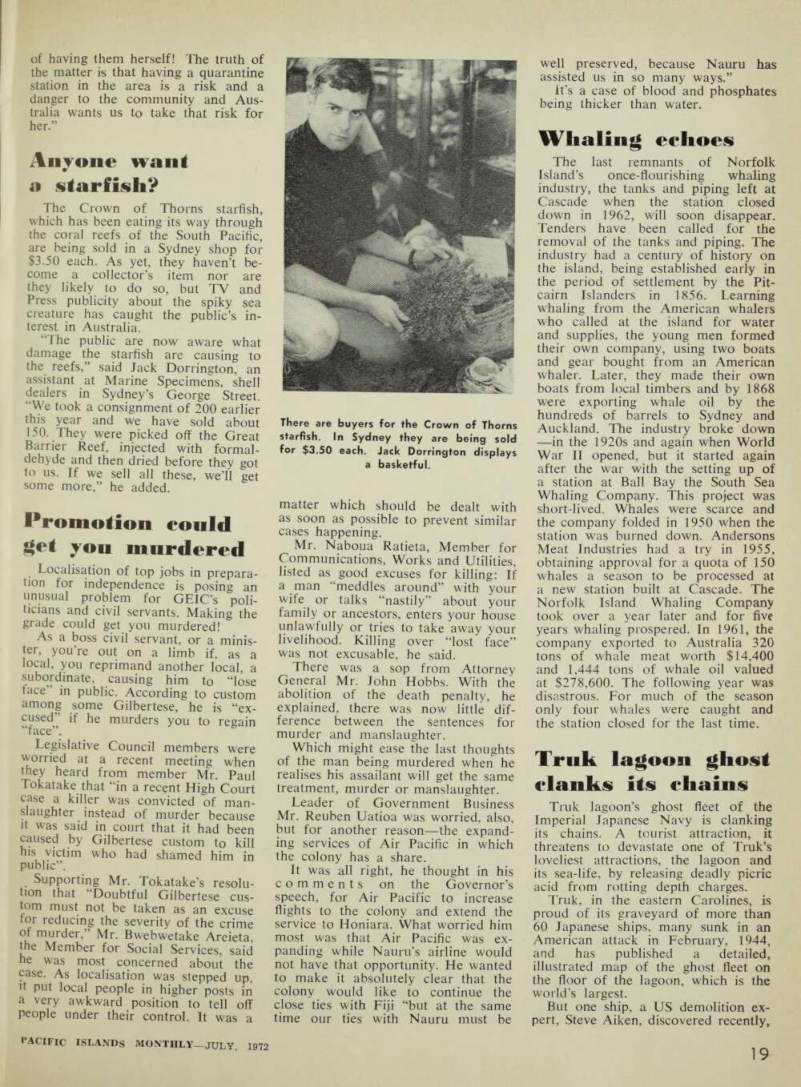
A PIM cover girl, beautiful Nia Fifita, daughter of Captain Tevita Fiflta, of Minerva Reef fame, was married in Sydney recently to young Sydney salesman Albert Stevens. In this wedding picture the couple are with the bride's mother, 'Ala Fifita (left), and Madeleine Ruhen, wife of Sydney author Olaf Ruhen. The Ruhens have been acting as Nia's foster parents in Sydney while she completed her nursing training at Sydney Hospital. She passed her finals shortly before the wedding, and will continue her nursing career in Sydney. Nia is one of nine Fifita children. One died during the Minerva Reef tragedy; another, Tokilupe, is the Ruhen's daughter-in-law. Captain Fifita these days is at sea with the Mason Shipping Company, in the Queensland coastal trade. The bride was PIM's cover girl in February last year.
of having them herself! The truth of the matter is that having a quarantine station in the area is a risk and a danger to the community and Aus tralia wants us to take that risk for her.”
Anyone want
a starfish?
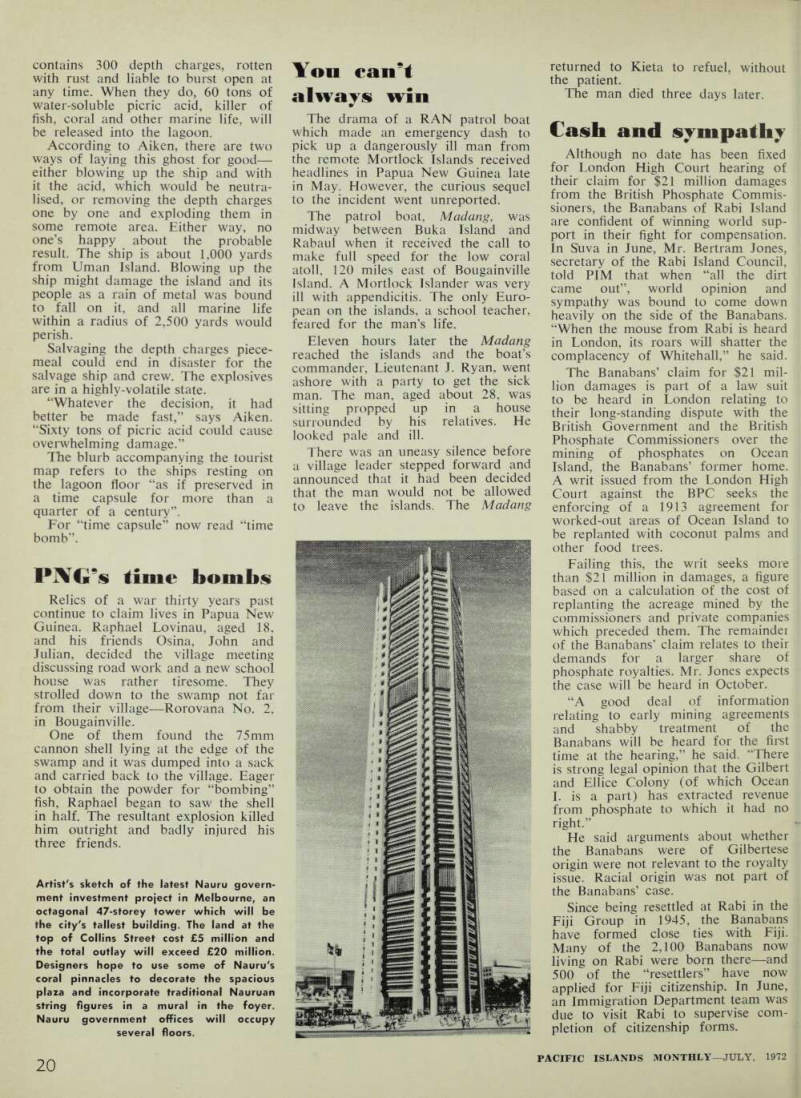
The Crown of Thorns starfish, which has been eating its way through the coral reefs of the South Pacific, are being sold in a Sydney shop for $3.50 each. As yet, they haven’t be come a collector’s item nor are they likely to do so, but TV and Press publicity about the spiky sea creature has caught the public’s in terest in Australia.
“The public are now aware what damage the starfish are causing to the reefs,” said Jack Dorrington, an assistant at Marine Specimens, shell dealers in Sydney’s George Street.
“We took a consignment of 200 earlier this year and we have sold about 150. They were picked off the Great Barrier Reef, injected with formal dehyde and then dried before they got to us. If we sell all these, we’ll get some more,” he added.
Promotion eon Id
get you murdered
Localisation of top jobs in prepara tion for independence is posing an unusual problem for GEIC’s poli ticians and civil servants. Making the grade could get you murdered!
As a boss civil servant, or a minis ter, you’re out on a limb if, as a local, you reprimand another local, a subordinate, causing him to “lose face” in public. According to custom among some Gilbertese, he is “ex cused” if he murders you to regain face”.
Legislative Council members were worried at a recent meeting when they heard from member Mr. Paul Tokatake that “in a recent High Court case a killer was convicted of man slaughter instead of murder because it was said in court that it had been caused by Gilbertese custom to kill his victim who had shamed him in public”.
Supporting Mr. Tokatake’s resolu tion that Doubtful Gilbertese cus tom must not be taken as an excuse for reducing the severity of the crime of murder,” Mr. Bwebwetake Areieta, the Member for Social Services, said he was most concerned about the case. As localisation was stepped up. it put local people in higher posts in a very awkward position to tell off people under their control. It was a
matter which should be dealt with as soon as possible to prevent similar cases happening.
Mr. Naboua Ratieta, Member for Communications, Works and Utilities, listed as good excuses for killing: If a man “meddles around” with your wife or talks “nastily” about your family or ancestors, enters your house unlawfully or tries to take away your livelihood. Killing over “lost face” was not excusable, he said.
There was a sop from Attorney General Mr. John Hobbs. With the abolition of the death penalty, he explained, there was now little dif ference between the sentences for murder and manslaughter.
Which might ease the last thoughts of the man being murdered when he realises his assailant will get the same treatment, murder or manslaughter.
Leader of Government Business Mr. Reuben Uatioa was worried, also, but for another reason—the expand ing services of Air Pacific in which the colony has a share.
It was all right, he thought in his comments on the Governor’s speech, for Air Pacific to increase flights to the colony and extend the service to Honiara. What worried him most was that Air Pacific was ex panding while Nauru’s airline would not have that opportunity. He wanted to make it absolutely clear that the colony would like to continue the close ties with Fiji “but at the same time our ties with Nauru must be
well preserved, because Nauru has assisted us in so many ways.”
It’s a case of blood and phosphates being thicker than water.
Whaling echoes
The last remnants of Norfolk Island’s once-flourishing whaling industry, the tanks and piping left at Cascade when the station closed down in 1962, will soon disappear.
Tenders have been called for the removal of the tanks and piping. The industry had a century of history on the island, being established early in the period of settlement by the Pit cairn Islanders in 1856. Learning whaling from the American whalers who called at the island for water and supplies, the young men formed their own company, using two boats and gear bought from an American whaler. Later, they made their own boats from local timbers and by 1868 were exporting whale oil by the hundreds of barrels to Sydney and Auckland. The industry broke down —in the 1920 s and again when World War II opened, but it started again after the war with the setting up of a station at Ball Bay the South Sea Whaling Company. This project was short-lived. Whales were scarce and the company folded in 1950 when the station was burned down. Andersens Meat Industries had a try in 1955, obtaining approval for a quota of 150 whales a season to be processed at a new station built at Cascade. The Norfolk Island Whaling Company took over a year later and for five years whaling prospered. In 1961, the company exported to Australia 320 tons of whale meat worth $14,400 and 1,444 tons of whale oil valued at $278,600. The following year was disastrous. For much of the season only four whales were caught and the station closed for the last time.
Truk lagoon ghost
Hank* its rhains
Truk lagoon’s ghost fleet of the Imperial Japanese Navy is clanking its chains. A tourist attraction, it threatens to devastate one of Truk’s loveliest attractions, the lagoon and its sea-life, by releasing deadly picric acid from rotting depth charges.
Truk, in the eastern Carolines, is proud of its graveyard of more than 60 Japanese ships, many sunk in an American attack in February, 1944, and has published a detailed, illustrated map of the ghost fleet on the floor of the lagoon, which is the world’s largest.
But one ship, a US demolition ex pert, Steve Aiken, discovered recently.
There are buyers for the Crown of Thorns starfish. In Sydney they are being sold for $3.50 each. Jack Dorrington displays a basketful.
contains 300 depth charges, rotten with rust and liable to burst open at any time. When they do, 60 tons of water-soluble picric acid, killer of fish, coral and other marine life, will be released into the lagoon.
According to Aiken, there are two ways of laying this ghost for good— either blowing up the ship and with it the acid, which would be neutra lised, or removing the depth charges one by one and exploding them in some remote area. Either way, no one’s happy about the probable result. The ship is about 1,000 yards from Uman Island. Blowing up the ship might damage the island and its people as a rain of metal was bound to fall on it, and all marine life within a radius of 2,500 yards would perish.
Salvaging the depth charges piece meal could end in disaster for the salvage ship and crew. The explosives are in a highly-volatile state.
“Whatever the decision, it had better be made fast,” says Aiken.
“Sixty tons of picric acid could cause overwhelming damage.”
The blurb accompanying the tourist map refers to the ships resting on the lagoon floor “as if preserved in a time capsule for more than a quarter of a century”.
For “time capsule” now read “time bomb”.
PNG’s time bombs
Relics of a war thirty years past continue to claim lives in Papua New Guinea. Raphael Lovinau, aged 18, and his friends Osina, John and Julian, decided the village meeting discussing road work and a new school house was rather tiresome. They strolled down to the swamp not far from their village—Rorovana No. 2, in Bougainville.
One of them found the 75mm cannon shell lying at the edge of the swamp and it was dumped into a sack and carried back to the village. Eager to obtain the powder for “bombing” fish, Raphael began to saw the shell in half. The resultant explosion killed him outright and badly injured his three friends.
You can 9 !
always wiu
The drama of a RAN patrol boat which made an emergency dash to pick up a dangerously ill man from the remote Mortlock Islands received headlines in Papua New Guinea late in May. However, the curious sequel to the incident went unreported.
The patrol boat, Madang, was midway between Buka Island and Rabaul when it received the call to make full speed for the low coral atoll, 120 miles east of Bougainville Island. A Mortlock Islander was very ill with appendicitis. The only Euro pean on the islands, a school teacher, feared for the man’s life.
Eleven hours later the Madang reached the islands and the boat’s commander, Lieutenant J. Ryan, went ashore with a party to get the sick man. The man, aged about 28, was sitting propped up in a house surrounded by his relatives. He looked pale and ill.
There was an uneasy silence before a village leader stepped forward and announced that it had been decided that the man would not be allowed to leave the islands. The Madang
returned to Kieta to refuel, without the patient.
The man died three days later.
Cash and sympathy
Although no date has been fixed for London High Court hearing of their claim for $2l million damages from the British Phosphate Commis sioners, the Banabans of Rabi Island are confident of winning world sup port in their fight for compensation.
In Suva in June, Mr. Bertram Jones, secretary of the Rabi Island Council, told PIM that when “all the dirt came out”, world opinion and sympathy was bound to come down heavily on the side of the Banabans.
“When the mouse from Rabi is heard in London, its roars will shatter the complacency of Whitehall,” he said.
The Banabans’ claim for $2l mil lion damages is part of a law suit to be heard in London relating to their long-standing dispute with the British Government and the British Phosphate Commissioners over the mining of phosphates on Ocean Island, the Banabans’ former home.
A writ issued from the London High Court against the BPC seeks the enforcing of a 1913 agreement for worked-out areas of Ocean Island to be replanted with coconut palms and other food trees.
Failing this, the writ seeks more than $2l million in damages, a figure based on a calculation of the cost of replanting the acreage mined by the commissioners and private companies which preceded them. The remainder of the Banabans’ claim relates to their demands for a larger share of phosphate royalties. Mr. Jones expects the case will be heard in October.
“A good deal of information relating to early mining agreements and shabby treatment of the Banabans will be heard for the first time at the hearing,” he said. “There is strong legal opinion that the Gilbert and Ellice Colony (of which Ocean I. is a part) has extracted revenue from phosphate to which it had no right.”
He said arguments about whether the Banabans were of Gilbertese origin were not relevant to the royalty issue. Racial origin was not part of the Banabans’ case.
Since being resettled at Rabi in the Fiji Group in 1945, the Banabans have formed close ties with Fiji.
Many of the 2,100 Banabans now living on Rabi were born there—and 500 of the “resettlers” have now applied for Fiji citizenship. In June, an Immigration Department team was due to visit Rabi to supervise com pletion of citizenship forms.
Artist's sketch of the latest Nauru govern ment investment project in Melbourne, an octagonal 47-storey tower which will be the city's tallest building. The land at the top of Collins Street cost £5 million and the total outlay will exceed £20 million.
Designers hope to use some of Nauru's coral pinnacles to decorate the spacious plaza and incorporate traditional Nauruan string figures in a mural in the foyer.
Nauru government offices will occupy several floors.