Samoa
pp. 50-57 · Read in the full issue

About
With
Sympathy
By staff writer REX MATTHEWS
“Of course, only those who have spent 20 years here or those who have just arrived would dare to write about the place,” I was told during a four-day visit made to Western Samoa in April. I agree. It takes long and sympathetic contact to write with insight about the people and practices of a place. That’s true of almost any place.
So this is just the chronicle of a visit. Samoans may learn of the impression that their islands give to a visitor, and others may see one Pacific Island group as they might on a quick visit. The occasion was the opening of the new Faleolo Airport on April 21.
The journey from Sydney introduced me to Qantas’ Jumbo jet for the flight to Nadi, and to Air Pacific’s new BACIII twin jet for the flight to Faleolo from Nauson. Both were enjoyable as a new experience, and on reflection, each did an efficient job of transportation very much suited to the traffic of its particular leg.
On board the BACIII I found a full load of VIP guests and a team of journalists and travel agents, all headed for the opening of the new airport. Here I gained my first glimpse of the “tourist question”, as I was to hear more of over the following days.
In flight we were handed the standard incoming passenger card and a visitor questionnaire. But on landing, after the jet had taxied behind the wagon pouring a final coat of tar on the approach strip to the aircraft parking apron, and due fuss had been made of the important guests who were whisked away in government
cars, the immigration cards were quite forgotten.
So too were any customs formali ties. In the genial atmosphere that prevailed, no one wanted to see pass ports or do anything else to hamper the enjoyment of the new arrivals, The new terminal building was swathed in greenery and flowers for the morrow’s ceremony, and infor mality prevailed, So much in fact, that as the jour nalists and travel agents were being loaded onto a bus, I decided I had better identify myself. It turned out that I was not expected but no matter, they happily handed me an envelope addressed to someone who didn't turn up, so I had a ticket, albeit in another name, for all the functions on the official programme, Our destination was the Hideaway Hotel, 40 minutes away on the other s kl e of the island, a beautiful journey through forests of impenetrable green, through overgrown plantations fighting a losing battle with jungle growth, past an occasional village with its thatch roofed fales and its much less attractive timber and iron houses and a glimpse here and there of a 4-inch steel water main along side the road with a thousand-gallon tank overflowing and squirting water from cracks in its side.
The Hideaway is well named. The bus turns in off the narrow gravel road and circumnavigates the Catholic mission by way of a two wheel track, and there by the water it is hidden. Not a hotel in the best ritzy tradition—my unfinished room didn’t look as if even on completion it would rival the Hilton’s but
certainly it was the kind of place where one could hide away from the world that Hilton stands for.
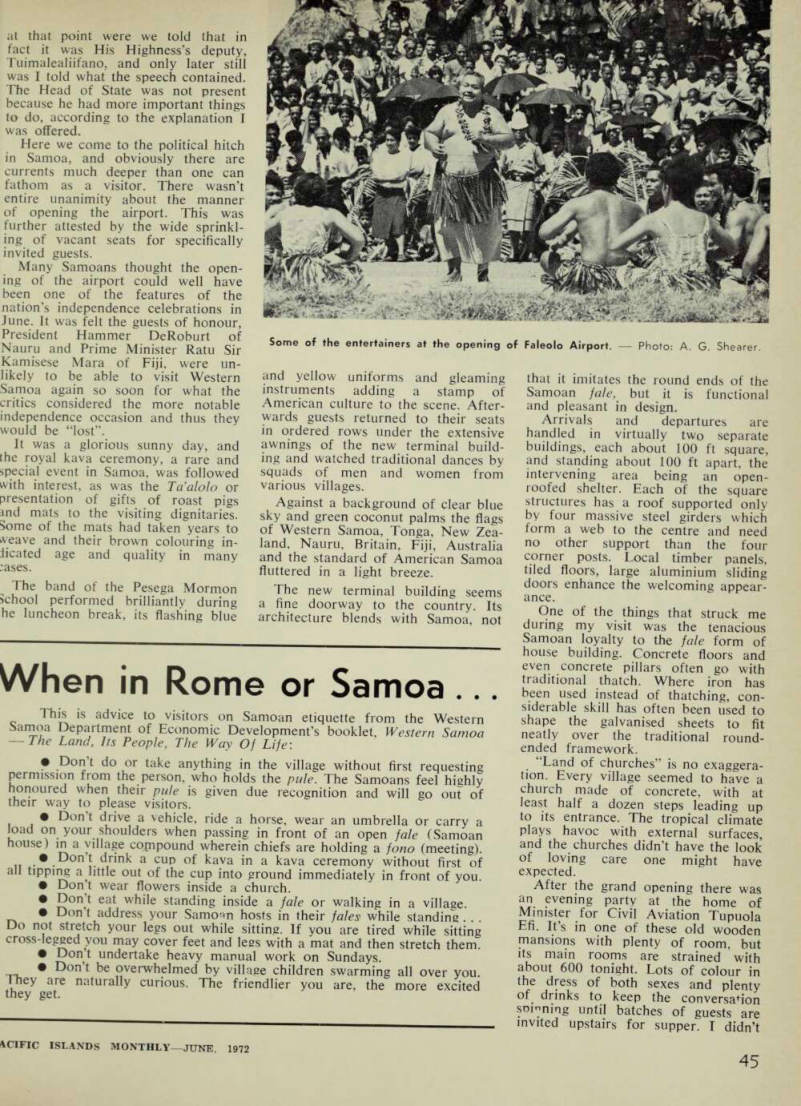
That evening there was a Fiafia (an informal gathering) at the Hide away sponsored by Polynesian Air lines. A fine display of Samoan dances and songs was presented in the open air by children from the mission next door. By the light of flares the boys gave a spectacular knife dance, but the dance and the singing were spoiled because a large proportion of the guests paid no heed to the repeated invitation to come out and watch the show, and continued drinking and talking at such a pitch that the entertainers could scarcely be heard.
I was ‘up at first light’ for break fast and a bus ride across Upolu to Apia via Tiavi Falls and Vailima, Robert Louis Stevenson’s old home which is now the residence of the Head of State. Some sort of record must have been set for a sightseeing tour, because we were only 20 minutes late for the ceremony at Faleolo Airport at 8.30.
We were in time to be bundled out in sight of the assembled populace and of the seated dignitaries, and being just able to scuttle around behind the scenes, when up rolled the police-escorted car bearing, we thought, His Highness Malietoa Tanumafili 11. Western Samoa’s national anthem was played and the Rev. Vavae Toma offered prayer in both Samoan and English.
Having found seats, we strangers listened politely to the Head of State’s speech before the cutting of the ribbon to open the airport. Only
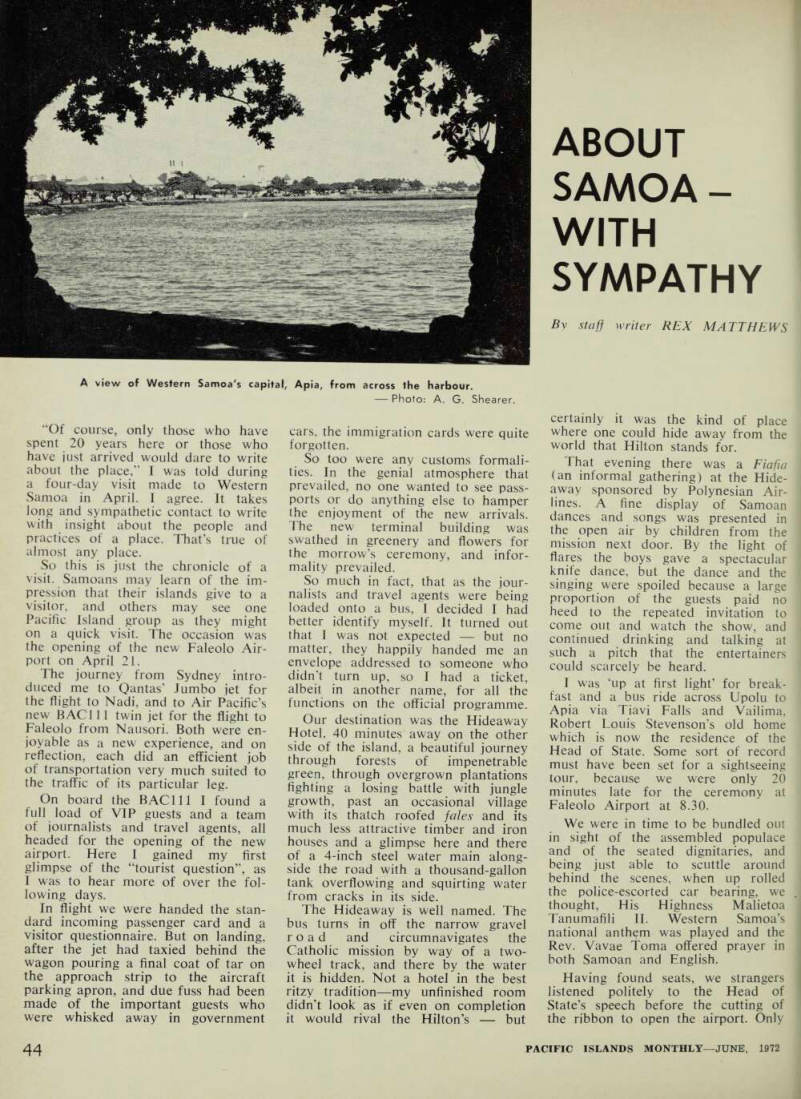
A view of Western Samoa's capital, Apia, from across the harbour.
Photo: A. G. Shearer.
at that point were we told that in fact it was His Highness’s deputy, Tuimalealiifano, and only later still was I told what the speech contained.
The Head of State was not present because he had more important things to do, according to the explanation I was offered.
Here we come to the political hitch in Samoa, and obviously there are currents much deeper than one can fathom as a visitor. There wasn’t entire unanimity about the manner of opening the airport. This was further attested by the wide sprinkl ing of vacant seats for specifically invited guests.
Many Samoans thought the open ing of the airport could well have been one of the features of the nation’s independence celebrations in June. It was felt the guests of honour, President Hammer Deßoburt of Nauru and Prime Minister Ratu Sir Kamisese Mara of Fiji, were un likely to be able to visit Western Samoa again so soon for what the critics considered the more notable independence occasion and thus they would be “lost”.
It was a glorious sunny day, and the royal kava ceremony, a rare and special event in Samoa, was followed with interest, as was the Ta’alolo or presentation of gifts of roast pigs and mats to the visiting dignitaries.
Some of the mats had taken years to weave and their brown colouring in- Jicated age and quality in many :ases.
The band of the Pesega Mormon school performed brilliantly during he luncheon break, its flashing blue
and yellow uniforms and gleaming instruments adding a stamp of American culture to the scene. After wards guests returned to their seats in ordered rows under the extensive awnings of the new terminal build ing and watched traditional dances by squads of men and women from various villages.
Against a background of clear blue sky and green coconut palms the flags of Western Samoa, Tonga, New Zea land, Nauru, Britain, Fiji, Australia and the standard of American Samoa fluttered in a light breeze.
The new terminal building seems a fine doorway to the country. Its architecture blends with Samoa, not
that it imitates the round ends of the Samoan fale, but it is functional and pleasant in design.
Arrivals and departures are handled in virtually two separate buildings, each about 100 ft square, and standing about 100 ft apart, the intervening area being an open roofed shelter. Each of the square structures has a roof supported only by four massive steel girders which form a web to the centre and need no other support than the four corner posts. Local timber panels, tiled floors, large aluminium sliding doors enhance the welcoming appear ance.
One of the things that struck me during my visit was the tenacious Samoan loyalty to the fale form of house building. Concrete floors and even concrete pillars often go with traditional thatch. Where iron has been used instead of thatching, con siderable skill has often been used to shape the galvanised sheets to fit neatly over the traditional round ended framework.
“Land of churches” is no exaggera tion. Every village seemed to have a church made of concrete, with at least half a dozen steps leading up to its entrance. The tropical climate plays havoc with external surfaces, and the churches didn’t have the look of loving care one might have expected.
After the grand opening there was an evening party at the home of Minister for Civil Aviation Tupuola Efi. It’s in one of these old wooden mansions with plenty of room, but its main rooms are strained with about 600 tonight. Lots of colour in the dress of both sexes and plenty of drinks to keep the conversation stunning until batches of guests are invited upstairs for supper. I didn’t
Some of the entertainers at the opening of Faleolo Airport. Photo: A. G. Shearer.
see the table until around midnight, when it was still burdened with an enormous load of delightful Island food, and dishes were still arriving in a steady stream.
I was able to make a brief visit to Savaii, Western Samoa’s biggest island. Our team of eight journalists and travel agents was a full load for the Britten-Norman Islander on the half-hour hop from Fagali’i, the grass mini-airport near Apia, to Asau, where the landing strip is a by product of the harbour project, being a fine crushed coral runway that is part of the artificially-constructed breakwater.
As usual, signs of habitation appear only around the coastline, but Savaii is fascinating to look down upon. Aggressive peaks and crevassed slopes are covered with the heaviest green. Dotted all over the landscape are pock-marks of little old craters, tented hills with a hole in the centre, all completely greened.
Approaching Asau the jungle thins and the plain is near black with a straggling green fuzz—it is the lava flow of ancient times. Very little soil there. Straight down onto the strip and the waiting vehicles.
But neither of them is waiting for us. Our guide begs us a lift on the back of a utility around the harbour to a village where we can sit on the step of the trade store, watch a spirited game of Samoan cricket played on a concrete pitch with a field of broken black rock, and sip cold orange drinks.
Here, life is lived on the rocks.
Houses, churches, everything is built on the solid lava. Beside the stoney cricket field is a fale where a wedding has taken place only this morning. It
is a rectangular house with high iron roof, coconut leaf shutters all round.
All its pillars are decorated with palm fronds and flowers. The girl was European. We saw the couple wandering across the road hand in hand later.
We had taken off at 2 p.m. for Savaii and were supposed to return on a flight at 4 p.m. At 3,45 two gov ernment Landcruisers turned up to take us on our inspection tour. Not much time just a quick look at Papa village a few miles away. En gage four-wheel drive both down to the village and climbing out again later, but the view is superb. Here it’s all built on sand. The houses are the same—a measure of concrete and iron judiciously integrated with tradi tional materials.
Tourist-like, I am out with my camera, but having read the literature
Continued on p. 49
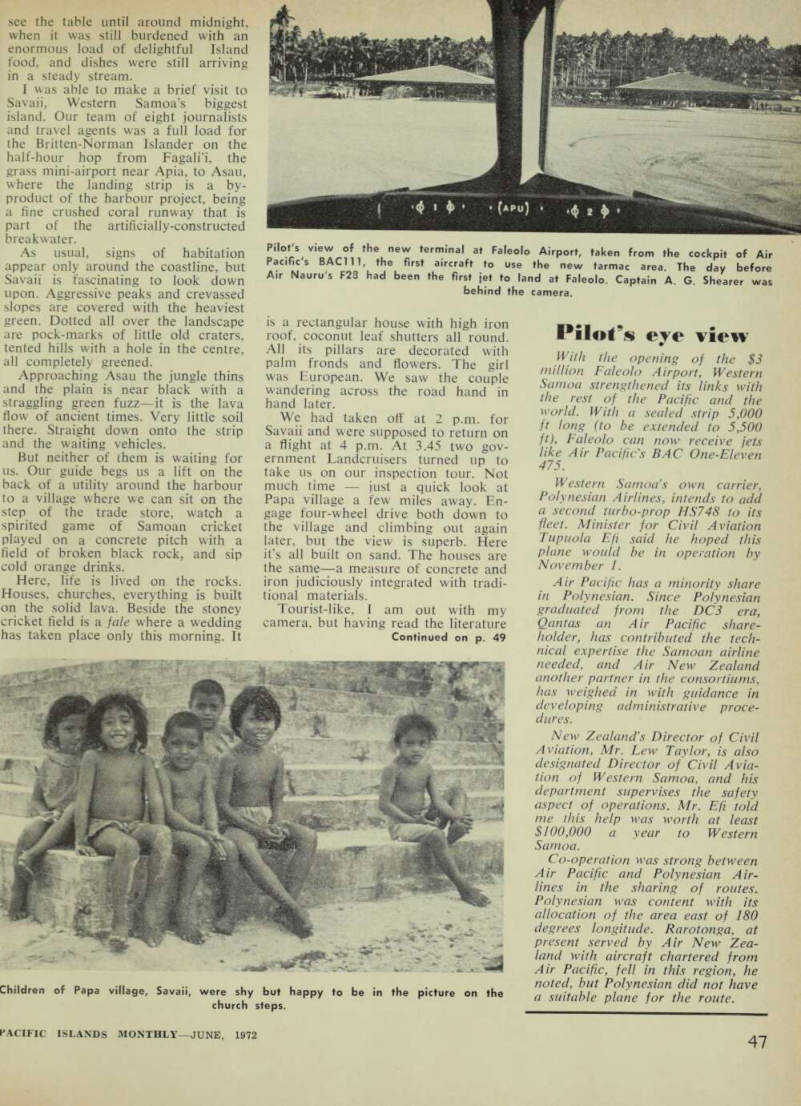
Children of Papa village, Savaii, were shy but happy to be in the picture on the church steps.
Pilot's view of the new terminal at Faleolo Airport, taken from the cockpit of Air Pacific's BAC111, the first aircraft to use the new tarmac area. The day before Air Nauru's F28 had been the first jet to land at Faleolo. Captain A. G. Shearer was behind the camera.
An anxious Potlatch
about being sure not to push in where you’re not wanted, I check first with our guide about local sensitivities. A pair of little girls ask me to take their photo, and a bunch of children pose shyly but cheerfully on the church steps.
At 4.30 our cavalcade reaches the harbour but around the other side from the airstrip, and we watch the plane which has apparently been waiting for us take off gracefully into the blue. There’s no need to hurry now—it will be back in an hour or so, so we have time to inspect the new concrete wharf and the Potlatch timber mill.
No wonder Potlatch has been anxious about the slow rate of dredg ing the harbour entrance. A lot of timber is stacked up ready for ship ment. It has cost a lot to get it to that stage and none of that money is going to come back until the timber reaches its market.
We have time to watch the dredge making several passes up and down the channel, pulled by a furiously smoking tug and pushed by a tired looking workboat. While we kill time throwing back into the sea a load of stones that have been dredged up, a wagon arrives with four Samoans dressed ready for travel. The plane puts down in gathering dusk at 5.45 and it seems we have to draw lots to see who has the four seats avail able—after all, our own flight left empty, these people have paid fares for this one.
Those who stayed got a fuller picture of Samoan village life while we who flew were in time for a showing of the prize-winning tourist film. “Western Samoa, the best kept secret in the South Pacific” at Aggie Greys. The Samoan singers and dancers who performed in Rome last year gave a polished display in the hotel’s magnificent fale. Aggie’s is famous for hospitality, and this par ticular building, constructed with care in pure Samoan style, is a de lightful introduction to Samoan-style living.
I had a brief interview with Fiame Mata’afa, the former Prime Minister, one of the people I had missed at the airport opening. He was concerned about the kind of tourism that Western Samoa will develop. All sides in Samoa recognise the value of the tourist dollar, but how far to go in chasing it is a matter for dispute.
Mata’afa’s approach is to keep it under control, not to wait until it has had an ill-effect on village life.
He tells of his wife having once come out of an inner room to find a tourist
Peace Corps failings
party loudly inspecting the spacious lounge of their home! It will be too late to apply the brakes when tourists are swarming all over the islands, he feels.
Mata’afa also expressed concern that tourism may bring wealth to a few entrepreneurs without doing much for the poor. Wages are very low, and uncontrolled tourism may aggravate the contrast between rich and poor.
I asked him about education. He was not happy about the contribution of Peace Corps volunteers, too many of whom were unqualified for the positions they occupied. It would be better to stick to New Zealand for the source of teachers Western Samoa needed, and to maintain the profes sional standards they could offer.
People were asking him when he would begin to campaign for the Prime Ministership, which would be at stake in the Legislative Assembly elections early next year. Western Samoa’s politics were too gentle manly for campaigning in the earliest days of independence, and it was its introduction by the present Prime Minister, Tamasese, that unseated Mata’afa in 1970.
The deep respect in which Samoan nobility is held is already being un settled by the adoption of even the present modified version of Western democracy (only the matais, or heads of families, vote), and it is obviously painful to Mata’afa to decide to descend to the hustings in search of office. Up till now, only the Fautua (paramount chiefs in social rank which include Mata’afa) have been elected to leadership as Head of State or Prime Minister, but Samoans are asking themselves if there may not possibly be an upheaval and someone of lesser rank emerge next year as Prime Minister.
It will be interesting to see which way Mata’afa turns. Aristocratic dignity is likely to be a casualty if he goes for the votes, and he thinks Tamasese has paid this price. But one suspects dignity will be the only con solation he will have if he waits for the leadership to be thrust upon him. • The Apia Chamber of Com merce has asked the government of Western Samoa to relax the rules regarding sale of liquor on Sundays and visa requirements for tourists.
It wants an extension of the period tourists may stay in the country without a visa from the present three days to seven days, and relaxation or removal of the rules prohibiting sale of liquor on Sundays.