Footnotes
pp. 48-49 · Read in the full issue
Myths Of
The Melanesian
Life-Style
f AST month I posed the question “When is a cargo cult not a cargo cult?”, and suggested that the answer was not all that simple.
This month I pose a much simpler question.
When is a rebel not a rebel? The answer, of course, is: When he’s a hero of the resistance.
Which we call him depends upon where our sympathies lie.
This reflection has been touched off by three pieces of information which I find quite horrify ing.
First there was the statement of an Australian academic to the effect that the primary role of the Pacific Islands Regiment in the future would be that of maintaining internal security.
Second, there has been a proposal from several quarters for the raising of a third battalion of the P.I.R. (at present it has two battalions). Since the difference between two battalions and three is obviously immaterial in terms of external
defence vis-a-vis the swarming millions of Indonesia and South east Asia, one can only assume that this proposal is also made with the problem of internal security in mind.
Third, a distinguished Aus tralian visiting Port Moresby for the opening of the third House of Assembly told me that he thought that Australia’s main worry in relation to Papua New Guinea after independence would be the possibility that she might be called
upon by an independent PNG Government to send Australian troops to assist in quelling a
separatist uprising.
And worry she should! It would indeed be an irony of history if Australia, which in the last decade has sacrificed so many young Australian lives to keep Vietnam as two, should in the present decade be called upon to sacrifice more young Australian lives to keep Papua New Guinea one.
For what, after all, is Papua New Guinea? It is simply the end product of a series of colonial adventures and accidents dating back to the last quarter of the 19th century. It has no natural unity. If it is to become a single nation, its unity
must be created and maintained by social, politi cal and economic agencies. To seek to either create or maintain it by military agencies is surely morally unjustifiable.
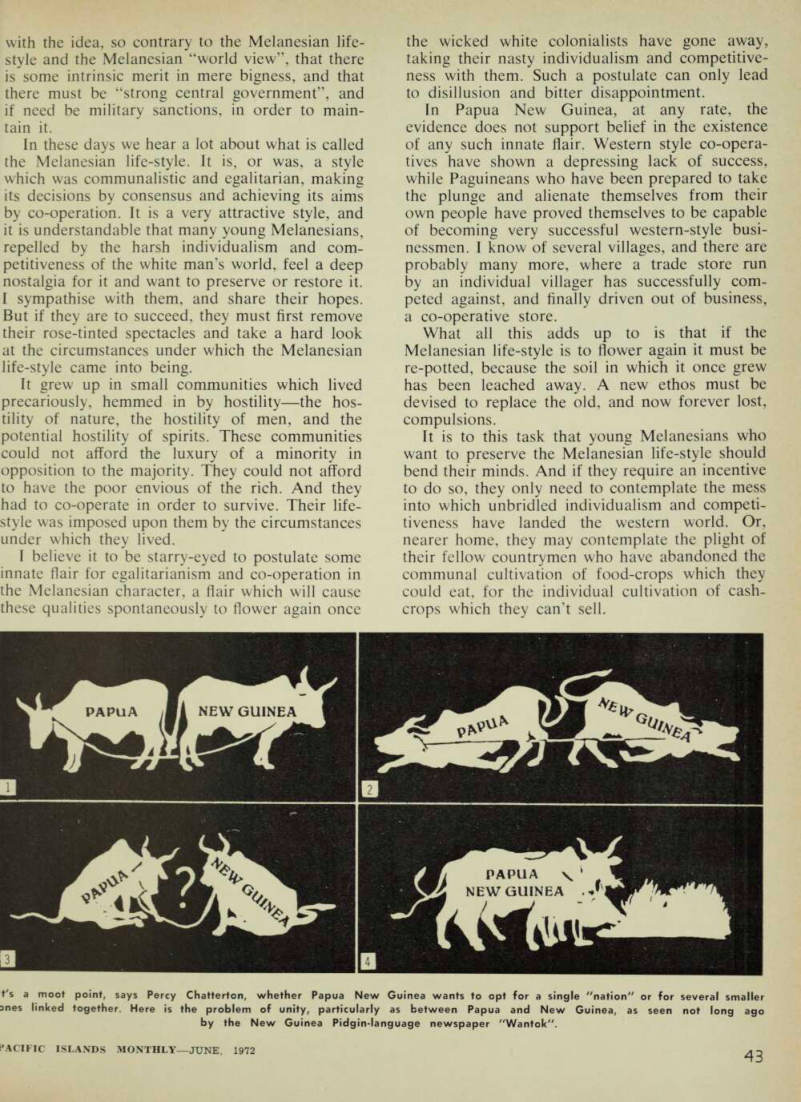
It is a moot point whether the people of Papua New Guinea would be better advised to opt for a single “nation” or for several smaller ones linked together by pacts of friendship and co-operation in social and economic matters but politically autonomous. There are arguments on both sides, and they need to be considered calmly and dis passionately.
To suggest that the central government of an
arbitrarily united Papua New Guinea should ever send troops, whether its own or borrowed from Australia, to massacre people whom it regards as rebels but who regard themselves as heroes of the resistance seems to me quite diabolical.
Yet it could easily happen, if
Paguineans are persuaded to
regard the issue in emotional terms, or if, worse still, they regard national unity as a kind of cargo cult. That many do so regard
it is due to the fact that they have been “sold” the idea that they will be more prosperous as a single large “nation” than as a group of smaller ones. This may be true, but in these days when conservation of the environment bids fair to become a brake on uncontrolled economic growth, it is a highly debatable proposition. It should be debated, not merely asserted.
The Australian Labour Party’s leader, Gough
Whitlam, has said that behind every separatist movement in Papua New Guinea there is a European. Even if this were true, which it is not, it might perhaps be postulated that such Euro peans are doing less harm than those other Europeans who have indoctrinated Paguineans
With Percy Chatterton
in Port Moresby
with the idea, so contrary to the Melanesian life style and the Melanesian “world view”, that there is some intrinsic merit in mere bigness, and that there must be “strong central government”, and if need be military sanctions, in order to main tain it.
In these days we hear a lot about what is called the Melanesian life-style. It is, or was, a style which was communalistic and egalitarian, making its decisions by consensus and achieving its aims by co-operation. It is a very attractive style, and it is understandable that many young Melanesians, repelled by the harsh individualism and com petitiveness of the white man’s world, feel a deep nostalgia for it and want to preserve or restore it.
I sympathise with them, and share their hopes.
But if they are to succeed, they must first remove their rose-tinted spectacles and take a hard look at the circumstances under which the Melanesian
life-style came into being.
It grew up in small communities which lived
precariously, hemmed in by hostility—the hos
tility of nature, the hostility of men, and the potential hostility of spirits. These communities could not afford the luxury of a minority in opposition to the majority. They could not afford to have the poor envious of the rich. And they had to co-operate in order to survive. Their life style was imposed upon them by the circumstances under which they lived.
I believe it to be starry-eyed to postulate some innate flair for egalitarianism and co-operation in the Melanesian character, a flair which will cause these qualities spontaneously to flower again once
the wicked white colonialists have gone away, taking their nasty individualism and competitive ness with them. Such a postulate can only lead to disillusion and bitter disappointment.
In Papua New Guinea, at any rate, the evidence does not support belief in the existence of any such innate flair. Western style co-opera tives have shown a depressing lack of success, while Paguineans who have been prepared to take the plunge and alienate themselves from their own people have proved themselves to be capable of becoming very successful western-style busi nessmen. I know of several villages, and there are probably many more, where a trade store run by an individual villager has successfully com peted against, and finally driven out of business, a co-operative store.
What all this adds up to is that if the Melanesian life-style is to flower again it must be re-potted, because the soil in which it once grew has been leached away. A new ethos must be devised to replace the old, and now forever lost,
compulsions.
It is to this task that young Melanesians who want to preserve the Melanesian life-style should bend their minds. And if they require an incentive to do so, they only need to contemplate the mess into which unbridled individualism and competi tiveness have landed the western world. Or, nearer home, they may contemplate the plight of their fellow countrymen who have abandoned the communal cultivation of food-crops which they could eat, for the individual cultivation of cash crops which they can’t sell.
[?]t's a moot point, says Percy Chatterton, whether Papua New Guinea wants to opt for a single "nation" or for several smaller [?]nes linked together. Here is the problem of unity, particularly as between Papua and New Guinea, as seen not long ago by the New Guinea Pidgin-language newspaper "Wantok".